Semicassis granulata
The Scotch bonnet is a medium-sized to large species of sea snail, a marine gastropod mollusk in the subfamily Cassinae, the helmet shells and bonnet shells. The common name "Scotch bonnet" alludes to the general outline and color pattern of the shell, which vaguely resemble a tam o' shanter, a traditional Scottish bonnet or cap. The shell is egg-shaped and fairly large, 2 to 4 inches in maximum dimension, with a regular pattern of yellow, orange or brown squarish spots. The surface sculpture of the shell is highly variable: the surface can be smooth and polished, have grooves, be granulated, or even be nodulose on the shoulder of the whorls.

H. Zell · CC BY-SA 3.0 · via Wikipedia/Commons. May be a photograph of a specimen, or an artist’s reconstruction — an interpretation of a skeleton, since colour and soft tissue are almost never preserved.
On record
Recorded, not inferred- Sits inside
- SemicassisPBDB
- Diet
- carnivorePBDB, for Cassidae
- Life habit
- epifaunalPBDB, for Cassidae
- Motility
- actively mobilePBDB, for Cassidae
- Vision
- limitedPBDB, for Gastropoda
Time the record covers
At least 7.2 million years on record.
The record covers at least 7.246 Mya to 11.7 ka. No occurrence read is dated outside 11.63 Mya to 0 Mya.
25 occurrences of Semicassis granulata on record, most of them in the Pliocene. The Paleobiology Database records this as a living group. Bar height is expected occurrences, not a count: each fossil is spread across the span it is dated to, so a tall narrow bar means tight dating and a low wide one means loose.
When
25 occurrences- Miocene20%
- Pliocene52%
- Pleistocene20%
- Holocene8%
These are dates about fossils, not the animal: the record can only begin after it arose and end before it died out, so either end may reach further. Shares are expected occurrences: a fossil dated to a span is counted partly in each period it straddles. More on what this infers.
Found in
12 formations
- Mare Formation · Cabo Blanco Group5
- Shark Hole Point Formation · Bocas del Toro Group3
- Nancy Point Formation · Bocas del Toro Group3
- Bermont Formation · Okeechobee Group2
- Moin Formation2
- Cayo Agua Formation · Bocas del Toro Group2
Loading coastlines…
The named rock units Semicassis granulata has been recovered from, largest first. Drawn where the rock is now, not where it formed. 2 occurrences have no formation on record, which is common for older literature.
Semicassis granulata and its relatives
PlioceneWhere Semicassis granulata and its relatives were recorded in the Pliocene.
Found in the same rock
356 taxa- Argopecten gibbus3 sites
- Chicoreus (Phyllonotus) pomum3 sites
- Chione cancellata3 sites
- Fasciolaria3 sites
- Lunarca ovalis3 sites
- Parvanachis obesa3 sites
- Pyrazisinus3 sites
- Scaphella junonia3 sites
- Sinistrofulgur3 sites
- Strombus alatus3 sites
- Trachycardium (Dallocardia) muricatum3 sites
- Abra aequalis2 sites
- Acteocina canaliculata2 sites
- Agriopoma2 sites
- Aligena texasiana2 sites
- Amusium2 sites
- Anadara2 sites
- Anadara (Cunearca) brasiliana2 sites
- Anadara (Larkinia) transversa2 sites
- Angulus texanus2 sites
- Anodontia alba2 sites
- Anomalocardia cuneimeris2 sites
- Anomia simplex2 sites
- Arcinella cornuta2 sites
The Paleobiology Database records 7 sites for Semicassis granulata, and this reads all of them. The number is how many of those sites it was catalogued from too. The 24 sharing the most are listed.
This is not a list of everything alive at the time. It is only what has come out of the same ground as this animal and been written down.
Entered from
10 references- Neogene Tonnoidean Gastropods of Tropical and South America; contributions to the Dominican Republic and Panama Paleontology Projects and Uplift of the Central American Isthmus12
- Unpublished notes on Caribbean collection of Jack and Winifred Gibson-Smith, Naturhistorisches Museum Basel4
- Late Cenozoic gastropods from northern Venezuela2
- New Cancellariidae (Mollusca, Gastropoda) from the Miocene Gatun Formation of Panama, with eleven new species1
- Mollusca: Fort Thompson Formation (Late Pleistocene)1
- Petuch and Roberts, 20071
- Checklist of the Pleistocene marine molluscs of Prainha and Lagoinhas (Santa Maria Island, Azores)1
- Unpublished notes on Caribbean collection of the Naturhistorisches Museum Basel1
- Stratigraphy of newly exposed Quaternary sediments, eastern Orleans Parish, Louisiana1
- Stratigraphy of newly exposed Quaternary seduments, eastern Orleans Parish, Louisiana1
Each of the 25 occurrences read was entered from one of these publications, ordered by how many each accounts for. This is not a search for papers mentioning the name. Entries link to doi.org where the Paleobiology Database holds an identifier, and to its own record where it does not. Relayed as the Paleobiology Database holds them, not checked against what they resolve to.
Media and terms
Media content2

Picture of Semicassis granulata
- Source
- Wikipedia/Commons
- Credit
- H. Zell
- Licence
- CC BY-SA 3.0
- Commercial use
- the licence allows it
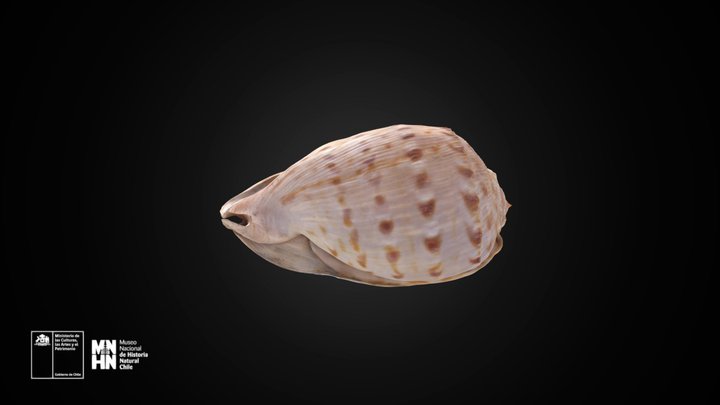
3D model
- Source
- Sketchfab
- Licence
- CC Attribution-NonCommercial-ShareAlike
- Commercial use
- the licence does not allow it
MorphoSource was not reached for this taxon, so this list is what the others held rather than everything there is.
The description on this site
- Licence
- CC BY-SA 4.0
This is what the site found, which is not the same as what exists.
Keep going
What may have been alongside itSemicassis through timeFormations of the PlioceneThe world it lived on
Occurrence data from the Paleobiology Database, CC BY 4.0. (Born 1778)