Sconsia
Sconsia is a genus of large sea snails, marine gastropod mollusks in the family Cassidae, the helmet snails and bonnet snails.

Adams, 1855 · CC0 · via Wikipedia/Commons. May be a photograph of a specimen, or an artist’s reconstruction — an interpretation of a skeleton, since colour and soft tissue are almost never preserved.
On record
Recorded, not inferred- Sits inside
- CassinaePBDB
- Diet
- carnivorePBDB, for Cassidae
- Life habit
- epifaunalPBDB, for Cassidae
- Motility
- actively mobilePBDB, for Cassidae
- Vision
- limitedPBDB, for Gastropoda
Time the record covers
At least 47 million years on record.
The record covers at least 48.07 Mya to 774 ka. No occurrence read is dated outside 56 Mya to 129 ka.
187 occurrences of Sconsia on record, most of them in the Miocene. The Paleobiology Database records this as a living group, and the chart stops with its fossils rather than at the present. Bar height is expected occurrences, not a count: each fossil is spread across the span it is dated to, so a tall narrow bar means tight dating and a low wide one means loose.
When
187 occurrences- Eocene6%
- Oligocene7%
- Miocene49%
- Pliocene36%
- Pleistocene2%
These are dates about fossils, not the animal: the record can only begin after it arose and end before it died out, so either end may reach further. Shares are expected occurrences: a fossil dated to a span is counted partly in each period it straddles. More on what this infers.
Found in
49 formations
- Gurabo Formation50
- Cayo Agua Formation · Bocas del Toro Group11
- Nancy Point Formation · Bocas del Toro Group8
- Bowden Formation · Coastal Group6
- Mao Formation6
- Chagres Sandstone Formation6
Loading coastlines…
The named rock units Sconsia has been recovered from, largest first. Drawn where the rock is now, not where it formed. 25 further formations hold fewer occurrences each and are not listed. 11 occurrences have no formation on record, which is common for older literature.
Sconsia and its relatives
MioceneWhere Sconsia and its relatives were recorded in the Miocene.
Found in the same rock
2,430 taxa- Architectonica nobilis17 sites
- Turritella17 sites
- Spondylus bostrychites16 sites
- Conus15 sites
- Distorsio simillima14 sites
- Cassis sulcifera13 sites
- Pitar13 sites
- Dentalium12 sites
- Lyria (Lyria) pulchella12 sites
- Mitra12 sites
- Strombus bifrons12 sites
- Chicoreus (Triplex) cornurectus11 sites
- Distorsio mcgintyi11 sites
- Oliva11 sites
- Antillocyathus maoensis10 sites
- Antillophos (Antillophos) moorei10 sites
- Argopecten thetidis10 sites
- Laevicardium serratum10 sites
- Lobatus haitensis10 sites
- Prunum coniforme10 sites
- Rhinoclavis (Ochetoclava)10 sites
- Serpulorbis papulosus10 sites
- Strioterebrum10 sites
- Anadara9 sites
The Paleobiology Database records 82 sites for Sconsia, and this reads all of them. Of that, one read hit the database's own return limit, so every count below is a floor rather than a total. The number is how many of those sites it was catalogued from too. The 24 sharing the most are listed.
This is not a list of everything alive at the time. It is only what has come out of the same ground as this animal and been written down.
Entered from
34 references- Neogene Tonnoidean Gastropods of Tropical and South America; contributions to the Dominican Republic and Panama Paleontology Projects and Uplift of the Central American Isthmus91
- Unpublished census data from Atlantic coastal plain and circum-Caribbean Neogene assemblages and taxonomic opinions18
- A paleobiotic survey of Caribbean faunas from the Neogene of the Isthmus of Panama13
- Unpublished notes on Caribbean collection of the Naturhistorisches Museum Basel11
- Lower Oligocene Gastropoda, Scaphopoda, and Cephalopoda of the Vicksburg Group in Mississippi7
- Santo Domingo type sections and fossils7
- Localidades fossiliferas da Formacao Pirabas (Mioceno Inferior)3
- Eocene biostratigraphy of South Carolina and its relationship to Gulf Coastal Plain zonations and global changes of coastal onlap3
- Les Mesogastropoda Fossiles du Cenozoïque étranger des Collections de L'Institute Royale des Sciences Naturelles de Belgique3
- Petuch and Roberts, 20072
- The Early Eocene London Clay Formation mollusc fauna of the former Bursledon Brickworks, Lower Swanwick, Hampshire2
- Mollusca from the Miocene and Lower Pliocene of Virginia and North Carolina: Part 2. Scaphopoda and Gastropoda2
Each of the 187 occurrences read was entered from one of these publications, ordered by how many each accounts for. This is not a search for papers mentioning the name. 22 further references are not listed. Entries link to doi.org where the Paleobiology Database holds an identifier, and to its own record where it does not. Relayed as the Paleobiology Database holds them, not checked against what they resolve to.
Media and terms
Media content1
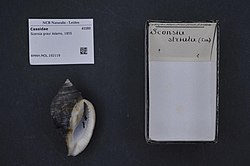
Picture of Sconsia
- Source
- Wikipedia/Commons
- Credit
- Adams, 1855
- Licence
- CC0
- Commercial use
- the licence allows it
No 3D scan of Sconsia was found in Sketchfab.
Smithsonian Open Access and MorphoSource were not reached for this taxon, so this list is what the others held rather than everything there is.
The description on this site
- Source
- Wikipedia, “Sconsia”
- Licence
- CC BY-SA 4.0
This is what the site found, which is not the same as what exists.
Keep going
What may have been alongside itCassinae through timeFormations of the MioceneThe world it lived on
Occurrence data from the Paleobiology Database, CC BY 4.0. (Gray 1847)