Sarcophilus harrisii
The Tasmanian devil is a carnivorous marsupial of the family Dasyuridae. It was formerly present across mainland Australia, but became extinct there around 3,500 years ago; it is now confined to the island of Tasmania. The size of a small dog, the Tasmanian devil became the largest carnivorous marsupial in the world following the extinction of the thylacine in 1936. It is related to quolls, and distantly related to the thylacine. It is characterised by its stocky and muscular build, black fur, pungent odour, extremely loud screech, keen sense of smell, and ferocity when feeding. The Tasmanian devil's large head and neck allow it to generate among the strongest bites per unit body mass of any extant predatory land mammal. It hunts prey and scavenges on carrion.

JJ Harrison ( https://www.jjharrison.com.au/ ) · CC BY-SA 3.0 · via Wikipedia/Commons. May be a photograph of a specimen, or an artist’s reconstruction — an interpretation of a skeleton, since colour and soft tissue are almost never preserved.
On record
Recorded, not inferred- Also called
- Tasmanian devilPBDB
- Sits inside
- SarcophilusPBDB
- Diet
- insectivore, carnivorePBDB, for Dasyuridae
- Life habit
- scansorialPBDB, for Sarcophilus
- Motility
- actively mobilePBDB, for Osteichthyes
- Environment
- terrestrialPBDB, for Mammalia
Time the record covers
At most 3.6 million years on record.
Every occurrence read is dated to somewhere between 3.6 Mya and 0 Mya, and nothing in the dating separates them, so that window is what the record shows rather than a span.
3 occurrences of Sarcophilus harrisii on record, most of them in the Pleistocene. The Paleobiology Database records this as a living group. Bar height is expected occurrences, not a count: each fossil is spread across the span it is dated to, so a tall narrow bar means tight dating and a low wide one means loose.
When
3 occurrences- Pliocene9%
- Pleistocene90%
These are dates about fossils, not the animal: the record can only begin after it arose and end before it died out, so either end may reach further. Shares are expected occurrences: a fossil dated to a span is counted partly in each period it straddles. More on what this infers.
Sarcophilus harrisii and its relatives
PleistoceneWhere Sarcophilus harrisii and its relatives were recorded in the Pleistocene.
Found in the same rock
89 taxa- Antechinus flavipes3 sites
- Dasyurus geoffroii3 sites
- Sminthopsis murina3 sites
- Cercartetus concinnus2 sites
- Isoodon obesulus2 sites
- Phascogale tapoatafa2 sites
- Protemnodon brehus2 sites
- Pseudocheirus peregrinus2 sites
- Thylacinus cynocephalus2 sites
- Trichosurus vulpecula2 sites
- <Mollusca>1 site
- <Rodent>1 site
- <Small bats>1 site
- <Small birds>1 site
- <Small reptiles>1 site
- Acrobates pygmaeus1 site
- Aepyprymnus rufescens1 site
- Aves1 site
- Bettongia1 site
- Bettongia lesueur1 site
- Bettongia penicillina1 site
- Chiroptera1 site
- Conilurus1 site
- Dasyroides sp.1 site
The Paleobiology Database records 3 sites for Sarcophilus harrisii, and this reads all of them. The number is how many of those sites it was catalogued from too. The 24 sharing the most are listed.
This is not a list of everything alive at the time. It is only what has come out of the same ground as this animal and been written down.
Entered from
3 references- The late Quaternary sediments and fossil vertebrate fauna from Cathedral Cave, Wellington Caves, New South Wales1
- Late Quaternary mammal remains, spanning about 30,000 years from excavations in Devil's Lair, Western Australia1
- Prehistoric mammal faunas from two small caves in the extreme southwest of Western Australia1
Each of the 3 occurrences read was entered from one of these publications, ordered by how many each accounts for. This is not a search for papers mentioning the name. Each entry links to the Paleobiology Database's own record for the work.
Media and terms
Media content2

Picture of Sarcophilus harrisii
- Source
- Wikipedia/Commons
- Credit
- JJ Harrison ( https://www.jjharrison.com.au/ )
- Licence
- CC BY-SA 3.0
- Commercial use
- the licence allows it
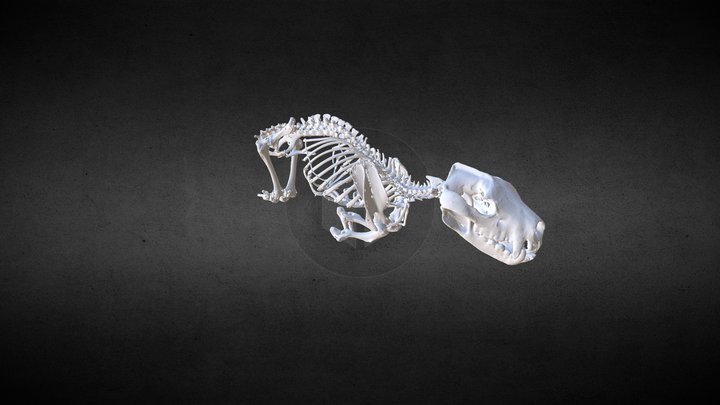
3D model
- Source
- Sketchfab
- Licence
- CC Attribution
- Commercial use
- cannot be read from the licence given — check the record
Smithsonian Open Access and MorphoSource were not reached for this taxon, so this list is what the others held rather than everything there is.
The description on this site
- Licence
- CC BY-SA 4.0
This is what the site found, which is not the same as what exists.
Keep going
What may have been alongside itSarcophilus through timeFormations of the PleistoceneThe world it lived on
Occurrence data from the Paleobiology Database, CC BY 4.0. (Boitard 1841)