Radulopecten
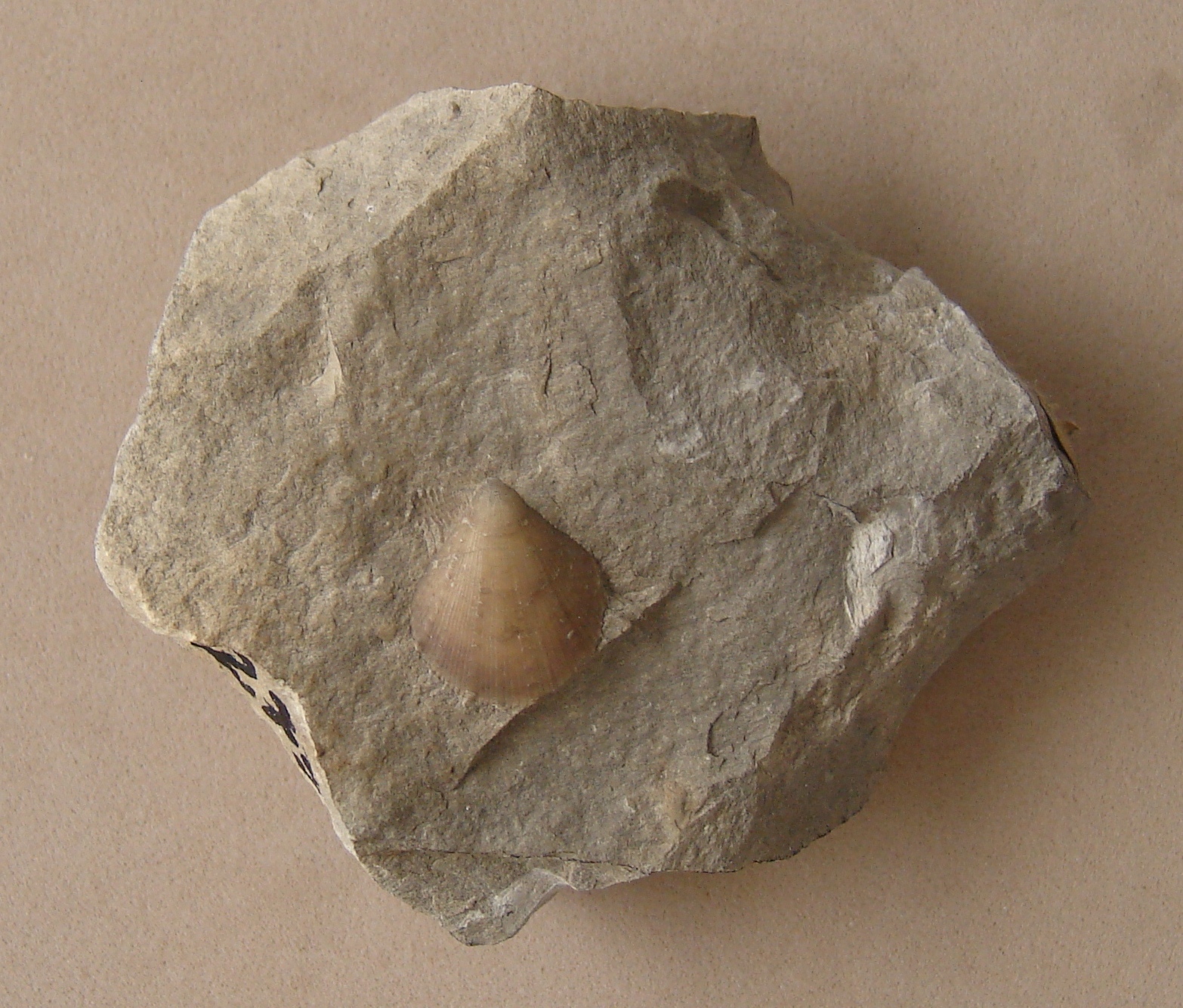
Edmond Pellat · CC0 · via GBIF. May be a photograph of a specimen, or an artist’s reconstruction — an interpretation of a skeleton, since colour and soft tissue are almost never preserved.
On record
Recorded, not inferred- Sits inside
- PectinidaePBDB
- Diet
- suspension feederPBDB, for Pectinidae
- Life habit
- low-level epifaunalPBDB, for Pectinidae
- Motility
- facultatively mobilePBDB, for Pectinidae
- Vision
- limitedPBDB, for Pectinidae
- Environment
- marinePBDB, for Pectinida
Time the record covers
At least 23 million years on record.
The record covers at least 168.2 Mya to 145.06 Mya. No occurrence read is dated outside 174.7 Mya to 143.1 Mya.
231 occurrences of Radulopecten on record, most of them in the Late Jurassic. Bar height is expected occurrences, not a count: each fossil is spread across the span it is dated to, so a tall narrow bar means tight dating and a low wide one means loose.
When
231 occurrencesThese are dates about fossils, not the animal: the record can only begin after it arose and end before it died out, so either end may reach further. Shares are expected occurrences: a fossil dated to a span is counted partly in each period it straddles. More on what this infers.
Found in
46 formations
- Trigonia clavellata Formation30
- Osmington Oolite Formation19
- Coral Rag de Trouville Formation14
- Calcaires marneux inferieurs Formation13
- Coralline Oolite Formation11
- Argiles a Lopha gregarea Formation9
Loading coastlines…
The named rock units Radulopecten has been recovered from, largest first. Drawn where the rock is now, not where it formed. 22 further formations hold fewer occurrences each and are not listed. 26 occurrences have no formation on record, which is common for older literature.
Radulopecten and its relatives
Late JurassicWhere Radulopecten and its relatives were recorded in the Late Jurassic.
Found in the same rock
682 taxa- Nanogyra (Nanogyra) nana128 sites
- Pleuromya uniformis80 sites
- Serpula53 sites
- Isocyprina49 sites
- Isognomon46 sites
- Pseudomelania42 sites
- Actinostreon gregarea39 sites
- Gryphaea37 sites
- Myophorella34 sites
- Nucleolites scutatus34 sites
- Plagiostoma34 sites
- Protocardia33 sites
- Gervillella aviculoides32 sites
- Deltoideum (Deltoideum) delta28 sites
- Pholadomya28 sites
- Anisocardia26 sites
- Modiolus bipartitus26 sites
- Sowerbya25 sites
- Actinostreon24 sites
- Modiolus24 sites
- Myophorella (Clavotrigonia) clavellata22 sites
- Nerinella22 sites
- Nubeculinella22 sites
- Chlamys20 sites
The Paleobiology Database records 187 sites for Radulopecten, and this reads all of them. The number is how many of those sites it was catalogued from too. The 24 sharing the most are listed.
This is not a list of everything alive at the time. It is only what has come out of the same ground as this animal and been written down.
Entered from
32 references- Unpublished data151
- Geologie, Paleontologie et Paleoecologie du Bathonien au sud-ouest du Massif Ardennais21
- The Stratigraphical Palaeontology, ammonites excluded, of the Stowell Park borehole6
- Middle to Upper Jurassic (Callovian-Kimmeridgian) in the Arcos Plateau (Arino-Oliere area, eastern Iberian chain, Spain): Taphonomic analysis and biostratigraphy5
- A systematic survey of the Mesozoic Bivalvia from Japan5
- The Jurassic bivalve fauna from the western side of the Bucegi Mountains, part II subclass Pteriomorphia (Order Pectinoida)4
- Jurassic Bivalvia and Gastropoda from Tanganyika and Kenya4
- Late Permian to Miocene bivalve assemblages from Hohxil, Qinghai-Xizang Plateau, China3
- Palaeontology of the 1985 Geotraverse, Lhasa to Golmud3
- First record of a Middle Jurassic macrofauna from the Brnjica (NE Serbia): stratigraphy, palaeoecology and correlation with adjacent regions2
- Jurassic rocks, bivalves, and depositional environments of the source area of the Yangtze River, Qinghai Province, western China2
- Taxonomie der Muschelfauna aus dem Oberjura von Hildesheim (N-Deutschland)[Taxonomy of Upper Jurassic Bivalves from Hildesheim (Northern Germany)]2
Each of the 231 occurrences read was entered from one of these publications, ordered by how many each accounts for. This is not a search for papers mentioning the name. 20 further references are not listed. Entries link to doi.org where the Paleobiology Database holds an identifier, and to its own record where it does not. Relayed as the Paleobiology Database holds them, not checked against what they resolve to.
Media and terms
Media content1
Picture of Radulopecten
- Source
- GBIF
- Credit
- Edmond Pellat
- Licence
- CC0
- Commercial use
- the licence allows it
No 3D scan was found. Smithsonian Open Access, MorphoSource and Sketchfab were all searched.
This is what the site found, which is not the same as what exists.
Keep going
Everything alive alongside itPectinidae through timeFormations of the Late JurassicThe world it lived on
Occurrence data from the Paleobiology Database, CC BY 4.0. Rollier 1911