Psittacosaurus
Psittacosaurus is a genus of extinct ceratopsian dinosaur from the Early Cretaceous of what is now Asia, existing between 125 and 105 million years ago. It is notable for being the most species-rich non-avian dinosaur genus. Up to 13 species are known, from across China, Mongolia, Russia, and Thailand. The species of Psittacosaurus were obligate bipeds at adulthood, with a high skull and a robust beak. One individual was found preserved with long filaments on the tail, similar to those of Tianyulong. Psittacosaurus probably had complex behaviours, based on the proportions and relative size of the brain. It may have been active for short periods of time during the day and night, and had well-developed senses of smell and vision.

Uncredited · CC BY-SA 3.0 · via Wikipedia/Commons. May be a photograph of a specimen, or an artist’s reconstruction — an interpretation of a skeleton, since colour and soft tissue are almost never preserved.
On record
Recorded, not inferred- Sits inside
- CeratopsiaPBDB
- Diet
- herbivorePBDB
- Life habit
- ground dwellingPBDB
- Motility
- actively mobilePBDB, for Ornithischia
- Environment
- terrestrialPBDB
- Length
- 2 mWikidata
Time the record covers
At least 25 million years on record.
The record covers at least 125.77 Mya to 100.5 Mya. No occurrence read is dated outside 161.5 Mya to 66 Mya.
70 occurrences of Psittacosaurus on record, most of them in the Early Cretaceous. Bar height is expected occurrences, not a count: each fossil is spread across the span it is dated to, so a tall narrow bar means tight dating and a low wide one means loose.
When
70 occurrences- Late Jurassicunder 1%
- Early Cretaceous98%
- Late Cretaceous1%
These are dates about fossils, not the animal: the record can only begin after it arose and end before it died out, so either end may reach further. Shares are expected occurrences: a fossil dated to a span is counted partly in each period it straddles. More on what this infers.
Found in
22 formations
- Yixian Formation · Jehol Group12
- Ilek Formation7
- Öösh Formation7
- Ejinhoro Formation6
- Jiufotang Formation · Jehol Group4
- Doushan Formation · Qingshan Group3
Loading coastlines…
The named rock units Psittacosaurus has been recovered from, largest first. Drawn where the rock is now, not where it formed. 8 occurrences have no formation on record, which is common for older literature.
Psittacosaurus and its relatives
Early CretaceousWhere Psittacosaurus and its relatives were recorded in the Early Cretaceous.
Found in the same rock
216 taxa- Theropoda14 sites
- Sauropoda11 sites
- Testudines8 sites
- Stegosauria7 sites
- Deinonychosauria5 sites
- Pterosauria5 sites
- Coelurosauria4 sites
- Confuciusornis4 sites
- Mammalia4 sites
- Ornithocheiridae4 sites
- Osteichthyes4 sites
- Troodontidae4 sites
- Champsosauridae3 sites
- Choristodera3 sites
- Dromaeosauridae3 sites
- Gobiconodon3 sites
- Gobiconodon borissiaki3 sites
- Gobiconodon hoburensis3 sites
- Sinovenator changii3 sites
- Tetanurae3 sites
- Tritylodontidae3 sites
- Amiiformes2 sites
- Amphilestidae2 sites
- Aves2 sites
The Paleobiology Database records 62 sites for Psittacosaurus, and this reads all of them. The number is how many of those sites it was catalogued from too. The 24 sharing the most are listed.
This is not a list of everything alive at the time. It is only what has come out of the same ground as this animal and been written down.
Entered from
43 references- New psittacosaur occurrences in Inner Mongolia9
- Psittacosaurus meileyingensis (Ornithischia: Ceratopsia), a new psittacosaur from the Lower Cretaceous of northeastern China4
- Dinosaurs from the Early Cretaceous Ilek Formation in West Siberia, Russia3
- Stratigraphic sequence and vertebrate-bearing beds of the lower part of the Yixian Formation in Sihetun and neighboring area, western Liaoning, China3
- Páxíng lèi {Reptilia}3
- Andrews, 19323
- On some new dinosaurs from western Suiyuan, Inner Mongolia3
- Report on the Japan–Mongolia Joint Paleontological Expedition to the Gobi desert, 19932
- A new psittacosaur (Psittacosaurus mazongshanensis sp. nov.) from Mazongshan area, Gansu Province, China2
- Nizhnemelove mestonakhozhdeniya nazemnykh pozvonochnykh Mongolii [Lower Cretaceous terrestrial vertebrate localities of Mongolia]2
- O geologicheskom stroenii i vozraste mestonakhozhdenii Khobur i Khuren-Dukh [On the geology and age of the Khobur and Khuren-Dukh localities]2
- The dinosaurian remains of Laiyang, Shantung2
Each of the 70 occurrences read was entered from one of these publications, ordered by how many each accounts for. This is not a search for papers mentioning the name. 31 further references are not listed. Entries link to doi.org where the Paleobiology Database holds an identifier, and to its own record where it does not. Relayed as the Paleobiology Database holds them, not checked against what they resolve to.
Media and terms
Media content3

Picture of Psittacosaurus
- Source
- Wikipedia/Commons
- Credit
- nobody named on the record
- Licence
- CC BY-SA 3.0
- Commercial use
- the licence allows it
CT scan
- Source
- MorphoSource
- Licence
- not stated by the source
- Commercial use
- cannot be read from the licence given — check the record
- Specimen
- Psittacosaurus lujiatunensis · ivpp:v:12617
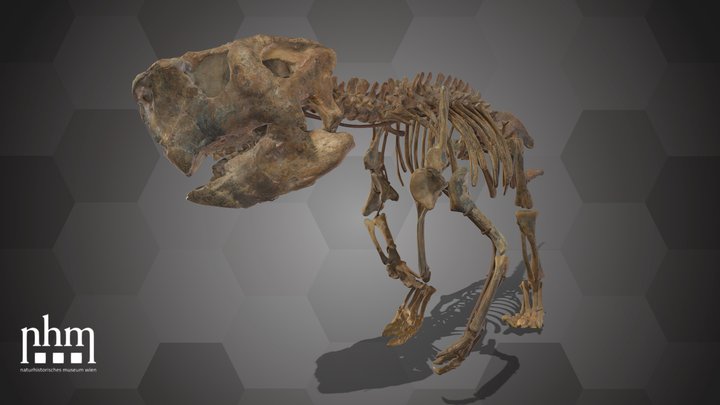
3D model
- Source
- Sketchfab
- Licence
- CC Attribution-NonCommercial
- Commercial use
- the licence does not allow it
The description on this site
- Licence
- CC BY-SA 4.0
This is what the site found, which is not the same as what exists.
Keep going
What may have been alongside itCeratopsia through timeFormations of the Early CretaceousThe world it lived on
Occurrence data from the Paleobiology Database, CC BY 4.0. Osborn 1923