Pseudopolyconites
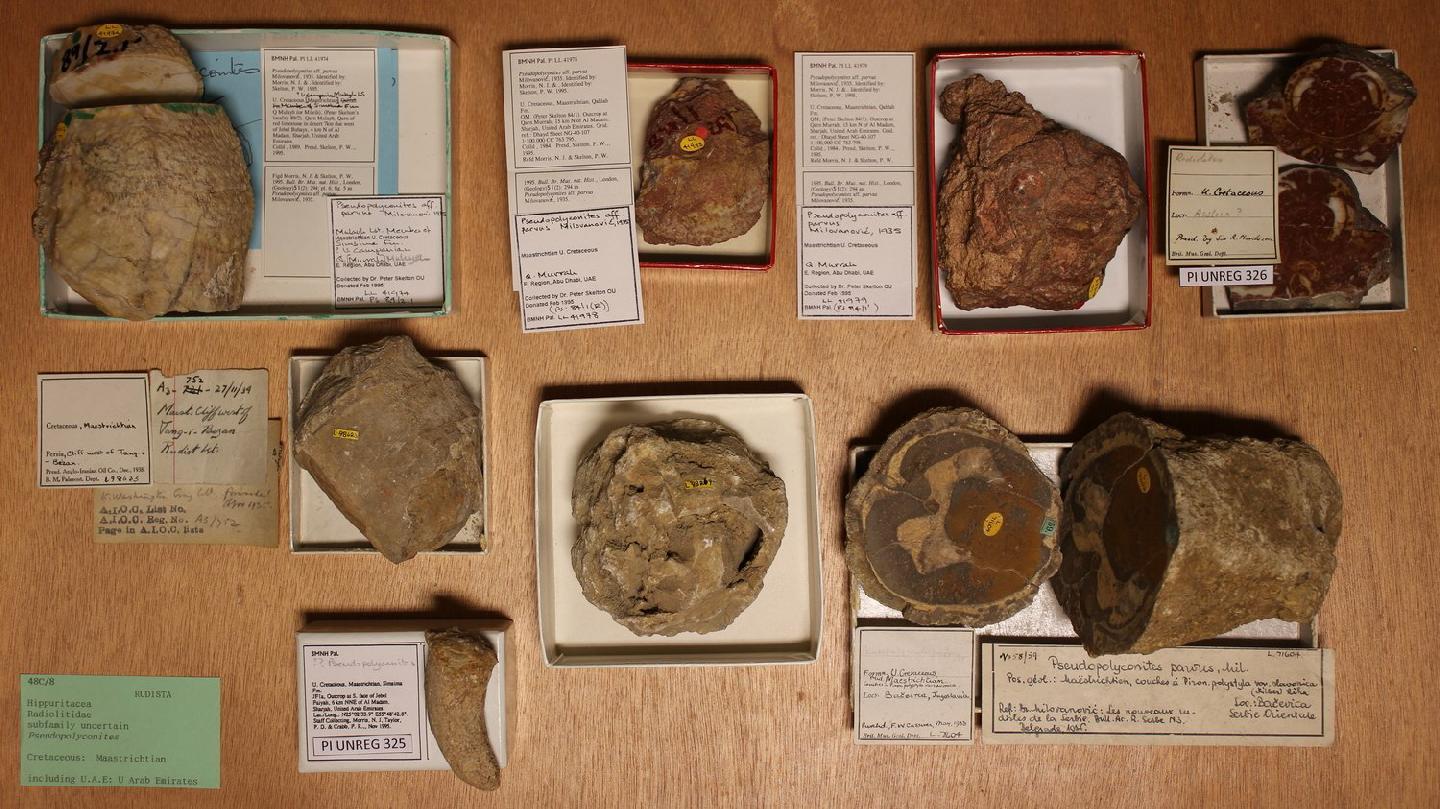
via iDigBio · CC BY · via iDigBio. May be a photograph of a specimen, or an artist’s reconstruction — an interpretation of a skeleton, since colour and soft tissue are almost never preserved.
On record
Recorded, not inferred- Sits inside
- RadiolitidaePBDB
- Diet
- suspension feederPBDB, for Hippuritida
- Life habit
- intermediate-level epifaunal, gregariousPBDB, for Hippuritida
- Motility
- stationary, attachedPBDB, for Hippuritida
- Vision
- blindPBDB, for Bivalvia
- Environment
- marinePBDB, for Hippuritida
Time the record covers
At least 11 million years on record.
The record covers at least 83.6 Mya to 72.2 Mya. No occurrence read is dated outside 89.8 Mya to 66 Mya.
39 occurrences of Pseudopolyconites on record, most of them in the Late Cretaceous. Bar height is expected occurrences, not a count: each fossil is spread across the span it is dated to, so a tall narrow bar means tight dating and a low wide one means loose.
When
39 occurrences- Late Cretaceous100%
These are dates about fossils, not the animal: the record can only begin after it arose and end before it died out, so either end may reach further. Shares are expected occurrences: a fossil dated to a span is counted partly in each period it straddles. More on what this infers.
Found in
8 formations
- Vrbovac Beds Formation6
- Ciolo Limestone Formation3
- Merfeg Formation1
- Cesarea Limestone Formation1
- Pucisca Formation1
- Yalaz Formation1
Loading coastlines…
The named rock units Pseudopolyconites has been recovered from, largest first. Drawn where the rock is now, not where it formed. 24 occurrences have no formation on record, which is common for older literature.
Pseudopolyconites and its relatives
Late CretaceousWhere Pseudopolyconites and its relatives were recorded in the Late Cretaceous.
Found in the same rock
131 taxa- Biradiolites10 sites
- Pironaea10 sites
- Vaccinites10 sites
- Sabinia9 sites
- Hippurites8 sites
- Joufia reticulata8 sites
- Bournonia7 sites
- Hippurites cornucopiae7 sites
- Radiolites7 sites
- Hippuritella6 sites
- Lapeirousia6 sites
- Durania5 sites
- Hippuritella lapeirousei5 sites
- Mitrocaprina5 sites
- Bournonia excavata4 sites
- Colveraia4 sites
- Pseudosabinia klinghardti4 sites
- Radiolitella maestrichtiana4 sites
- Vautrinia4 sites
- Apricardia3 sites
- Dictyoptychus3 sites
- Hippurites colliciatus3 sites
- Kuehnia3 sites
- Lapeirousella3 sites
The Paleobiology Database records 18 sites for Pseudopolyconites, and this reads all of them. The number is how many of those sites it was catalogued from too. The 24 sharing the most are listed.
This is not a list of everything alive at the time. It is only what has come out of the same ground as this animal and been written down.
Entered from
14 references- On the Senonian rudist-bearing sediments in Yugoslavia9
- Description of Pseudosabinia klinghardti and some species of Pseudopolyconites (rudist bivalves) from the Late Cretaceous shallow-marine deposits from the Rosia Basin, Apuseni Mountains, Romania: Systematic palaeontology, biostratigraphy, and palaeobiogeography7
- Unpublished data on Cretaceous-Paleocene molluscan assemblages5
- Late Campanian Rudist Assemblages and Biometrical Analysis of Pseudopolyconites from Bačevica (Eastern Serbia)3
- Chronostratigraphy of Campanian-Maastrichtian platform carbonates and rudist associations of Salento (Apulia, Italy)3
- Latest Maastrichtian species-rich rudist associations of the Apulian margin of Salento (S Italy) and the Ionian Islands (Greece)3
- Description of Paracaprinula syriaca Piveteau (Hippuritoidea, Plagioptychidae) and a revised age of ophiolite obduction on the African-Arabian Plate in southeastern Turkey2
- Radiolitid rudist colonisation strategies and biostrome development in moderate-energy inner-platform environments (Campanian, Brac Island, Croatia)1
- The state of knowledge of the genus Pseudopolyconites1
- Rudist facies distribution in the late Cretaceous of Cilento and western Basilicata (southern Italy)1
- Campanian Pseudosabinia from the Pucisca Formation on the island of Hvar (Adriatic Sea, Croatia)1
- Sedimentation, diagenesis and syntectonic erosion of Upper Cretaceous rudist mounds in central Tunisia1
Each of the 39 occurrences read was entered from one of these publications, ordered by how many each accounts for. This is not a search for papers mentioning the name. 2 further references are not listed. Entries link to doi.org where the Paleobiology Database holds an identifier, and to its own record where it does not. Relayed as the Paleobiology Database holds them, not checked against what they resolve to.
Media and terms
Media content1
Picture of Pseudopolyconites
- Source
- iDigBio
- Credit
- via iDigBio
- Licence
- CC BY
- Commercial use
- the licence allows it
No 3D scan of Pseudopolyconites was found in Sketchfab.
Smithsonian Open Access and MorphoSource were not reached for this taxon, so this list is what the others held rather than everything there is.
This is what the site found, which is not the same as what exists.
Keep going
What may have been alongside itRadiolitidae through timeFormations of the Late CretaceousThe world it lived on
Occurrence data from the Paleobiology Database, CC BY 4.0. Milovanovic 1935