Pristiophoridae
A sawshark or saw shark is a member of a shark order bearing a unique long, saw-like rostrum edged with sharp teeth, which they use to slash and disable their prey. There are ten species within the Pristiophoriformes, the longnose or common sawshark, shortnose sawshark, Japanese sawshark, Bahamas sawshark, Warren's sixgill sawshark, Anna's sixgill sawshark, Kaja's sixgill sawshark, African dwarf sawshark, Lana's sawshark and the tropical sawshark.

Illustrated Catalogue of the Fishes of South Australia, Adelaide, Australia : G. Hassell & Son, 1921 · Public Domain · via Wikipedia/Commons. May be a photograph of a specimen, or an artist’s reconstruction — an interpretation of a skeleton, since colour and soft tissue are almost never preserved.
On record
Recorded, not inferred- Sits inside
- PristiophoriformesPBDB
- Diet
- carnivorePBDB, for Pristiophoriformes
- Life habit
- nektobenthicPBDB, for Pristiophoriformes
- Motility
- actively mobilePBDB, for Pristiophoriformes
Time the record covers
At least 81 million years on record.
The record covers at least 83.6 Mya to 2.58 Mya. No occurrence read is dated outside 85.7 Mya to 774 ka.
159 occurrences of Pristiophoridae on record, most of them in the Miocene. The Paleobiology Database records this as a living group, and the chart stops with its fossils rather than at the present. Bar height is expected occurrences, not a count: each fossil is spread across the span it is dated to, so a tall narrow bar means tight dating and a low wide one means loose.
When
159 occurrences- Late Cretaceous6%
- Paleoceneunder 1%
- Eocene24%
- Oligocene13%
- Miocene40%
- Pliocene14%
- Pleistocene3%
These are dates about fossils, not the animal: the record can only begin after it arose and end before it died out, so either end may reach further. Shares are expected occurrences: a fossil dated to a span is counted partly in each period it straddles. More on what this infers.
Found in
71 formations
- La Meseta Formation15
- Horcón Formation6
- Gehannam Formation5
- Boom Clay Formation5
- Laksarska Nova Ves Formation4
- Bahía Inglesa Formation4
Loading coastlines…
The named rock units Pristiophoridae has been recovered from, largest first. Drawn where the rock is now, not where it formed. 47 further formations hold fewer occurrences each and are not listed. 39 occurrences have no formation on record, which is common for older literature.
Pristiophoridae and its relatives
MioceneWhere Pristiophoridae and its relatives were recorded in the Miocene.
Found in the same rock
1,296 taxa- Pristiophorus47 sites
- Squatina38 sites
- Pristiophorus lanceolatus32 sites
- Carcharodon hastalis31 sites
- Myliobatis27 sites
- Squalus27 sites
- Carcharhinus priscus22 sites
- Dasyatis22 sites
- Galeocerdo aduncus21 sites
- Otodus megalodon21 sites
- Striatolamia macrota21 sites
- Carcharhinus18 sites
- Centrophorus granulosus18 sites
- Hemipristis serra18 sites
- Isurus oxyrinchus18 sites
- Notorynchus primigenius18 sites
- Chaenogaleus affinis16 sites
- Pristiophorus laevis16 sites
- Squatina subserrata16 sites
- Dalatias licha15 sites
- Keasius parvus15 sites
- Mustelus15 sites
- Carcharhinus acuarius14 sites
- Isistius triangulus14 sites
The Paleobiology Database records 145 sites for Pristiophoridae, and this reads all of them. The number is how many of those sites it was catalogued from too. The 24 sharing the most are listed.
This is not a list of everything alive at the time. It is only what has come out of the same ground as this animal and been written down.
Entered from
76 references- The Cenozoic sawshark Pristiophorus lanceolatus (Davis) (Order Selachii) of New Zealand and Australia, with a review of the phylogeny and distribution of world fossil and extant Pristiophoridae24
- A new sawshark, Pristiophorus laevis, from the Eocene of Antarctica with comments on Pristiophorus lanceolatus10
- Middle Eocene chondrichthyan fauna from Antarctic Peninsula housed in the Museo de La Plata, Argentina6
- Condrictios fósiles del Plioceno Superior de la Formación Horcón, Región de Valparaíso, Chile central6
- Inventaire des Élasmobranches (requins, raies, chimères) des dépôts molassiques du Sud-Luberon (Miocène supérieur)6
- Shark and ray faunas in the Middle and Late Eocene of the Fayum Area, Egypt5
- Ikamauius, a new genus of fossil sawshark (Order Selachii: Family Pristiophoridae) from the Cenozoic of New Zealand5
- Deep-Water Chondrichthyans from the Early Miocene of the Vienna Basin (Central Paratethys, Slovakia)4
- Additions to the fauna of the Boom Clay Formation of Belgium (Rupelian, Oligocene). Taxonomic adjustments on the Scyliorhinidae and Rajoidei, discovery of a dasyatid species (Pisces, Chondrichthyes) and of a curculionid species (Insecta, Coleoptera)4
- On fossil-fish remains from the Tertiary and Cretaceo-Tertiary formations of New Zealand4
- A shark fauna from the Campanian of Hornby Island, British Columbia, Canada: an insight into the diversity of Cretaceous deep-water assemblages3
- A new deep-sea elasmobranch fauna from the Central Paratethys (Neuhofener Beds, Mitterdorf, near Passau, Germany, Early Miocene, Middle Burdigalian)3
Each of the 159 occurrences read was entered from one of these publications, ordered by how many each accounts for. This is not a search for papers mentioning the name. 64 further references are not listed. Entries link to doi.org where the Paleobiology Database holds an identifier, and to its own record where it does not. Relayed as the Paleobiology Database holds them, not checked against what they resolve to.
Media and terms
Media content1
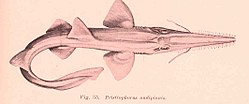
Picture of Pristiophoridae
- Source
- Wikipedia/Commons
- Credit
- Illustrated Catalogue of the Fishes of South Australia, Adelaide, Australia : G. Hassell & Son, 1921
- Licence
- Public Domain
- Commercial use
- the licence allows it
No 3D scan of Pristiophoridae was found in MorphoSource and Sketchfab.
Smithsonian Open Access was not reached for this taxon, so this list is what the others held rather than everything there is.
The description on this site
- Source
- Wikipedia, “Sawshark”
- Licence
- CC BY-SA 4.0
This is what the site found, which is not the same as what exists.
Keep going
What may have been alongside itPristiophoriformes through timeFormations of the MioceneThe world it lived on
Occurrence data from the Paleobiology Database, CC BY 4.0. Bleeker 1859