Postosuchus
Postosuchus, Ancient Greek, meaning "Crocodile from Post", is an extinct genus of rauisuchid reptiles comprising two species, P. kirkpatricki and P. alisonae, that lived in what is now North America during the Late Triassic. Postosuchus is a member of the clade Pseudosuchia, the lineage of archosaurs that includes modern crocodilians. Its name refers to Post Quarry, a place in Texas where many fossils of the type species, P. kirkpatricki, were found.

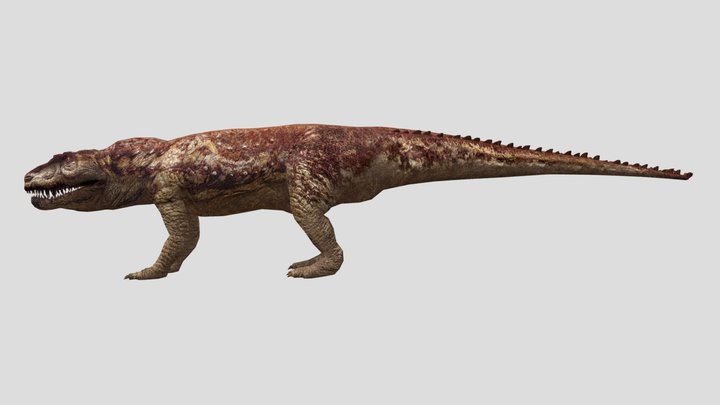
Dallas Krentzel · CC BY 2.0 · via Wikipedia/Commons. May be a photograph of a specimen, or an artist’s reconstruction — an interpretation of a skeleton, since colour and soft tissue are almost never preserved.
On record
Recorded, not inferred- Sits inside
- RauisuchidaePBDB
- Diet
- carnivorePBDB, for Pseudosuchia
- Motility
- actively mobilePBDB, for Osteichthyes
- Environment
- terrestrialPBDB, for Diapsida
- Length
- 5 mWikidata
- Mass
- 300 kgWikidata
Time the record covers
At least 21 million years on record.
The record covers at least 227.3 Mya to 205.7 Mya. No occurrence read is dated outside 237 Mya to 201.4 Mya.
31 occurrences of Postosuchus on record, most of them in the Late Triassic. Bar height is expected occurrences, not a count: each fossil is spread across the span it is dated to, so a tall narrow bar means tight dating and a low wide one means loose.
When
31 occurrences- Late Triassic100%
These are dates about fossils, not the animal: the record can only begin after it arose and end before it died out, so either end may reach further. Shares are expected occurrences: a fossil dated to a span is counted partly in each period it straddles. More on what this infers.
Found in
5 formations
- Chinle Formation21
- Tecovas Formation · Dockum Group4
- Cooper Canyon Formation · Dockum Group2
- Colorado City Formation · Dockum Group2
- Garita Creek Formation · Chinle Group1
Loading coastlines…
The named rock units Postosuchus has been recovered from, largest first. Drawn where the rock is now, not where it formed. 1 occurrence has no formation on record, which is common for older literature.
Postosuchus and its relatives
Late TriassicWhere Postosuchus and its relatives were recorded in the Late Triassic.
Found in the same rock
165 taxa- Anaschisma browni11 sites
- Typothorax coccinarum11 sites
- Calyptosuchus wellesi10 sites
- Archosauria9 sites
- Aetosauria8 sites
- Apachesaurus gregorii8 sites
- Vancleavea campi7 sites
- Leptosuchus6 sites
- Redfieldiidae6 sites
- Turseodus6 sites
- Archosauriformes5 sites
- Metoposauridae5 sites
- Mystriosuchini5 sites
- Paratypothorax5 sites
- Phytosauria5 sites
- Poposaurus gracilis5 sites
- Reptilia5 sites
- Shuvosaurus5 sites
- Shuvosaurus inexpectatus5 sites
- Temnospondyli5 sites
- Theropoda5 sites
- Triodus moorei5 sites
- Crocodylomorpha4 sites
- Lonchidion humblei4 sites
The Paleobiology Database records 30 sites for Postosuchus, and this reads all of them. The number is how many of those sites it was catalogued from too. The 24 sharing the most are listed.
This is not a list of everything alive at the time. It is only what has come out of the same ground as this animal and been written down.
Entered from
12 references- Late Triassic (Carnian and Norian) Tetrapods from the Southwestern United States17
- A vertebrate fauna from the Upper Triassic Owl Rock Member of the Chinle Formation in Northern Arizona, Northern Arizona University3
- Advances in Late Triassic vertebrate paleontology based on new material from Petrified Forest National Park, Arizona2
- Rotten Hill: A Late Triassic bonebed in the Texas Panhandle, USA1
- Vertebrate fossil preservation in blue paleosols from the Petrified Forest National Park, Arizona, with implications for vertebrate biostratigraphy in the Chinle Formation1
- A new suchian archosaur from the Upper Triassic of North Carolina1
- Tetrapod fauna of the Upper Triassic (Revueltian) Owl Rock Formation, Chinle Group, Arizona1
- Triassic vertebrate fossils in Arizona1
- The vertebrate fauna of the Upper Triassic (Revueltian) Snyder Quarry1
- Late Triassic vertebrates from the Patricia site near Post, Texas1
- Paleontology and vertebrate biochronology of the Upper Triassic Garita Creek Formation, east-central New Mexico1
- Postosuchus, a new thecodontian reptile from the Triassic of Texas and the origin of tyrannosaurs1
Each of the 31 occurrences read was entered from one of these publications, ordered by how many each accounts for. This is not a search for papers mentioning the name. Entries link to doi.org where the Paleobiology Database holds an identifier, and to its own record where it does not. Relayed as the Paleobiology Database holds them, not checked against what they resolve to.
Media and terms
Media content3

Picture of Postosuchus
- Source
- Wikipedia/Commons
- Credit
- Dallas Krentzel
- Licence
- CC BY 2.0
- Commercial use
- the licence allows it
Photogrammetry
- Source
- MorphoSource
- Licence
- not stated by the source
- Commercial use
- cannot be read from the licence given — check the record
- Specimen
- Postosuchus sp. · ttup:9002
Smithsonian Open Access was not reached for this taxon, so this list is what the others held rather than everything there is.
The description on this site
- Source
- Wikipedia, “Postosuchus”
- Licence
- CC BY-SA 4.0
This is what the site found, which is not the same as what exists.
Keep going
What may have been alongside itRauisuchidae through timeFormations of the Late TriassicThe world it lived on
Occurrence data from the Paleobiology Database, CC BY 4.0. Chatterjee 1985