Mystriosuchini
Mystriosuchini, historically known as Pseudopalatinae, is an extinct tribe of derived phytosaurs in the clade Leptosuchomorpha. As with all other phytosaurs, mystriosuchins lived during Late Triassic. The name is derived from the genus Mystriosuchus, and the clade was phylogenetically defined by Andrew S. Jones and Richard J. Butler in 2018 as the last common ancestor and all descendants of Mystriosuchus planirostris, Machaeroprosopus jablonskiae, and Machaeroprosopus buceros.

Park Ranger · Public Domain · via Wikipedia/Commons. May be a photograph of a specimen, or an artist’s reconstruction — an interpretation of a skeleton, since colour and soft tissue are almost never preserved.
On record
Recorded, not inferred- Sits inside
- LeptosuchomorphaPBDB
- Diet
- carnivorePBDB, for Phytosauria
- Motility
- actively mobilePBDB, for Osteichthyes
- Environment
- terrestrialPBDB, for Diapsida
Time the record covers
At least 9.7 million years on record.
The record covers at least 211.18 Mya to 201.4 Mya. No occurrence read is dated outside 227.3 Mya to 199.5 Mya.
123 occurrences of Mystriosuchini on record, most of them in the Late Triassic. Bar height is expected occurrences, not a count: each fossil is spread across the span it is dated to, so a tall narrow bar means tight dating and a low wide one means loose.
When
123 occurrences- Late Triassic99%
- Early Jurassicunder 1%
These are dates about fossils, not the animal: the record can only begin after it arose and end before it died out, so either end may reach further. Shares are expected occurrences: a fossil dated to a span is counted partly in each period it straddles. More on what this infers.
Found in
15 formations
- Chinle Formation82
- Löwenstein Formation · Keuper Group15
- Bull Canyon Formation · Dockum Group6
- Redonda Formation · Chinle Group4
- Arnstadt Formation · Middle Keuper Group3
- Cooper Canyon Formation · Dockum Group3
Loading coastlines…
The named rock units Mystriosuchini has been recovered from, largest first. Drawn where the rock is now, not where it formed.
Mystriosuchini and its relatives
Late TriassicWhere Mystriosuchini and its relatives were recorded in the Late Triassic.
Found in the same rock
167 taxa- Typothorax coccinarum37 sites
- Machaeroprosopus buceros13 sites
- Reptilia13 sites
- Apachesaurus gregorii12 sites
- Metoposauridae12 sites
- Arganodus11 sites
- Machaeroprosopus10 sites
- Paratypothorax10 sites
- Shuvosaurus10 sites
- Machaeroprosopus pristinus9 sites
- Theropoda9 sites
- Redfieldiidae8 sites
- Archosauria7 sites
- Postosuchus6 sites
- Vancleavea campi6 sites
- Araucarioxylon5 sites
- Archosauriformes5 sites
- Mystriosuchus5 sites
- Nicrosaurus kapffi5 sites
- Phytosauria5 sites
- Postosuchus kirkpatricki5 sites
- Redondasaurus gregorii5 sites
- Actinopterygii4 sites
- Anaschisma browni4 sites
The Paleobiology Database records 100 sites for Mystriosuchini, and this reads all of them. The number is how many of those sites it was catalogued from too. The 24 sharing the most are listed.
This is not a list of everything alive at the time. It is only what has come out of the same ground as this animal and been written down.
Entered from
40 references- Late Triassic (Carnian and Norian) Tetrapods from the Southwestern United States51
- Tetrapod fauna of the Upper Triassic (Revueltian) Owl Rock Formation, Chinle Group, Arizona17
- Cranial anatomy and diversity of the Norian phytosaurs from southwest Germany6
- The Late Triassic phytosaur Mystriosuchus westphali, with a revision of the genus4
- Phytosaur remains from the Norian Arnstadt Formation (Leine Valley, Germany), with reference to European phytosaur habits3
- Two new phytosaur species (Archosauria, Crurotarsi) from the Upper Triassic of southwest Germany3
- A new phytosaur (Reptilia: Archosauria) genus from the uppermost Triassic of the western United States and its biochonological significance3
- Tetrapod fauna of the Upper Triassic Redonda formation, East-Central New Mexico: the characteristic assemblage of the Apachean land-vertebrate faunachron2
- Lithostratigraphy, chemostratigraphy, and vertebrate biostratigraphy of the Dockum Group (Upper Triassic), of southern Garza County, West Texas. Unpublished PhD thesis, Texas Tech University2
- Sexual dimorphism in a large brachyrostral phytosaur (Archosauria: Crurotarsi) from the Late Triassic of western North America2
- A Late Triassic dinosauromorph assemblage from New Mexico and the rise of dinosaurs1
- A new species of the Late Triassic phytosaur Pseudopalatus (Archosauria: Pseudosuchia) from Petrified Forest National Park, Arizona1
Each of the 123 occurrences read was entered from one of these publications, ordered by how many each accounts for. This is not a search for papers mentioning the name. 28 further references are not listed. Entries link to doi.org where the Paleobiology Database holds an identifier, and to its own record where it does not. Relayed as the Paleobiology Database holds them, not checked against what they resolve to.
Media and terms
Media content1
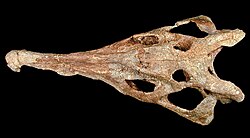
Picture of Mystriosuchini
- Source
- Wikipedia/Commons
- Credit
- Park Ranger
- Licence
- Public Domain
- Commercial use
- the licence allows it
No 3D scan was found. Smithsonian Open Access, MorphoSource and Sketchfab were all searched.
The description on this site
- Licence
- CC BY-SA 4.0
This is what the site found, which is not the same as what exists.
Keep going
What may have been alongside itLeptosuchomorpha through timeFormations of the Late TriassicThe world it lived on
Occurrence data from the Paleobiology Database, CC BY 4.0. (Huene 1915)