Pieris
Pieris is a genus of seven species of shrubs in the flowering plant family Ericaceae, native to mountain regions of eastern and southern Asia, eastern North America and Cuba. Known commonly in North America as andromedas or fetterbushes, they are broad-leaved evergreen shrubs growing to 1–6 metres (3–20 ft) tall and 0.9–3.0 m (3–10 ft) wide. The leaves are spirally arranged, often appearing to be in whorls at the end of each shoot with bare stretches of shoot below; they are lanceolate-ovate, 2–10 cm (1–4 in) long and 1.0–3.5 cm broad, leathery textured, and with an entire or serrated margin. The young leaves in spring are typically brightly coloured. The flowers, which may have a very appealing honey scent, are bell-shaped, 5–15 mm long, white or pink, and arranged in racemes 5–12 cm long. The fruit is a woody capsule which splits into five sections to release the numerous small seeds.

First Light ( talk ) · CC BY 3.0 · via Wikipedia/Commons. May be a photograph of a specimen, or an artist’s reconstruction — an interpretation of a skeleton, since colour and soft tissue are almost never preserved.
On record
Recorded, not inferred- Sits inside
- EricaceaePBDB
- Diet
- "photoautotroph"PBDB, for Angiospermae
Time the record covers
At most 8.1 million years on record.
The one occurrence read is dated to somewhere between 11.63 Mya and 3.6 Mya, which is a dating window rather than a span.
1 occurrence of Pieris on record, most of them in the Miocene. The Paleobiology Database records this as a living group, and the chart stops with its fossils rather than at the present. Bar height is expected occurrences, not a count: each fossil is spread across the span it is dated to, so a tall narrow bar means tight dating and a low wide one means loose.
When
1 occurrencesThese are dates about fossils, not the animal: the record can only begin after it arose and end before it died out, so either end may reach further. Shares are expected occurrences: a fossil dated to a span is counted partly in each period it straddles. More on what this infers.
Found in
1 formation
Loading coastlines…
The named rock units Pieris has been recovered from, largest first. Drawn where the rock is now, not where it formed.
Pieris and its relatives
MioceneWhere Pieris and its relatives were recorded in the Miocene.
Found in the same rock
22 taxa- Aphananthe1 site
- Berchemia1 site
- Brasenia purpurea1 site
- Buxus1 site
- Camellia japonica1 site
- Castanopsis1 site
- Cinnamomum1 site
- Cunninghamia1 site
- Glyptostrobus pensilis1 site
- Illicium1 site
- Mallotus1 site
- Metasequoia disticha1 site
- Myrica1 site
- Nuphar1 site
- Pseudolarix1 site
- Quercus1 site
- Sciadopitys1 site
- Sequoia sempervirens1 site
- Symplocos1 site
- Trapa1 site
- Trapella antennifera1 site
- Zelkova ungeri1 site
The Paleobiology Database records 1 site for Pieris, and this reads all of them. The number is how many of those sites it was catalogued from too.
This is not a list of everything alive at the time. It is only what has come out of the same ground as this animal and been written down.
Entered from
1 referenceEach of the 1 occurrence read was entered from one of these publications, ordered by how many each accounts for. This is not a search for papers mentioning the name. Each entry links to the Paleobiology Database's own record for the work.
Media and terms
Media content3

Picture of Pieris
- Source
- Wikipedia/Commons
- Credit
- First Light ( talk )
- Licence
- CC BY 3.0
- Commercial use
- the licence allows it

CT scan
- Source
- MorphoSource
- Licence
- not stated by the source
- Commercial use
- cannot be read from the licence given — check the record
- Specimen
- Pieris napi · su:ins
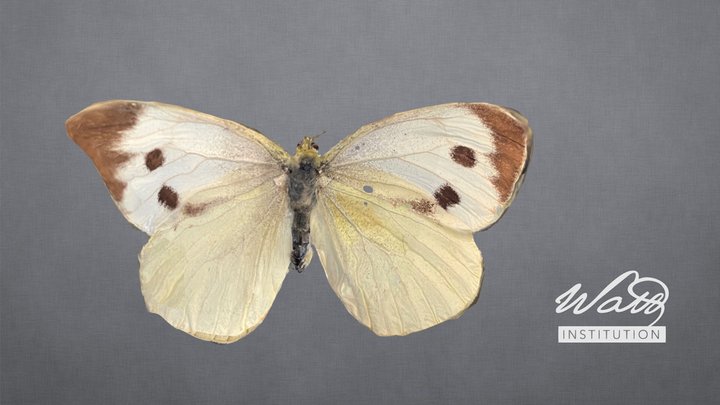
3D model
- Source
- Sketchfab
- Credit
- The Watt Institution
- Licence
- CC Attribution
- Commercial use
- cannot be read from the licence given — check the record
Smithsonian Open Access was not reached for this taxon, so this list is what the others held rather than everything there is.
The description on this site
- Licence
- CC BY-SA 4.0
This is what the site found, which is not the same as what exists.
Keep going
What may have been alongside itEricaceae through timeFormations of the MioceneThe world it lived on
Occurrence data from the Paleobiology Database, CC BY 4.0. Don 1834