Peromyscus gossypinus
The cotton mouse is a species of rodent in the family Cricetidae. It is a species of the genus Peromyscus, a closely related group of New World mice often called "deermice". It is endemic to the woodlands of the Southern United States.

Uncredited · Public Domain · via Wikipedia/Commons. May be a photograph of a specimen, or an artist’s reconstruction — an interpretation of a skeleton, since colour and soft tissue are almost never preserved.
On record
Recorded, not inferred- Also called
- cotton mousePBDB
- Sits inside
- PeromyscusPBDB
- Diet
- herbivorePBDB, for Rodentia
- Life habit
- ground dwellingPBDB, for Peromyscus
- Motility
- actively mobilePBDB, for Osteichthyes
- Environment
- terrestrialPBDB, for Eutheria
Time the record covers
At most 199 thousand years on record.
Every occurrence read is dated to somewhere between 210 ka and 11.7 ka, and nothing in the dating separates them, so that window is what the record shows rather than a span.
13 occurrences of Peromyscus gossypinus on record, most of them in the Pleistocene. The Paleobiology Database records this as a living group. Bar height is expected occurrences, not a count: each fossil is spread across the span it is dated to, so a tall narrow bar means tight dating and a low wide one means loose.
When
13 occurrences- Pleistocene100%
These are dates about fossils, not the animal: the record can only begin after it arose and end before it died out, so either end may reach further. Shares are expected occurrences: a fossil dated to a span is counted partly in each period it straddles. More on what this infers.
Found in
2 formations
Loading coastlines…
The named rock units Peromyscus gossypinus has been recovered from, largest first. Drawn where the rock is now, not where it formed. 11 occurrences have no formation on record, which is common for older literature.
Peromyscus gossypinus and its relatives
PleistoceneWhere Peromyscus gossypinus and its relatives were recorded in the Pleistocene.
Found in the same rock
364 taxa- Neofiber alleni11 sites
- Oryzomys palustris11 sites
- Dasypus bellus10 sites
- Equus10 sites
- Odocoileus virginianus10 sites
- Sylvilagus floridanus10 sites
- Geomys pinetis9 sites
- Neotoma floridana9 sites
- Scalopus aquaticus9 sites
- Sigmodon hispidus9 sites
- Spilogale putorius9 sites
- Cryptotis parva8 sites
- Microtus pinetorum8 sites
- Didelphis virginiana7 sites
- Myotis austroriparius7 sites
- Platygonus compressus7 sites
- Procyon lotor7 sites
- Synaptomys australis7 sites
- Terrapene carolina7 sites
- Urocyon cinereoargenteus7 sites
- Aenocyon dirus6 sites
- Holmesina septentrionalis6 sites
- Lynx rufus6 sites
- Mephitis mephitis6 sites
The Paleobiology Database records 13 sites for Peromyscus gossypinus, and this reads all of them. The number is how many of those sites it was catalogued from too. The 24 sharing the most are listed.
This is not a list of everything alive at the time. It is only what has come out of the same ground as this animal and been written down.
Entered from
9 references- Chronology of Florida Pleistocene mammals3
- Late Rancholabrean mammals from south- ernmost Florida, and the Neotropical influence in Florida Pleistocene faunas2
- Historical Biogeography of Florida Pleistocene Mammals2
- Middle Pleistocene (early Rancholabrean) vertebrates and associated marine and non-marine invertebrates from Oldsmar, Pinnellas County, Florida1
- A new Late Pleistocene Conepatus and associated vertebrate fauna from Florida1
- Late Pleistocene mammals from the Devil's Den Fauna, Levy County1
- Further study of the Friesenhahn Cave Peromyscus1
- A Pleistocene campsite near Lewisville, Texas1
- Additions to the Pleistocene mammalian fauna from Melbourne, Florida1
Each of the 13 occurrences read was entered from one of these publications, ordered by how many each accounts for. This is not a search for papers mentioning the name. Entries link to doi.org where the Paleobiology Database holds an identifier, and to its own record where it does not. Relayed as the Paleobiology Database holds them, not checked against what they resolve to.
Media and terms
Media content2
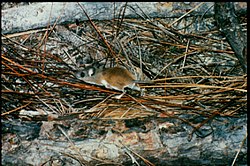
Picture of Peromyscus gossypinus
- Source
- Wikipedia/Commons
- Credit
- nobody named on the record
- Licence
- Public Domain
- Commercial use
- the licence allows it
CT scan
- Source
- MorphoSource
- Licence
- In Copyright
- Commercial use
- cannot be read from the licence given — check the record
- Specimen
- Peromyscus gossypinus · UMMZ:mammals:103750
The description on this site
- Licence
- CC BY-SA 4.0
This is what the site found, which is not the same as what exists.
Keep going
What may have been alongside itPeromyscus through timeFormations of the PleistoceneThe world it lived on
Occurrence data from the Paleobiology Database, CC BY 4.0. (Le Conte 1853)