Percrocuta
Percrocuta is an extinct genus of percrocutid hyena. It lived in Eurasia and Africa, during the Miocene epoch.

Werdelin, Lars · CC0 · via Wikipedia/Commons. May be a photograph of a specimen, or an artist’s reconstruction — an interpretation of a skeleton, since colour and soft tissue are almost never preserved.
On record
Recorded, not inferred- Sits inside
- PercrocutidaePBDB
- Diet
- carnivore, omnivorePBDB, for Carnivora
- Life habit
- ground dwellingPBDB, for Carnivora
- Motility
- actively mobilePBDB, for Osteichthyes
- Environment
- terrestrialPBDB, for Eutheria
Time the record covers
At least 9.1 million years on record.
The record covers at least 12.75 Mya to 3.6 Mya. No occurrence read is dated outside 15.98 Mya to 2.58 Mya.
23 occurrences of Percrocuta on record, most of them in the Miocene. Bar height is expected occurrences, not a count: each fossil is spread across the span it is dated to, so a tall narrow bar means tight dating and a low wide one means loose.
When
23 occurrencesThese are dates about fossils, not the animal: the record can only begin after it arose and end before it died out, so either end may reach further. Shares are expected occurrences: a fossil dated to a span is counted partly in each period it straddles. More on what this infers.
Found in
10 formations
- Sahabi Formation3
- Hadar Formation · Awash Group2
- Upper Koru Series Formation · Kericho Phonolites Group2
- Varswater Formation2
- USNO Formation · Omo Group1
- Hofuf Formation1
Loading coastlines…
The named rock units Percrocuta has been recovered from, largest first. Drawn where the rock is now, not where it formed. 8 occurrences have no formation on record, which is common for older literature.
Percrocuta and its relatives
MioceneWhere Percrocuta and its relatives were recorded in the Miocene.
Found in the same rock
520 taxa- Hipparion7 sites
- Gazella6 sites
- Aceratherium5 sites
- Homotherium5 sites
- Listriodon5 sites
- Nyanzachoerus5 sites
- Orycteropus5 sites
- Palaeotragus5 sites
- Cetacea4 sites
- Diceros bicornis4 sites
- Dinofelis4 sites
- Raphicerus4 sites
- Alcelaphini3 sites
- Anchitherium3 sites
- Bathyergidae3 sites
- Canidae3 sites
- Ceratotherium3 sites
- Cervidae3 sites
- Chalicomys3 sites
- Deinotherium3 sites
- Deinotherium bozasi3 sites
- Dicrocerus3 sites
- Elephas ekorensis3 sites
- Enhydriodon3 sites
The Paleobiology Database records 22 sites for Percrocuta, and this reads all of them. The number is how many of those sites it was catalogued from too. The 24 sharing the most are listed.
This is not a list of everything alive at the time. It is only what has come out of the same ground as this animal and been written down.
Entered from
19 references- The Chinese Neogene mammalian biochronology - its correlation with the European Neogene mammal zonation3
- Preliminary observations on Carnivora from the Sahabi Formation (Libya)3
- Percrocuta miocenica (Percrocutidae, Carnivora) from the middle Miocene of Brajkovac (Central Serbia)1
- The Carnivora (Mammalia) from the middle Miocene locality of Gračanica (Bugojno Basin, Gornji Vakuf, Bosnia and Herzegovina)1
- A new species of Nyanzachoerus (Mammalia, Artiodactyla, Suidae, Tetraconodontinae) from the upper Miocene Nakali Formation, Kenya1
- Associatia de vertebrate din punctul fosilifer Sarmatian mediu Otovasca (Mun. Chisinau) si importanta oor biostratigraphfica1
- Middle Miocene Carnivora and Hyaenodonta from Fort Ternan, western Kenya1
- The Herpetofauna (Amphibia: Caudata, Anura; Reptilia: Sclerogiossa) of the Upper Miocene Locality Kohfidisch (Burgenland, Austria)1
- New material of Hispanotherium matritense (Rhinocerotidae, Perissodactyla) from Laogou of Hezheng County (Gansu, China), with special reference to the Chinese Middle Miocene elasmotheres1
- The middle Miocene mammalian site of Belometchetskaya, North Caucasus: an important biostratigraphic link between Europe and China1
- Extinct large Colobines from the Plio-Pleistocene of Africa1
- Un nouveau gisment de Vertebres dans le Chersonian Kurtchuk-Tchenkmedje Ouest (Thrace turque)1
Each of the 23 occurrences read was entered from one of these publications, ordered by how many each accounts for. This is not a search for papers mentioning the name. 7 further references are not listed. Entries link to doi.org where the Paleobiology Database holds an identifier, and to its own record where it does not. Relayed as the Paleobiology Database holds them, not checked against what they resolve to.
Media and terms
Media content1
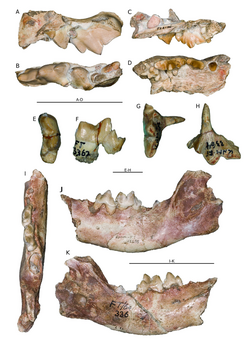
Picture of Percrocuta
- Source
- Wikipedia/Commons
- Credit
- Werdelin, Lars
- Licence
- CC0
- Commercial use
- the licence allows it
No 3D scan of Percrocuta was found in Sketchfab.
Smithsonian Open Access and MorphoSource were not reached for this taxon, so this list is what the others held rather than everything there is.
The description on this site
- Source
- Wikipedia, “Percrocuta”
- Licence
- CC BY-SA 4.0
This is what the site found, which is not the same as what exists.
Keep going
What may have been alongside itPercrocutidae through timeFormations of the MioceneThe world it lived on
Occurrence data from the Paleobiology Database, CC BY 4.0. Kretzoi 1938