Pelophylax perezi
The Perez's frog, also known as Iberian waterfrog, Iberian green frog or Coruna frog, is a species of frog in the family Ranidae. It is native to southern France, Portugal, Spain, and has been introduced to the Canary and Balearic Islands, Madeira, the United Kingdom, and the Azores. In the Iberian Peninsula it is widespread and common.

David Perez · CC BY 3.0 · via Wikipedia/Commons. May be a photograph of a specimen, or an artist’s reconstruction — an interpretation of a skeleton, since colour and soft tissue are almost never preserved.
On record
Recorded, not inferred- Sits inside
- PelophylaxPBDB
- Diet
- carnivorePBDB, for Temnospondyli
- Life habit
- amphibiousPBDB, for Temnospondyli
- Motility
- actively mobilePBDB, for Temnospondyli
- Environment
- brackish,freshwater,terrestrialPBDB, for Tetrapoda
Time the record covers
At least 1.8 million years on record.
The record covers at least 2.58 Mya to 774 ka. No occurrence read is dated outside 3.6 Mya to 11.7 ka.
5 occurrences of Pelophylax perezi on record, most of them in the Pleistocene. The Paleobiology Database records this as a living group. Bar height is expected occurrences, not a count: each fossil is spread across the span it is dated to, so a tall narrow bar means tight dating and a low wide one means loose.
When
5 occurrences- Pliocene40%
- Pleistocene60%
These are dates about fossils, not the animal: the record can only begin after it arose and end before it died out, so either end may reach further. Shares are expected occurrences: a fossil dated to a span is counted partly in each period it straddles. More on what this infers.
Pelophylax perezi and its relatives
PleistoceneWhere Pelophylax perezi and its relatives were recorded in the Pleistocene.
Found in the same rock
66 taxa- Discoglossus3 sites
- Alephis tigneresi2 sites
- Bufo2 sites
- Castillomys crusafonti2 sites
- Coronella girondica2 sites
- Lacertidae2 sites
- Lissotriton2 sites
- Mauremys leprosa2 sites
- Natrix natrix2 sites
- Pelobates cultripes2 sites
- Allocricetus1 site
- Allophaiomys1 site
- Allophaiomys pliocaenicus1 site
- Apodemus atavus1 site
- Apodemus mystacinus1 site
- Apodemus sylvaticus1 site
- Artiodactyla1 site
- Blanus cinereus1 site
- Bufo bufo1 site
- Bufo calamita1 site
- Canis etruscus1 site
- Caprini1 site
- Cervidae1 site
- cf. Dmanisibos sp.1 site
The Paleobiology Database records 5 sites for Pelophylax perezi, and this reads all of them. The number is how many of those sites it was catalogued from too. The 24 sharing the most are listed.
This is not a list of everything alive at the time. It is only what has come out of the same ground as this animal and been written down.
Entered from
4 references- A new key locality for the Pliocene vertebrate record of Europe: the Camp dels Ninots maar (NE Spain)2
- A new middle Pleistocene (Marine Oxygen Isotope Stage 6) cold herpetofaunal assemblage from the central Iberian Peninsula (Manzanares Valley, Madrid)1
- The early Pleistocene small vertebrate succession from the Orce region (Guadix-Baza Basin, SE Spain) and its bearing on the first human occupation of Europe1
- Anurans and squamate reptiles from the latest early Pleistocene of Almenara-Casablanca-3 (Castellón, East of Spain. Systematic, climatic and environmental considerations1
Each of the 5 occurrences read was entered from one of these publications, ordered by how many each accounts for. This is not a search for papers mentioning the name. Entries link to doi.org where the Paleobiology Database holds an identifier, and to its own record where it does not. Relayed as the Paleobiology Database holds them, not checked against what they resolve to.
Media and terms
Media content1
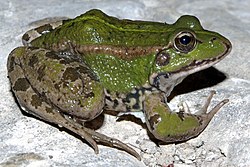
Picture of Pelophylax perezi
- Source
- Wikipedia/Commons
- Credit
- David Perez
- Licence
- CC BY 3.0
- Commercial use
- the licence allows it
No 3D scan of Pelophylax perezi was found in MorphoSource and Sketchfab.
Smithsonian Open Access was not reached for this taxon, so this list is what the others held rather than everything there is.
The description on this site
- Licence
- CC BY-SA 4.0
This is what the site found, which is not the same as what exists.
Keep going
What may have been alongside itPelophylax through timeFormations of the PleistoceneThe world it lived on
Occurrence data from the Paleobiology Database, CC BY 4.0. Frost et al. 2006