Pavona duerdeni
Pavona duerdeni, the porkchop coral, is a coral that forms clusters of cream-colored lobes or discs. They grow in large colonies, divided into ridges or hillocks. The coral is considered to be uncommon due to its low confirmed abundance, yet they are more commonly found in Hawaii, the Indo-Pacific, and the Tropical Eastern Pacific. They make up some of the largest colonies of corals, and have a slow growth rate, as indicated by their dense skeletons. Their smooth appearance is due to their small corallites growing on their surface.

Dr. Dwayne Meadows, NOAA/NMFS/OPR · Public Domain · via Wikipedia/Commons. May be a photograph of a specimen, or an artist’s reconstruction — an interpretation of a skeleton, since colour and soft tissue are almost never preserved.
On record
Recorded, not inferred- Sits inside
- PavonaPBDB
- Diet
- microcarnivore, photosymbioticPBDB, for Scleractinia
- Life habit
- intermediate-level epifaunal, colonial, clonalPBDB, for Scleractinia
- Motility
- stationary, attachedPBDB, for Scleractinia
- Vision
- blindPBDB, for Anthozoa
- Environment
- marinePBDB, for Scleractinia
Time the record covers
At most 2.6 million years on record.
The one occurrence read is dated to somewhere between 2.58 Mya and 11.7 ka, which is a dating window rather than a span.
1 occurrence of Pavona duerdeni on record, most of them in the Pleistocene. The Paleobiology Database records this as a living group. Bar height is expected occurrences, not a count: each fossil is spread across the span it is dated to, so a tall narrow bar means tight dating and a low wide one means loose.
When
1 occurrences- Pleistocene100%
These are dates about fossils, not the animal: the record can only begin after it arose and end before it died out, so either end may reach further. Shares are expected occurrences: a fossil dated to a span is counted partly in each period it straddles. More on what this infers.
Pavona duerdeni and its relatives
PleistoceneWhere Pavona duerdeni and its relatives were recorded in the Pleistocene.
Found in the same rock
17 taxa- Acropora1 site
- Cyphastrea ocellina1 site
- Gardineroseris planulata1 site
- Heterocentrotus1 site
- Hydrolithon onkodes1 site
- Leptastrea purpurea1 site
- Lobactis scutaria1 site
- Montipora hispida1 site
- Pocillopora damicornis1 site
- Pocillopora eydouxi1 site
- Pocillopora ligulata1 site
- Pocillopora verrucosa1 site
- Porites compressa1 site
- Porites lobata1 site
- Porolithon1 site
- Psammocora1 site
- Turbo1 site
The Paleobiology Database records 1 site for Pavona duerdeni, and this reads all of them. The number is how many of those sites it was catalogued from too.
This is not a list of everything alive at the time. It is only what has come out of the same ground as this animal and been written down.
Entered from
1 referenceEach of the 1 occurrence read was entered from one of these publications, ordered by how many each accounts for. This is not a search for papers mentioning the name. Each entry links to doi.org. Relayed as the Paleobiology Database holds them, not checked against what they resolve to.
Media and terms
Media content1
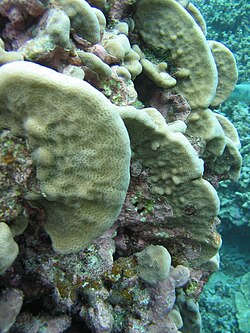
Picture of Pavona duerdeni
- Source
- Wikipedia/Commons
- Credit
- Dr. Dwayne Meadows, NOAA/NMFS/OPR
- Licence
- Public Domain
- Commercial use
- the licence allows it
No 3D scan of Pavona duerdeni was found in Sketchfab.
Smithsonian Open Access and MorphoSource were not reached for this taxon, so this list is what the others held rather than everything there is.
The description on this site
- Licence
- CC BY-SA 4.0
This is what the site found, which is not the same as what exists.
Keep going
What may have been alongside itPavona through timeFormations of the PleistoceneThe world it lived on
Occurrence data from the Paleobiology Database, CC BY 4.0. Vaughan 1907