Parasuchus
Parasuchus is an extinct genus of basal phytosaur known from the Late Triassic of Telangana and Madhya Pradesh, India. At its most restricted definition, Parasuchus contains a single species, Parasuchus hislopi. Parasuchus hislopi is one of several species belonging to a basal grade of phytosaurs, typified by the genus Paleorhinus. Historically, Paleorhinus has been known from better-described fossils, and many species have been lumped into that genus. Parasuchus hislopi, despite being described earlier than Paleorhinus, was considered an undiagnostic chimera until new neotype fossils were described in the late 1970s. Parasuchus hislopi and the two unambiguously valid species of Paleorhinus are all closely related; some authors have historically described them all under the species Paleorhinus, while others place the two Paleorhinus species into Parasuchus according to the principle of priority. The bite force of Parasuchus hislopi is estimated to be 450 newtons at the anterior portion of the jaw, with 1,958 newtons at the posterior portion.

Martin D. Ezcurra · CC BY 4.0 · via Wikipedia/Commons. May be a photograph of a specimen, or an artist’s reconstruction — an interpretation of a skeleton, since colour and soft tissue are almost never preserved.
On record
Recorded, not inferred- Sits inside
- ParasuchidaePBDB
- Diet
- carnivorePBDB
- Motility
- actively mobilePBDB, for Osteichthyes
- Environment
- terrestrialPBDB, for Diapsida
Time the record covers
At least 21 million years on record.
The record covers at least 248.6 Mya to 227.3 Mya. No occurrence read is dated outside 250.8 Mya to 205.7 Mya.
22 occurrences of Parasuchus on record, most of them in the Late Triassic. Bar height is expected occurrences, not a count: each fossil is spread across the span it is dated to, so a tall narrow bar means tight dating and a low wide one means loose.
When
22 occurrencesThese are dates about fossils, not the animal: the record can only begin after it arose and end before it died out, so either end may reach further. Shares are expected occurrences: a fossil dated to a span is counted partly in each period it straddles. More on what this infers.
Found in
10 formations
- Colorado City Formation · Dockum Group5
- Maleri Formation · Gondwana Group3
- Drawno Beds Formation2
- Popo Agie Formation · Chugwater Group2
- Hassberge Formation · Keuper Group2
- Tiki Formation · Gondwana Group2
Loading coastlines…
The named rock units Parasuchus has been recovered from, largest first. Drawn where the rock is now, not where it formed. 1 occurrence has no formation on record, which is common for older literature.
Parasuchus and its relatives
Late TriassicWhere Parasuchus and its relatives were recorded in the Late Triassic.
Found in the same rock
121 taxa- Phytosauria6 sites
- Anaschisma browni4 sites
- Hyperodapedon huxleyi4 sites
- Trilophosaurus buettneri4 sites
- Aetosauria3 sites
- Archosauromorpha3 sites
- Ceratodus3 sites
- Coelacanthidae3 sites
- Metoposaurus3 sites
- Osteichthyes3 sites
- Poposaurus gracilis3 sites
- Postosuchus kirkpatricki3 sites
- Trilophosaurus3 sites
- Turseodus3 sites
- Actinopterygii2 sites
- Archosauria2 sites
- Brachysuchus megalodon2 sites
- Doswellia2 sites
- Lissodus2 sites
- Longosuchus meadei2 sites
- Lucasuchus hunti2 sites
- Metoposauridae2 sites
- Metoposaurus diagnosticus2 sites
- Mystriosuchinae2 sites
The Paleobiology Database records 21 sites for Parasuchus, and this reads all of them. The number is how many of those sites it was catalogued from too. The 24 sharing the most are listed.
This is not a list of everything alive at the time. It is only what has come out of the same ground as this animal and been written down.
Entered from
15 references- Late Triassic (Carnian and Norian) Tetrapods from the Southwestern United States5
- Lithostratigraphy, chemostratigraphy, and vertebrate biostratigraphy of the Dockum Group (Upper Triassic), of southern Garza County, West Texas. Unpublished PhD thesis, Texas Tech University2
- The Paleorhinus biochron and the correlation of the non-marine Upper Triassic of Pangaea2
- A primitive parasuchid (Phytosaur) reptile from the Upper Triassic Maleri Formation of India2
- Micro and mega-vertebrate fossils from the Late Triassic Tiki Formation, South Rewa Gondwana Basin, India: palaeoenvironmental and palaeobiogeographic implications1
- Redescription of the phytosaurs Paleorhinus (‘Francosuchus’) angustifrons and Ebrachosuchus neukami from Germany, with implications for Late Triassic biochronology1
- A new taxonomic arrangement for Paleorhinus scurriensis1
- A review of the early Late Triassic Krasiejów biota from Silesia, Poland1
- A giant skull, ontogenetic variation and taxonomic validity of the Late Triassic phytosaur Parasuchus1
- Póznotriasowe cmentarzysko kregowców ladowych w Krasiejowie na Slasku Opolskim [Post-Triassic graveyard of terrestrial vertebrates in Krasiejów in Opole, Silesia]1
- The prosauropod dinosaur Azendohsaurus laaroussii from the Upper Triassic of Morocco1
- Tikisuchus romeri, a new rauisuchid reptile from the Late Triassic of India1
Each of the 22 occurrences read was entered from one of these publications, ordered by how many each accounts for. This is not a search for papers mentioning the name. 3 further references are not listed. Entries link to doi.org where the Paleobiology Database holds an identifier, and to its own record where it does not. Relayed as the Paleobiology Database holds them, not checked against what they resolve to.
Media and terms
Media content2

Picture of Parasuchus
- Source
- Wikipedia/Commons
- Credit
- Martin D. Ezcurra
- Licence
- CC BY 4.0
- Commercial use
- the licence allows it
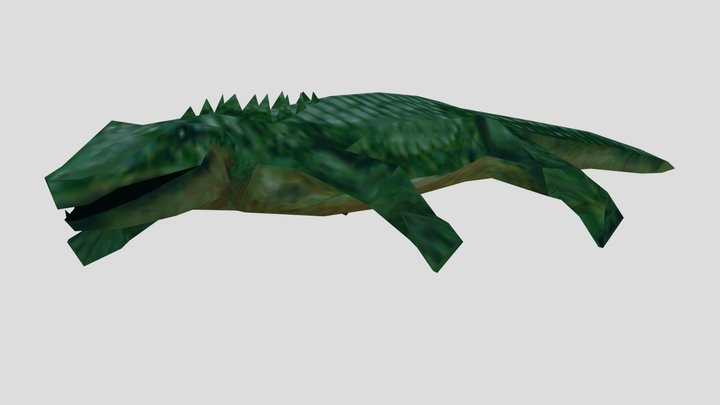
3D model
- Source
- Sketchfab
- Credit
- Ziggertron
- Licence
- CC Attribution
- Commercial use
- cannot be read from the licence given — check the record
Smithsonian Open Access was not reached for this taxon, so this list is what the others held rather than everything there is.
The description on this site
- Source
- Wikipedia, “Parasuchus”
- Licence
- CC BY-SA 4.0
This is what the site found, which is not the same as what exists.
Keep going
What may have been alongside itParasuchidae through timeFormations of the Late TriassicThe world it lived on
Occurrence data from the Paleobiology Database, CC BY 4.0. Lydekker 1885