Paranthropus robustus
Paranthropus robustus is an extinct species of robust australopithecine from the Early and possibly Middle Pleistocene of the Cradle of Humankind, South Africa, about 2.27 to 0.87 million years ago. It has been identified in Kromdraai, Swartkrans, Sterkfontein, Gondolin, Cooper's, and Drimolen Caves. Discovered in 1938, it was among the first early hominins described, and became the type species for the genus Paranthropus. However, it has been argued by some that Paranthropus is an invalid grouping and synonymous with Australopithecus, so the species is also often classified as Australopithecus robustus.

Ditsong National Museum of Natural History · CC BY-SA 4.0 · via Wikipedia/Commons. May be a photograph of a specimen, or an artist’s reconstruction — an interpretation of a skeleton, since colour and soft tissue are almost never preserved.
On record
Recorded, not inferred- Sits inside
- ParanthropusPBDB
- Diet
- omnivorePBDB, for Hominidae
- Life habit
- ground dwellingPBDB, for Hominidae
- Motility
- actively mobilePBDB, for Osteichthyes
- Environment
- terrestrialPBDB, for Eutheria
Time the record covers
At most 3.6 million years on record.
Every occurrence read is dated to somewhere between 3.6 Mya and 11.7 ka, and nothing in the dating separates them, so that window is what the record shows rather than a span.
8 occurrences of Paranthropus robustus on record, most of them in the Pleistocene. Bar height is expected occurrences, not a count: each fossil is spread across the span it is dated to, so a tall narrow bar means tight dating and a low wide one means loose.
When
8 occurrences- Pliocene11%
- Pleistocene89%
These are dates about fossils, not the animal: the record can only begin after it arose and end before it died out, so either end may reach further. Shares are expected occurrences: a fossil dated to a span is counted partly in each period it straddles. More on what this infers.
Found in
2 formations
- Swartkrans Formation · Transvaal Group4
- Kromdraai Formation3
Loading coastlines…
The named rock units Paranthropus robustus has been recovered from, largest first. Drawn where the rock is now, not where it formed. 1 occurrence has no formation on record, which is common for older literature.
Paranthropus robustus and its relatives
PleistoceneWhere Paranthropus robustus and its relatives were recorded in the Pleistocene.
Found in the same rock
184 taxa- Bovidae7 sites
- Panthera pardus7 sites
- Mammalia6 sites
- Adenota recki5 sites
- Cercopithecidae5 sites
- Connochaetes5 sites
- Aves4 sites
- Canidae4 sites
- Cercopithecoides williamsi4 sites
- Chasmaporthetes nitidula4 sites
- Damaliscus4 sites
- Gazella4 sites
- Hyaenidae4 sites
- Lupulella mesomelas4 sites
- Megalotragus4 sites
- Papio robinsoni4 sites
- Parahyaena brunnea4 sites
- Suidae4 sites
- Syncerus4 sites
- Amphibia3 sites
- Antidorcas marsupialis australis3 sites
- Beatragus3 sites
- Crocuta crocuta3 sites
- Equidae3 sites
The Paleobiology Database records 8 sites for Paranthropus robustus, and this reads all of them. The number is how many of those sites it was catalogued from too. The 24 sharing the most are listed.
This is not a list of everything alive at the time. It is only what has come out of the same ground as this animal and been written down.
Entered from
8 references- Macromammalian faunas, biochronology and palaeoecology of the early Pleistocene Main Quarry hominin-bearing deposits of the Drimolen Palaeocave System, South Africa1
- The Swartkrans Palaeontological Research Project in perspective: results and conclusions1
- Palaeoecology of the Pliocene and lower Pleistocene hominids of southern Africa: how good is the chronological and paleoenvironmental evidence?1
- Brief comments on "sedimentological characteristics of the 'Red Muds' at the Makapansgat Limeworks," by B.R. Turner1
- New perspectives on taphonomy, palaeoecology, and chronology of the Kromdraai apemen1
- The Hunters of the Hunted? An Introduction to African Cave Taphonomy1
- Re-interpretation of the Swartkrans site and its remains1
- The Transvaal Museum's fossil project at Swartkrans1
Each of the 8 occurrences read was entered from one of these publications, ordered by how many each accounts for. This is not a search for papers mentioning the name. Entries link to doi.org where the Paleobiology Database holds an identifier, and to its own record where it does not. Relayed as the Paleobiology Database holds them, not checked against what they resolve to.
Media and terms
Media content3

Picture of Paranthropus robustus
- Source
- Wikipedia/Commons
- Credit
- Ditsong National Museum of Natural History
- Licence
- CC BY-SA 4.0
- Commercial use
- the licence allows it
CT scan
- Source
- MorphoSource
- Licence
- In Copyright
- Commercial use
- cannot be read from the licence given — check the record
- Specimen
- Paranthropus robustus · wits:DNH 7
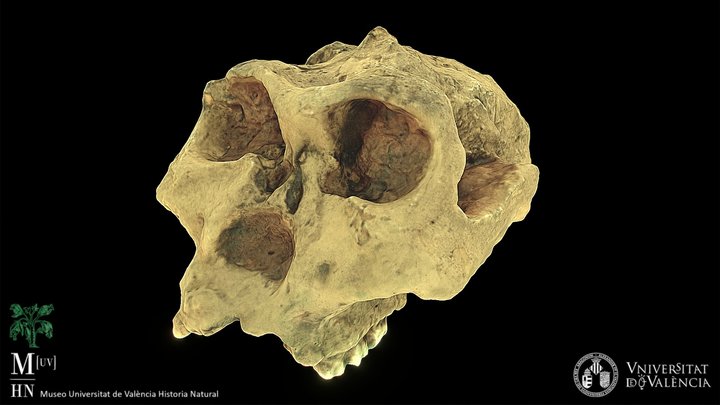
3D model
- Source
- Sketchfab
- Licence
- CC Attribution
- Commercial use
- cannot be read from the licence given — check the record
Smithsonian Open Access was not reached for this taxon, so this list is what the others held rather than everything there is.
The description on this site
- Licence
- CC BY-SA 4.0
This is what the site found, which is not the same as what exists.
Keep going
What may have been alongside itParanthropus through timeFormations of the PleistoceneThe world it lived on
Occurrence data from the Paleobiology Database, CC BY 4.0. (Broom 1938)