Panopea intermedia
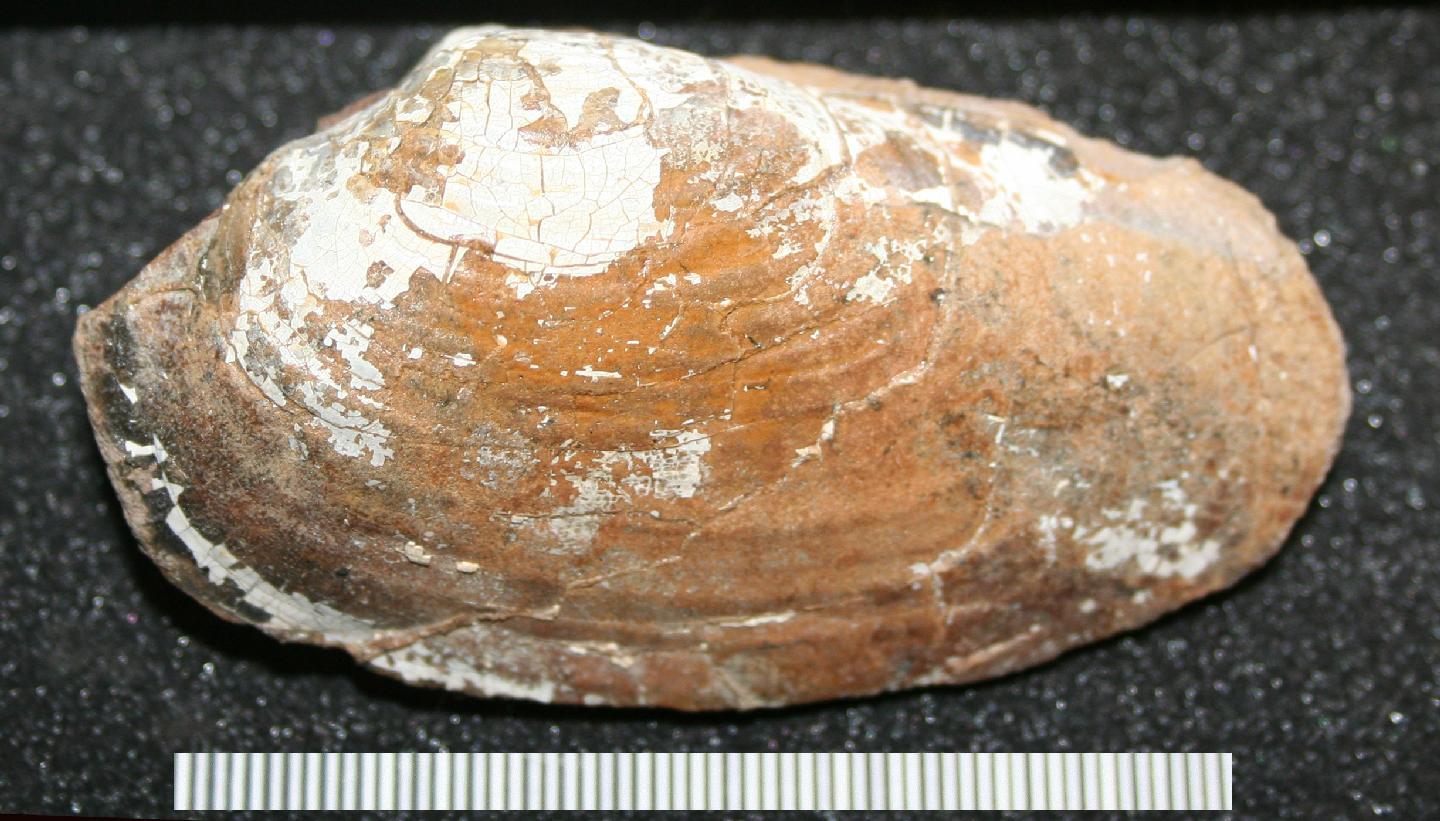
via iDigBio · CC BY · via iDigBio. May be a photograph of a specimen, or an artist’s reconstruction — an interpretation of a skeleton, since colour and soft tissue are almost never preserved.
On record
Recorded, not inferred- Sits inside
- PanopeaPBDB
- Diet
- suspension feederPBDB, for Panopea
- Life habit
- deep infaunalPBDB, for Panopea
- Motility
- stationaryPBDB, for Panopea
- Vision
- blindPBDB, for Bivalvia
Time the record covers
At least 97 million years on record.
The record covers at least 100.5 Mya to 2.58 Mya. No occurrence read is dated outside 113.2 Mya to 0 Mya.
22 occurrences of Panopea intermedia on record, most of them in the Eocene. Bar height is expected occurrences, not a count: each fossil is spread across the span it is dated to, so a tall narrow bar means tight dating and a low wide one means loose.
When
22 occurrencesThese are dates about fossils, not the animal: the record can only begin after it arose and end before it died out, so either end may reach further. Shares are expected occurrences: a fossil dated to a span is counted partly in each period it straddles. More on what this infers.
Found in
9 formations
- London Clay Formation4
- Tiyon Formation3
- Selsey Formation · Bracklesham Group2
- Barton Beds Formation2
- Inucu Formation2
- Woolwich and Reading Formation1
Loading coastlines…
The named rock units Panopea intermedia has been recovered from, largest first. Drawn where the rock is now, not where it formed. 5 occurrences have no formation on record, which is common for older literature.
Panopea intermedia and its relatives
EoceneWhere Panopea intermedia and its relatives were recorded in the Eocene.
Found in the same rock
782 taxa- Odostomia6 sites
- Euspira glaucinoides5 sites
- Nucula5 sites
- Pitar (Calpitaria) sulcatarius5 sites
- Sigatica hantoniensis5 sites
- Acteon4 sites
- Anomia anomialis4 sites
- Corbula4 sites
- Corbula (Bicorbula) gallica4 sites
- Eopleurotoma4 sites
- Pitar4 sites
- Rimella fissurella4 sites
- Ringicula4 sites
- Seila mundula4 sites
- Sigapatella4 sites
- Tellina4 sites
- Teredo4 sites
- Tibia (Eotibia) sublucida4 sites
- Turbonilla4 sites
- Turricula4 sites
- Arca3 sites
- Arcopagia (Bertinella) pseudodonacialis3 sites
- Bonellitia3 sites
- Cerithium3 sites
The Paleobiology Database records 18 sites for Panopea intermedia, and this reads all of them. The number is how many of those sites it was catalogued from too. The 24 sharing the most are listed.
This is not a list of everything alive at the time. It is only what has come out of the same ground as this animal and been written down.
Entered from
13 references- Biostratigraphy of the Tiyon Formation (Middle Eocene) of Sind, Pakistan4
- Fauna de moluste a depozitelor Paleogene din nord-vestul Transilvaniei [Molluscan fauna from Paleogene deposits from NW Transilvania]4
- The Early Eocene London Clay Formation mollusc fauna of the former Bursledon Brickworks, Lower Swanwick, Hampshire2
- Distribution of Mollusca in Units S1 to S9 of the Selsey Formation (middle Lutetian), Selsey Peninsula, West Sussex2
- On the Tertiary or SupraCretaceous Formations of the Isle of Wight as exhibited in the sections at Alum Bay and White Cliff Bay2
- Geologie, Paläontologie und Palökologie der südostbayerischen unter-priabonen (Ober-Eozän) Riffkalkvorkommen bei Hallthurm (Nördliche Kalkalpen) und der Kirchbergs bei Neubeuern (Helvetikum)1
- Molluscs from the Tilehurst Member (London Clay Formation, Early Eocene) at Crondall and Up Nately (Hampshire)1
- Lower Tertiary strata exposed in a temporary excavation at Well Hall, Eltham, south east London1
- The London Clay and associated deposits exposed in Chichester Harbour (West Sussex)1
- Geologie de Madagascar I. Les Terrains Sedimentaires1
- Tertiary faunas from Kap Brewstwer, East Greenland1
- Eocene Mollusca from the Subathu group (Lutetian), Simla Hills state, India1
Each of the 22 occurrences read was entered from one of these publications, ordered by how many each accounts for. This is not a search for papers mentioning the name. 1 further reference is not listed. Entries link to doi.org where the Paleobiology Database holds an identifier, and to its own record where it does not. Relayed as the Paleobiology Database holds them, not checked against what they resolve to.
Media and terms
Media content1
Picture of Panopea intermedia
- Source
- iDigBio
- Credit
- via iDigBio
- Licence
- CC BY
- Commercial use
- the licence allows it
No 3D scan of Panopea intermedia was found in MorphoSource and Sketchfab.
Smithsonian Open Access was not reached for this taxon, so this list is what the others held rather than everything there is.
This is what the site found, which is not the same as what exists.
Keep going
What may have been alongside itPanopea through timeFormations of the EoceneThe world it lived on
Occurrence data from the Paleobiology Database, CC BY 4.0. (Sowerby 1814)