Palmula
Searched as Palmula sp.. The Paleobiology Database treats Palmula as the accepted name.
Palmula is an extinct genus of foraminifera which is known from a number of species found in rocks dating from near the beginning of the Jurassic to the end of the Cretaceous, in Africa, Asia, Europe, and New Zealand. A genus of polycotylid plesiosaur was named Palmula in 2007, but because the name was already in use, the plesiosaur was renamed, becoming Palmulasaurus.
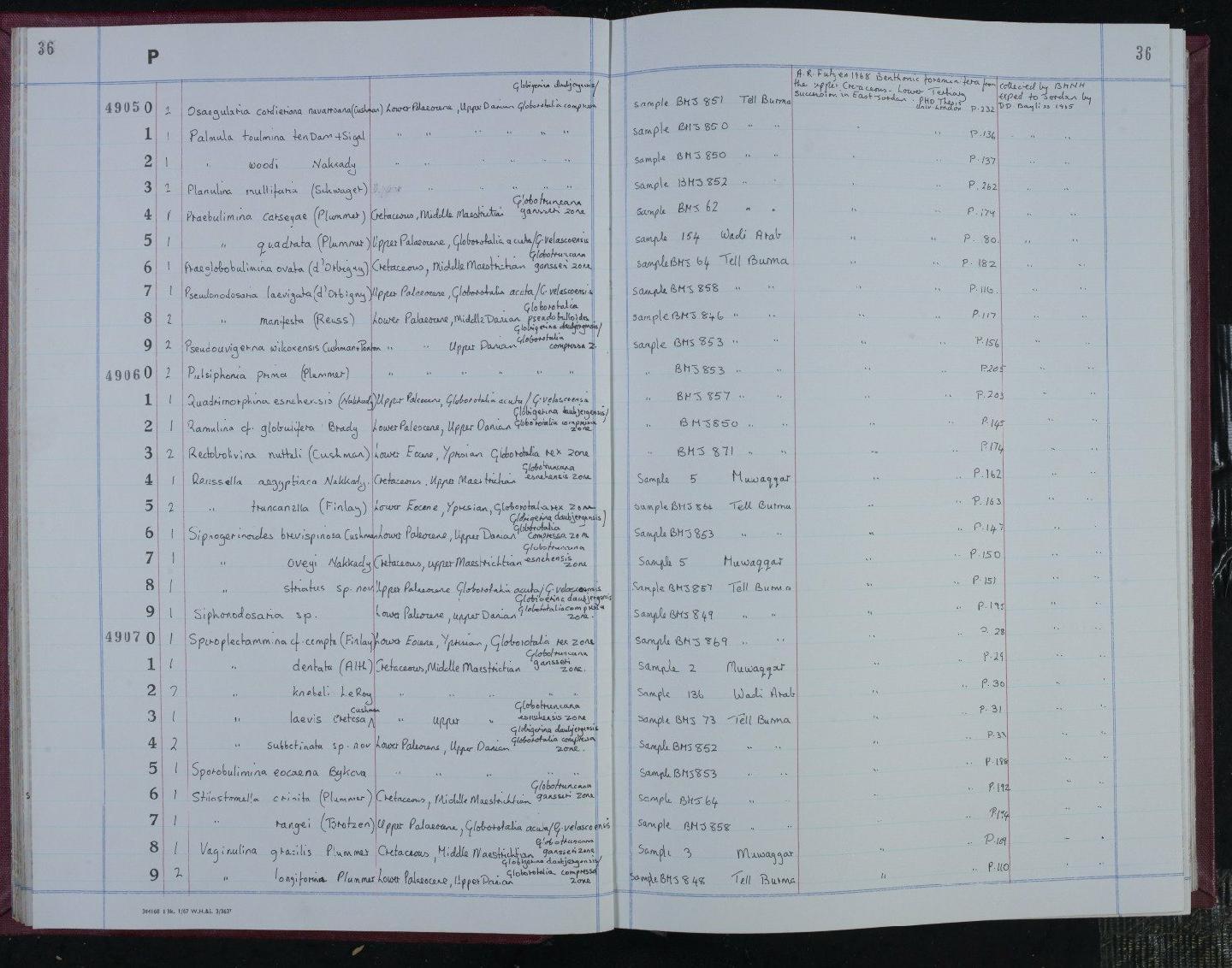
Derek Bayliss · CC0 · via GBIF. May be a photograph of a specimen, or an artist’s reconstruction — an interpretation of a skeleton, since colour and soft tissue are almost never preserved.
On record
Recorded, not inferred- Sits inside
- VaginulinidaePBDB
- Diet
- omnivorePBDB, for Foraminifera
- Life habit
- semi-infaunalPBDB, for Foraminifera
- Motility
- stationaryPBDB, for Foraminifera
Time the record covers
At least 151 million years on record.
The record covers at least 192.9 Mya to 41.03 Mya. No occurrence read is dated outside 199.5 Mya to 37.71 Mya.
136 occurrences of Palmula on record, most of them in the Middle Jurassic. Bar height is expected occurrences, not a count: each fossil is spread across the span it is dated to, so a tall narrow bar means tight dating and a low wide one means loose.
When
136 occurrences- Early Jurassic27%
- Middle Jurassic35%
- Late Jurassic5%
- Early Cretaceousunder 1%
- Late Cretaceous28%
- Paleocene3%
- Eocene1%
These are dates about fossils, not the animal: the record can only begin after it arose and end before it died out, so either end may reach further. Shares are expected occurrences: a fossil dated to a span is counted partly in each period it straddles. More on what this infers.
Found in
11 formations
- El Haria Formation25
- Roca Formation · Malargüe Group6
- Kahuitara Tuff Formation · Pitt Island Group3
- Chenaibo Formation · Middle Yezo Group1
- fahdène Formation1
- Renggeri-Ton Formation1
Loading coastlines…
The named rock units Palmula has been recovered from, largest first. Drawn where the rock is now, not where it formed. 94 occurrences have no formation on record, which is common for older literature.
Palmula and its relatives
Middle JurassicWhere Palmula and its relatives were recorded in the Middle Jurassic.
Found in the same rock
401 taxa- Lenticulina76 sites
- Nodosaria58 sites
- Astacolus54 sites
- Gaudryina53 sites
- Saracenaria53 sites
- Cristellaria (Marginulina)43 sites
- Eoguttulina41 sites
- Frondicularia37 sites
- Textularia37 sites
- Dentalina35 sites
- Laevidentalina34 sites
- Vaginulina33 sites
- Citharina32 sites
- Lenticulina munsteri30 sites
- Lingulina30 sites
- Pseudoglandulina29 sites
- Anomalinoides acuta27 sites
- Gyroidinoides27 sites
- Anomalinoides26 sites
- Cibicidoides25 sites
- Coryphostoma25 sites
- Praebulimina25 sites
- Anomalinoides welleri24 sites
- Gyroidinoides subangulata24 sites
The Paleobiology Database records 88 sites for Palmula, and this reads all of them. The number is how many of those sites it was catalogued from too. The 24 sharing the most are listed.
This is not a list of everything alive at the time. It is only what has come out of the same ground as this animal and been written down.
Entered from
16 references- Benthic foraminifers and palaeoenvironment in the Lower and Middle Jurassic of the Western Basque-Cantabrian Basin (Northern Spain)79
- The Late Campian and Maastrichtian in northwestern Tunisia: palaeoenvironmental inferences from lithology, macrofauna and benthic formainifera25
- Foraminiferal assemblages of the uppermost Oxfordian and Lower Kimmeridgian of the Wielun Upland and their stratigraphic importance6
- Micropaleontología del Paleoceno de General Roca (provincia de Río Negro)6
- Biostratigraphie, Fauna und Mikropaläontologie des Untertoarcium-Profiles von Unterstürmig (Oberfranken, Süddeutschland)4
- Palaeoceanographic events in the Middle Cenomanian of northwest Europe3
- Cretaceous-Cenozoic geology and biostratigraphy of the Chatham Islands, New Zealand3
- Benthic foraminifera and biostratigraphy of the Middle–Upper Eocene transition at Wadi Hitan area, Fayum, Egypt2
- Early Jurassic coral reef development outside Tethys: an example from western Argentina1
- A new elasmosaurid (Sauropterygia, Plesiosauria) from the upper levels of the La Colonia Formation (upper Maastrichtian), Chubut Province, Argentina1
- Elasmobranchs from the upper Paleocene of Togo1
- Plesiosaurs from the Upper Cretaceous (Cenomanian-Turonian) Tropic Shale of southern Utah, part 2: Polycotylidae1
Each of the 136 occurrences read was entered from one of these publications, ordered by how many each accounts for. This is not a search for papers mentioning the name. 4 further references are not listed. Entries link to doi.org where the Paleobiology Database holds an identifier, and to its own record where it does not. Relayed as the Paleobiology Database holds them, not checked against what they resolve to.
Media and terms
Media content1
Picture of Palmula
- Source
- GBIF
- Credit
- Derek Bayliss
- Licence
- CC0
- Commercial use
- the licence allows it
No 3D scan of Palmula was found in Sketchfab.
Smithsonian Open Access and MorphoSource were not reached for this taxon, so this list is what the others held rather than everything there is.
The description on this site
- Source
- Wikipedia, “Palmula”
- Licence
- CC BY-SA 4.0
This is what the site found, which is not the same as what exists.
Keep going
What may have been alongside itVaginulinidae through timeFormations of the Middle JurassicThe world it lived on
Occurrence data from the Paleobiology Database, CC BY 4.0. Lea 1833