Ortalis
Chachalacas are galliform birds from the genus Ortalis. These birds are found in wooded habitats in the far southern United States (Texas), Mexico, and Central and South America. They are social, can be very noisy and often remain fairly common even near humans, as their relatively small size makes them less desirable to hunters than their larger relatives. As agricultural pests, they have a ravenous appetite for tomatoes, melons, beans, and radishes and can ravage a small garden in short order. They travel in packs of six to twelve. Their nests are made of sticks, twigs, leaves, or moss and are generally frail, flat structures only a few feet above the ground. During April, they lay from three to five buffy white eggs, the shell of which is very rough and hard. They somewhat resemble the guans, and the two have commonly been placed in a subfamily together, though the chachalacas are probably closer to the curassows.

Fernando Flores from Caracas, Venezuela · CC BY-SA 2.0 · via Wikipedia/Commons. May be a photograph of a specimen, or an artist’s reconstruction — an interpretation of a skeleton, since colour and soft tissue are almost never preserved.
On record
Recorded, not inferred- Also called
- chachalacaPBDB
- Sits inside
- CracidaePBDB
- Diet
- frugivorePBDB, for Cracidae
- Life habit
- volantPBDB, for Cracidae
- Motility
- actively mobilePBDB, for Theropoda
- Environment
- terrestrialPBDB, for Cracidae
Time the record covers
At least 18 million years on record.
The record covers at least 18.5 Mya to 11.7 ka. No occurrence read is dated outside 23.1 Mya to 0 Mya.
7 occurrences of Ortalis on record, most of them in the Miocene. The Paleobiology Database records this as a living group. Bar height is expected occurrences, not a count: each fossil is spread across the span it is dated to, so a tall narrow bar means tight dating and a low wide one means loose.
When
7 occurrencesThese are dates about fossils, not the animal: the record can only begin after it arose and end before it died out, so either end may reach further. Shares are expected occurrences: a fossil dated to a span is counted partly in each period it straddles. More on what this infers.
Found in
4 formations
- Ogallala Formation1
- Pungo River Formation1
- Marsland Formation · Hemingford Group1
- Batesland Formation1
Loading coastlines…
The named rock units Ortalis has been recovered from, largest first. Drawn where the rock is now, not where it formed. 3 occurrences have no formation on record, which is common for older literature.
Ortalis and its relatives
MioceneWhere Ortalis and its relatives were recorded in the Miocene.
Found in the same rock
404 taxa- Accipitridae2 sites
- Archaeolaginae2 sites
- Camelidae2 sites
- Canidae2 sites
- Marmotini2 sites
- Abertella aberta1 site
- Accipiter striatus1 site
- Acris1 site
- Actinocyclus1 site
- Actinocyclus ingens1 site
- Actinocyclus octonarius1 site
- Actinocyclus tenellus1 site
- Actinoptychus marylandicus1 site
- Actinoptychus senarius1 site
- Actinoptychus virginicus1 site
- Aetobatus1 site
- Aletomeryx1 site
- Alopias superciliosus1 site
- Alopias vulpinus1 site
- Aluterus1 site
- Amazona1 site
- Amazona albifrons1 site
- Amblystoma1 site
- Amblystoma maculatum1 site
The Paleobiology Database records 5 sites for Ortalis, and this reads all of them. The number is how many of those sites it was catalogued from too. The 24 sharing the most are listed.
This is not a list of everything alive at the time. It is only what has come out of the same ground as this animal and been written down.
Entered from
5 references- Prehistoric exploitation of birds on the Pacific coast of Chiapas, Mexico3
- Miocene and Pliocene birds from the Lee Creek Mine, North Carolina1
- Systematics and faunal analysis of a Lower Pliocene vertebrate assemblage from Trego County, Kansas1
- An avifauna from the lower Miocene of South Dakota1
- A fossil gallinaceous bird from the Lower Miocene of Nebraska1
Each of the 7 occurrences read was entered from one of these publications, ordered by how many each accounts for. This is not a search for papers mentioning the name. Entries link to doi.org where the Paleobiology Database holds an identifier, and to its own record where it does not. Relayed as the Paleobiology Database holds them, not checked against what they resolve to.
Media and terms
Media content3
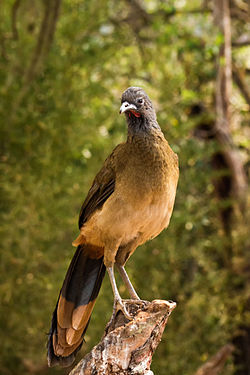
Picture of Ortalis
- Source
- Wikipedia/Commons
- Credit
- Fernando Flores from Caracas, Venezuela
- Licence
- CC BY-SA 2.0
- Commercial use
- the licence allows it
CT scan
- Source
- MorphoSource
- Licence
- In Copyright
- Commercial use
- cannot be read from the licence given — check the record
- Specimen
- Ortalis motmot motmot · YPM:VZ:YPM ORN 137598
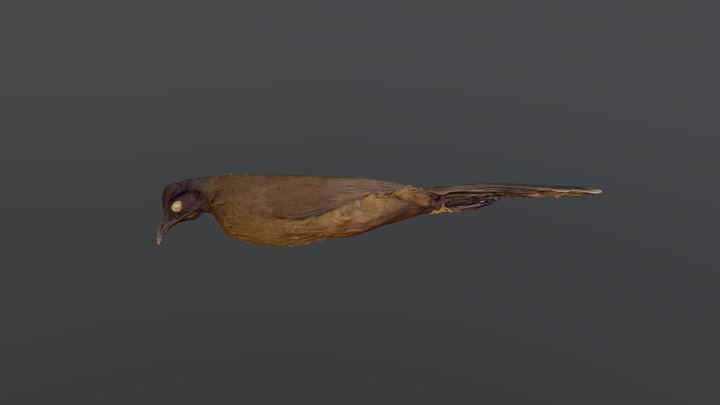
Smithsonian Open Access was not reached for this taxon, so this list is what the others held rather than everything there is.
The description on this site
- Source
- Wikipedia, “Chachalaca”
- Licence
- CC BY-SA 4.0
This is what the site found, which is not the same as what exists.
Keep going
What may have been alongside itCracidae through timeFormations of the MioceneThe world it lived on
Occurrence data from the Paleobiology Database, CC BY 4.0. Merrem 1786