Ophthalmosaurus
Ophthalmosaurus is a genus of ichthyosaur known from the Middle-Late Jurassic. Possible remains from the earliest Cretaceous are also known. It was a relatively medium-sized ichthyosaur, measuring 4 m (13 ft) long and weighing 940 kg (2,070 lb). Named for its extremely large eyes, it had a jaw containing many small but robust teeth. Major fossil finds of this genus have been recorded in Europe with a second species possibly being found in North America.

User:Captmondo · CC BY-SA 3.0 · via Wikipedia/Commons. May be a photograph of a specimen, or an artist’s reconstruction — an interpretation of a skeleton, since colour and soft tissue are almost never preserved.
On record
Recorded, not inferred- Sits inside
- OphthalmosaurinaePBDB
- Diet
- carnivorePBDB, for Ichthyosauria
- Life habit
- nektonicPBDB, for Ichthyopterygia
- Motility
- actively mobilePBDB, for Ichthyosauria
- Environment
- marinePBDB, for Ichthyosauria
- Length
- 6 mWikidata
Time the record covers
At least 37 million years on record.
The record covers at least 174.7 Mya to 137.05 Mya. No occurrence read is dated outside 201.4 Mya to 132.6 Mya.
27 occurrences of Ophthalmosaurus on record, most of them in the Late Jurassic. Bar height is expected occurrences, not a count: each fossil is spread across the span it is dated to, so a tall narrow bar means tight dating and a low wide one means loose.
When
27 occurrencesThese are dates about fossils, not the animal: the record can only begin after it arose and end before it died out, so either end may reach further. Shares are expected occurrences: a fossil dated to a span is counted partly in each period it straddles. More on what this infers.
Found in
5 formations
- Oxford Clay Formation · Ancholme Group7
- Sundance Formation4
- Vaca Muerta Formation4
- Spilsby Sandstone Formation1
- La Caja Formation1
Loading coastlines…
The named rock units Ophthalmosaurus has been recovered from, largest first. Drawn where the rock is now, not where it formed. 10 occurrences have no formation on record, which is common for older literature.
Ophthalmosaurus and its relatives
Late JurassicWhere Ophthalmosaurus and its relatives were recorded in the Late Jurassic.
Found in the same rock
96 taxa- Muraenosaurus leedsii4 sites
- Neusticemys neuquina4 sites
- Plesiosauria4 sites
- Pliosauridae4 sites
- Cryptoclidus eurymerus3 sites
- Geosaurus3 sites
- Liopleurodon ferox3 sites
- Peloneustes philarchus3 sites
- Thalattosuchus superciliosus3 sites
- Ammonitida2 sites
- Elasmosauridae2 sites
- Eurysternum neuquinum2 sites
- Machimosaurus hugii2 sites
- Metriorhynchus2 sites
- Metriorhynchus moreli2 sites
- Neosteneosaurus edwardsi2 sites
- Notoemys laticentralis2 sites
- Pliosaurus grandis2 sites
- Pterosauria2 sites
- Sauropoda2 sites
- Steneosaurus2 sites
- Aspidorhynchidae1 site
- Asteracanthus1 site
- Asteracanthus ornatissimus1 site
The Paleobiology Database records 26 sites for Ophthalmosaurus, and this reads all of them. The number is how many of those sites it was catalogued from too. The 24 sharing the most are listed.
This is not a list of everything alive at the time. It is only what has come out of the same ground as this animal and been written down.
Entered from
23 references- Late Jurassic ichthyosaurs from the Neuquen Basin, Argentina2
- Mesozoic marine reptiles of Russia and other former Soviet republics2
- Tithonian marine reptiles of the Eastern Pacific2
- The stratigraphic distribution and preservation of fossil vertebrates in the Oxford Clay of England2
- On the Upper Jurassic ichthyosaur remains from the Russian north1
- New ophthalmosaurid ichthyosaurs from the European Lower Cretaceous demonstrate extensive ichthyosaur survival across the Jurassic–Cretaceous boundary1
- [The first find of fragments of skeleton ichthyosaurus Jasykovia in Valanginian Crimea] translated from Russia: ПЕРВАЯ НАХОДКА ФРАГМЕНТОВ СКЕЛЕТА ИХТИОЗАВРА РОДА JASYKOVIA В ВАЛАНЖИНЕ КРЫМA1
- A plesiosaur containing an ichthyosaur embryo as stomach contents from the Sundance Formation of the Bighorn Basin, Wyoming1
- Alfred Leeds fossil vertebrate collection of the National Museum of Ireland - Natural History1
- A new Tithonian (Upper Jurassic) marine vertebrate concentration Lagerstätte in north-eastern Mexico1
- Jurassic marine reptiles of the Neuquen Basin: records, faunas, and their palaeobiogeographic significance1
- Gastric contents of an ichthyosaur from the Sundance Formation (Jurassic) of Central Wyoming1
Each of the 27 occurrences read was entered from one of these publications, ordered by how many each accounts for. This is not a search for papers mentioning the name. 11 further references are not listed. Entries link to doi.org where the Paleobiology Database holds an identifier, and to its own record where it does not. Relayed as the Paleobiology Database holds them, not checked against what they resolve to.
Media and terms
Media content3
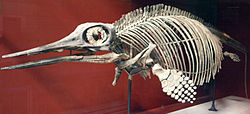
Picture of Ophthalmosaurus
- Source
- Wikipedia/Commons
- Credit
- User:Captmondo
- Licence
- CC BY-SA 3.0
- Commercial use
- the licence allows it
Photogrammetry
- Source
- MorphoSource
- Licence
- not stated by the source
- Commercial use
- cannot be read from the licence given — check the record
- Specimen
- Ophthalmosaurus icenicus · nhmuk:pal:PV R 389
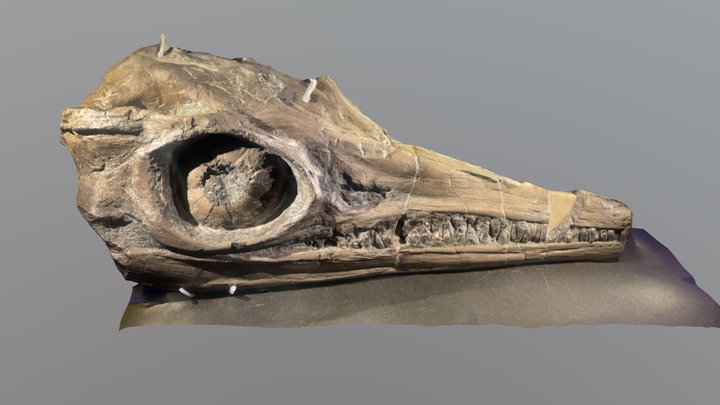
3D model
- Source
- Sketchfab
- Credit
- Tavernier Amaury
- Licence
- CC Attribution-NonCommercial-ShareAlike
- Commercial use
- the licence does not allow it
The description on this site
- Licence
- CC BY-SA 4.0
This is what the site found, which is not the same as what exists.
Keep going
What may have been alongside itOphthalmosaurinae through timeFormations of the Late JurassicThe world it lived on
Occurrence data from the Paleobiology Database, CC BY 4.0. Seeley 1874