Olcostephanus (Olcostephanus)
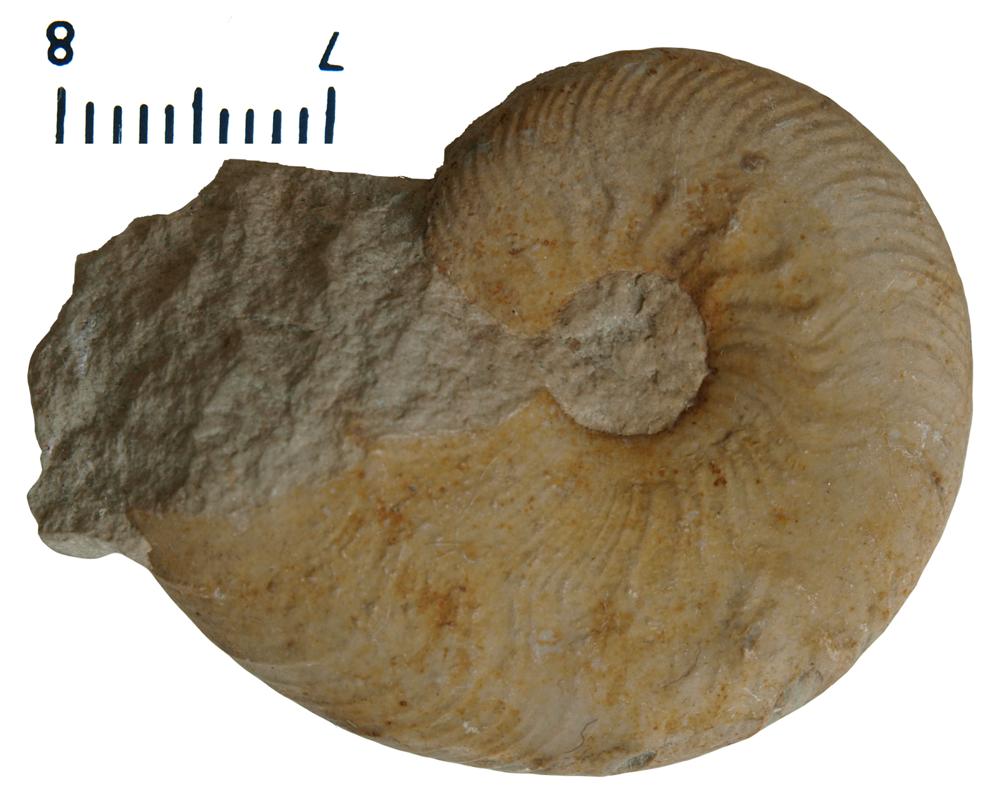
Wahl · CC BY-NC 4.0 · via GBIF. May be a photograph of a specimen, or an artist’s reconstruction — an interpretation of a skeleton, since colour and soft tissue are almost never preserved.
On record
Recorded, not inferred- Sits inside
- OlcostephanusPBDB
- Diet
- carnivorePBDB, for Ammonoidea
- Life habit
- nektonicPBDB, for Ammonoidea
- Motility
- fast-movingPBDB, for Ammonoidea
- Vision
- well-developedPBDB, for Cephalopoda
- Environment
- marinePBDB, for Cephalopoda
Time the record covers
At most 12 million years on record.
Every occurrence read is dated to somewhere between 137.05 Mya and 125.77 Mya, and nothing in the dating separates them, so that window is what the record shows rather than a span.
182 occurrences of Olcostephanus (Olcostephanus) on record, most of them in the Early Cretaceous. Bar height is expected occurrences, not a count: each fossil is spread across the span it is dated to, so a tall narrow bar means tight dating and a low wide one means loose.
When
182 occurrences- Early Cretaceous100%
These are dates about fossils, not the animal: the record can only begin after it arose and end before it died out, so either end may reach further. Shares are expected occurrences: a fossil dated to a span is counted partly in each period it straddles. More on what this infers.
Found in
15 formations
- Agrio Formation28
- Bersek Marl Formation11
- Maiolica Formation7
- Taraises Formation5
- Biancone Formation4
- Giumal Formation · Lagudarsi Group4
Loading coastlines…
The named rock units Olcostephanus (Olcostephanus) has been recovered from, largest first. Drawn where the rock is now, not where it formed. 109 occurrences have no formation on record, which is common for older literature.
Olcostephanus (Olcostephanus) and its relatives
Early CretaceousWhere Olcostephanus (Olcostephanus) and its relatives were recorded in the Early Cretaceous.
Found in the same rock
180 taxa- Neolissoceras grasianum86 sites
- Phyllopachyceras winkleri74 sites
- Bochianites neocomiensis60 sites
- Lytoceras57 sites
- Euphylloceras thetys52 sites
- Neocomites32 sites
- Neocomites (Teschenites)27 sites
- Oosterella25 sites
- Himantoceras21 sites
- Neocomites (Teschenites) subpachydicranus21 sites
- Crioceratites19 sites
- Teschenites subflucticulus19 sites
- Criosarasinella16 sites
- Criosarasinella furcillata16 sites
- Neocomites neocomiensis16 sites
- Phyllopachyceras infundibulum16 sites
- Oosterella cultrata15 sites
- Lytoceras subfimbriatum14 sites
- Oosterella gaudryi14 sites
- Eulytoceras lepidum13 sites
- Phylloceras13 sites
- Neocomites (Neocomites) praediscus12 sites
- Oosterella cultrataeformis12 sites
- Criosarasinella mandovi11 sites
The Paleobiology Database records 164 sites for Olcostephanus (Olcostephanus), and this reads all of them. The number is how many of those sites it was catalogued from too. The 24 sharing the most are listed.
This is not a list of everything alive at the time. It is only what has come out of the same ground as this animal and been written down.
Entered from
26 references- L'évolution des ammonites du Valanginien-Hauterivien inférieur du bassin Vocontien et de la plate-form Provençale (sud-est de la France): relations avec la stratigraphie séquentielle et implications biostratigraphiques82
- Lower Cretaceous ammonites from the Neuquén Basin, Argentina: a Hauterivian Olcostephanus fauna25
- Valanginian (Early Cretaceous ) ammonite faunas from the western High Atlas, Morocco, and the recognition of western Mediterranean 'standard' zones13
- Integrated Lower Cretaceous biostratigraphy of the Bersek Quarry, Gerecse Mountains, Transdanubian Range. Hungary11
- Valanginian and early Hauterivian ammonite successions in the Mt Catria group (Central Apennines) and the Lessini Mts (Southern Alps), Italy11
- Early Crioceratites (heteromorphic ammonites) from the lower Hauterivian of south-eastern France: systematics, intraspecific variation and biostratigraphic implications5
- Ammonoid and foraminiferal biostratigraphy from uppermost Valanginian to lowermost Barremian of the Jebel Boulahouajeb section (northern Tunisia)4
- Biostratigraphic implication of Olcostephanus Neumayr, 1875 (Ammonoidea) from the Lower Cretaceous Giumal Formation, Spiti Valley, Tethys Himalaya, India4
- Valanginian ammonite biostratigraphy of the La Peña del Águila section, Zacatecas State, northern Mexico3
- Le Crétacé inférieur de l'arc subalpin de Castellane entre l'Asse et le Var: Stratigraphy et Sédimentologie3
- The first definite record of a Valanginian ichthyosaur and its implications on the evolution of post-Liassic Ichthyosauria2
- Oosterella (Ammonoidea) from the Taraises Formation (Upper Valanginian), Durango, northeast Mexico2
Each of the 182 occurrences read was entered from one of these publications, ordered by how many each accounts for. This is not a search for papers mentioning the name. 14 further references are not listed. Entries link to doi.org where the Paleobiology Database holds an identifier, and to its own record where it does not. Relayed as the Paleobiology Database holds them, not checked against what they resolve to.
Media and terms
Media content1
Picture of Olcostephanus (Olcostephanus)
- Source
- GBIF
- Credit
- Wahl
- Licence
- CC BY-NC 4.0
- Commercial use
- the licence does not allow it
No 3D scan was found. Smithsonian Open Access, MorphoSource and Sketchfab were all searched.
This is what the site found, which is not the same as what exists.
Keep going
What may have been alongside itOlcostephanus through timeFormations of the Early CretaceousThe world it lived on
Occurrence data from the Paleobiology Database, CC BY 4.0. Neumayr 1875