Nettapus
Pygmy geese are a group of very small "perching ducks" in the genus Nettapus which breed in the Old World tropics. They are the smallest of all wildfowl. As the "perching ducks" are a paraphyletic group, they need to be placed elsewhere. The initially assumed relationship with the dabbling duck subfamily Anatinae has been questioned, and it appears they form a lineage in an ancient Gondwanan radiation of waterfowl, within which they are of unclear affinities. An undescribed fossil species from the late Hemphillian of Jalisco, central Mexico, has also been identified from the distal end of a tarsometatarsus. It is only record of the genus in the New World.

Duncan Wright · CC BY-SA 3.0 · via Wikipedia/Commons. May be a photograph of a specimen, or an artist’s reconstruction — an interpretation of a skeleton, since colour and soft tissue are almost never preserved.
On record
Recorded, not inferred- Sits inside
- AnatidaePBDB
- Diet
- herbivorePBDB, for Anseriformes
- Life habit
- volantPBDB, for Anseriformes
- Motility
- actively mobilePBDB, for Theropoda
- Environment
- terrestrialPBDB, for Theropoda
Time the record covers
At most 1.8 million years on record.
The one occurrence read is dated to somewhere between 5.333 Mya and 3.6 Mya, which is a dating window rather than a span.
1 occurrence of Nettapus on record, most of them in the Pliocene. The Paleobiology Database records this as a living group, and the chart stops with its fossils rather than at the present. Bar height is expected occurrences, not a count: each fossil is spread across the span it is dated to, so a tall narrow bar means tight dating and a low wide one means loose.
When
1 occurrences- Pliocene100%
These are dates about fossils, not the animal: the record can only begin after it arose and end before it died out, so either end may reach further. Shares are expected occurrences: a fossil dated to a span is counted partly in each period it straddles. More on what this infers.
Found in
1 formation
Loading coastlines…
The named rock units Nettapus has been recovered from, largest first. Drawn where the rock is now, not where it formed.
Nettapus and its relatives
PlioceneWhere Nettapus and its relatives were recorded in the Pliocene.
Found in the same rock
34 taxa- Agamidae1 site
- Anhinga1 site
- Cereopsis1 site
- Chelodina (Chelodina)1 site
- Crocodyloidea1 site
- Crustacea1 site
- Cygnus atratus1 site
- Dendrocygna arcuata1 site
- Diprotodontidae1 site
- Egretta picata1 site
- Elapidae1 site
- Ephippiorhynchus asiaticus1 site
- Euryzygoma1 site
- Koobor1 site
- Latagallina naracoortensis1 site
- Macropodidae1 site
- Macropus dryas1 site
- Macropus woodsi1 site
- Morelia1 site
- Numenius1 site
- Perameles allinghamensis1 site
- Phalacrocorax sulcirostris1 site
- Phascolonus lemleyi1 site
- Phoenicopterus ruber1 site
The Paleobiology Database records 1 site for Nettapus, and this reads all of them. The number is how many of those sites it was catalogued from too. The 24 sharing the most are listed.
This is not a list of everything alive at the time. It is only what has come out of the same ground as this animal and been written down.
Entered from
1 referenceEach of the 1 occurrence read was entered from one of these publications, ordered by how many each accounts for. This is not a search for papers mentioning the name. Each entry links to the Paleobiology Database's own record for the work.
Media and terms
Media content1
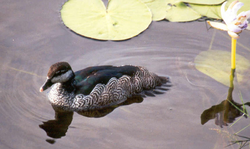
Picture of Nettapus
- Source
- Wikipedia/Commons
- Credit
- Duncan Wright
- Licence
- CC BY-SA 3.0
- Commercial use
- the licence allows it
No 3D scan of Nettapus was found in Sketchfab.
Smithsonian Open Access and MorphoSource were not reached for this taxon, so this list is what the others held rather than everything there is.
The description on this site
- Source
- Wikipedia, “Pygmy goose”
- Licence
- CC BY-SA 4.0
This is what the site found, which is not the same as what exists.
Keep going
What may have been alongside itAnatidae through timeFormations of the PlioceneThe world it lived on
Occurrence data from the Paleobiology Database, CC BY 4.0. Brandt 1836