Metriacanthosauridae
Metriacanthosauridae is an extinct family of allosauroid theropod dinosaurs that lived in Europe and Asia from the Middle Jurassic to the Early Cretaceous. The family is split into two subgroups: Metriacanthosaurinae, which includes dinosaurs closely related to Metriacanthosaurus, and another group composed of the close relatives of Yangchuanosaurus. Metriacanthosaurids are considered carnosaurs, belonging to the Allosauroidea superfamily. The group includes species of large range in body size. Of their physical traits, most notable are their neural spines. The records of the group are mostly confined to Asia, though Metriacanthosaurus is known from Europe. Metriacanthosauridae is used as a senior synonym of Sinraptoridae.

Ian Armstrong from Travelling the world at moment, Australia · CC BY-SA 2.0 · via Wikipedia/Commons. May be a photograph of a specimen, or an artist’s reconstruction — an interpretation of a skeleton, since colour and soft tissue are almost never preserved.
On record
Recorded, not inferred- Sits inside
- AllosauroideaPBDB
- Diet
- carnivorePBDB, for Theropoda
- Life habit
- ground dwelling, solitaryPBDB, for Theropoda
- Motility
- actively mobilePBDB, for Theropoda
- Environment
- terrestrialPBDB, for Theropoda
Time the record covers
At least 67 million years on record.
The record covers at least 168.2 Mya to 100.5 Mya. No occurrence read is dated outside 174.7 Mya to 93.9 Mya.
23 occurrences of Metriacanthosauridae on record, most of them in the Early Cretaceous. Bar height is expected occurrences, not a count: each fossil is spread across the span it is dated to, so a tall narrow bar means tight dating and a low wide one means loose.
When
23 occurrencesThese are dates about fossils, not the animal: the record can only begin after it arose and end before it died out, so either end may reach further. Shares are expected occurrences: a fossil dated to a span is counted partly in each period it straddles. More on what this infers.
Found in
13 formations
- Shaximiao Formation · Chongqing Group4
- Baharîje Formation3
- Shishugou Formation2
- Phu Kradung Formation · Khorat Group2
- Sao Khua Formation · Khorat Group1
- Oxford Clay Formation · Ancholme Group1
Loading coastlines…
The named rock units Metriacanthosauridae has been recovered from, largest first. Drawn where the rock is now, not where it formed. 3 occurrences have no formation on record, which is common for older literature.
Metriacanthosauridae and its relatives
Early CretaceousWhere Metriacanthosauridae and its relatives were recorded in the Early Cretaceous.
Found in the same rock
112 taxa- Erectopus superbus5 sites
- Sauropoda4 sites
- Erectopus sauvagei3 sites
- Hybodus2 sites
- Mamenchisauridae2 sites
- Pervushovisaurus campylodon2 sites
- Plesiosauria2 sites
- Testudinata2 sites
- Theropoda2 sites
- Yangchuanosaurus shangyouensis2 sites
- Abrosaurus dongpoensis1 site
- Acrodus1 site
- Acrolamna acuminata1 site
- Actinopterygii1 site
- Aegyptosaurus1 site
- Agilisaurus louderbacki1 site
- Alpkarakush kyrgyzicus1 site
- Analong chuanjieensis1 site
- Angustinaripterus longicephalus1 site
- Annemys1 site
- Azhdarchoidea1 site
- Bashuchelys1 site
- Bashuchelys youngi1 site
- Basilochelys macrobios1 site
The Paleobiology Database records 23 sites for Metriacanthosauridae, and this reads all of them. The number is how many of those sites it was catalogued from too. The 24 sharing the most are listed.
This is not a list of everything alive at the time. It is only what has come out of the same ground as this animal and been written down.
Entered from
20 references- Ergebnisse der Forschungsreisen Prof. E. Stromers in den Wüsten Ägyptens. II. Wirbeltierreste der Baharîje-Stufe (unterstes Cenoman). 13. Dinosauria [Results of the expeditions of Professor E. Stromer in the Egyptian deserts. II. Vertebrate animal remains from the Baharîje bed (lowest Cenomanian). 13. Dinosauria]3
- Recherches sur les reptiles trouvés dans le Gault de l'est du bassin de Paris [Research on the reptiles found in the Gault of the eastern Paris Basin]2
- A new metriacanthosaurid theropod dinosaur from the Middle Jurassic of Yunnan Province, China1
- A new theropod dinosaur from the Callovian Balabansai Formation of Kyrgyzstan1
- A Jurassic Tibetan theropod tooth reveals dental convergency and its implication for identifying fragmentary fossils1
- Preliminary note on a small ornithopod dinosaur from the Phu Kradung Formation (terminal Jurassic–basal Cretaceous) of Phu Noi, north-eastern Thailand1
- A new theropod dinosaur from the Middle Jurassic of Lufeng, Yunnan, China1
- The presence of a gigantic theropod in the Jurassic Shishugou Formation, Junggar Basin, western China1
- A sinraptorid theropod from Thailand1
- The earliest known tyrannosaur from the Lower Cretaceous of Thailand1
- [A new species of sauropod, Mamenchisaurus anyuensis sp. nov.]1
- A new carnosaur (Dinosauria, Theropoda) from the Jurassic of Xinjiang, People's Republic of China1
Each of the 23 occurrences read was entered from one of these publications, ordered by how many each accounts for. This is not a search for papers mentioning the name. 8 further references are not listed. Entries link to doi.org where the Paleobiology Database holds an identifier, and to its own record where it does not. Relayed as the Paleobiology Database holds them, not checked against what they resolve to.
Media and terms
Media content1
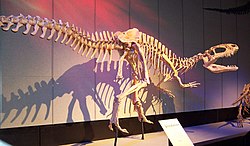
Picture of Metriacanthosauridae
- Source
- Wikipedia/Commons
- Credit
- Ian Armstrong from Travelling the world at moment, Australia
- Licence
- CC BY-SA 2.0
- Commercial use
- the licence allows it
No 3D scan of Metriacanthosauridae was found in MorphoSource and Sketchfab.
Smithsonian Open Access was not reached for this taxon, so this list is what the others held rather than everything there is.
The description on this site
- Licence
- CC BY-SA 4.0
This is what the site found, which is not the same as what exists.
Keep going
What may have been alongside itAllosauroidea through timeFormations of the Early CretaceousThe world it lived on
Occurrence data from the Paleobiology Database, CC BY 4.0. Carrano et al. 2012