Mesocyon
Mesocyon is an extinct genus of the Hesperocyoninae subfamily of early canids native to North America. It lived from the Oligocene to Early Miocene, 30.3—20.3 Ma, existing for approximately 10 million years. Fossils are known from Oregon, southern California and the northern Great Plains. It was roughly coyote-sized, and the first known canid to have a primarily meat-based diet.

Ted Fremd · Public Domain · via Wikipedia/Commons. May be a photograph of a specimen, or an artist’s reconstruction — an interpretation of a skeleton, since colour and soft tissue are almost never preserved.
On record
Recorded, not inferred- Sits inside
- HesperocyoninaePBDB
- Diet
- carnivore, omnivorePBDB, for Canidae
- Life habit
- ground dwellingPBDB, for Canidae
- Motility
- actively mobilePBDB, for Osteichthyes
- Environment
- terrestrialPBDB, for Eutheria
Time the record covers
At least 13 million years on record.
The record covers at least 31.8 Mya to 18.5 Mya. No occurrence read is dated outside 33.9 Mya to 16.3 Mya.
31 occurrences of Mesocyon on record, most of them in the Oligocene. Bar height is expected occurrences, not a count: each fossil is spread across the span it is dated to, so a tall narrow bar means tight dating and a low wide one means loose.
When
31 occurrencesThese are dates about fossils, not the animal: the record can only begin after it arose and end before it died out, so either end may reach further. Shares are expected occurrences: a fossil dated to a span is counted partly in each period it straddles. More on what this infers.
Found in
7 formations
- Brule Formation10
- John Day Formation7
- Sharps Formation6
- Sespe Formation2
- White River Formation1
- Otay Formation1
Loading coastlines…
The named rock units Mesocyon has been recovered from, largest first. Drawn where the rock is now, not where it formed. 3 occurrences have no formation on record, which is common for older literature.
Mesocyon and its relatives
OligoceneWhere Mesocyon and its relatives were recorded in the Oligocene.
Found in the same rock
201 taxa- Capacikala gradatus7 sites
- Leptauchenia decora7 sites
- Miohippus5 sites
- Palaeocastor5 sites
- Palaeolagus philoi5 sites
- Archaeocyon leptodus4 sites
- Cormocyon copei4 sites
- Daphoenus4 sites
- Megalagus primitivus4 sites
- Miohippus equiceps4 sites
- Nanotragulus loomisi4 sites
- Oreodontoides oregonensis4 sites
- Palaeolagus hypsodus4 sites
- Allomys3 sites
- Archaeotherium3 sites
- Archaeotherium caninus3 sites
- Cynarctoides lemur3 sites
- Cynodesmus thooides3 sites
- Diceratherium3 sites
- Eporeodon occidentalis3 sites
- Leidymys3 sites
- Nimravus brachyops3 sites
- Ocajila3 sites
- Paciculus3 sites
The Paleobiology Database records 30 sites for Mesocyon, and this reads all of them. The number is how many of those sites it was catalogued from too. The 24 sharing the most are listed.
This is not a list of everything alive at the time. It is only what has come out of the same ground as this animal and been written down.
Entered from
7 references- Phylogenetic systematics of the Hesperocyoninae (Carnivora: Canidae)21
- Revised chronostratigraphy and biostratigraphy of the John Day Formation (Turtle Cove and Kimberly Members), Oregon, with implications for updated calibration of the Arikareean North American land mammal age5
- Postcrania and locomotor function of Mesocyon coryphaeus (Canidae, Carnivora) from the Arikareean of North America1
- Fossil dogs (Carnivora, Canidae) from the Sespe and Vaqueros formations in Southern California, with comments on relationships of Phlaocyon taylori1
- John Day Basin paleontology field trip guide and road log: Society of Vertebrate Paleontology1
- A contribution to the Tertiary geology and paleontology of northeastern Colorado1
- An upper Oligocene mammalian fauna from southern California1
Each of the 31 occurrences read was entered from one of these publications, ordered by how many each accounts for. This is not a search for papers mentioning the name. Entries link to doi.org where the Paleobiology Database holds an identifier, and to its own record where it does not. Relayed as the Paleobiology Database holds them, not checked against what they resolve to.
Media and terms
Media content2

Picture of Mesocyon
- Source
- Wikipedia/Commons
- Credit
- Ted Fremd
- Licence
- Public Domain
- Commercial use
- the licence allows it
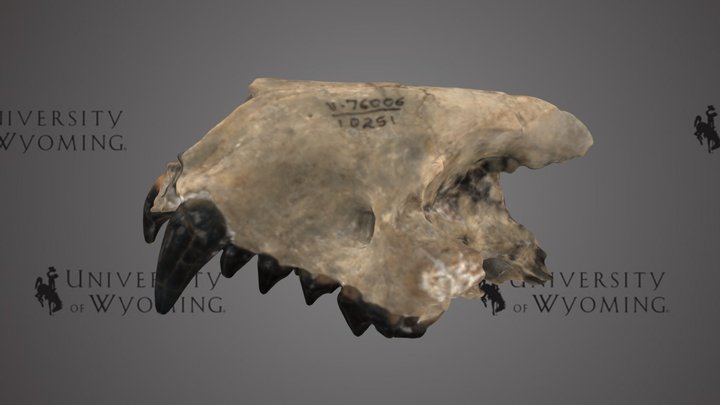
3D model
- Source
- Sketchfab
- Licence
- CC Attribution-NonCommercial
- Commercial use
- the licence does not allow it
Smithsonian Open Access and MorphoSource were not reached for this taxon, so this list is what the others held rather than everything there is.
The description on this site
- Source
- Wikipedia, “Mesocyon”
- Licence
- CC BY-SA 4.0
This is what the site found, which is not the same as what exists.
Keep going
What may have been alongside itHesperocyoninae through timeFormations of the OligoceneThe world it lived on
Occurrence data from the Paleobiology Database, CC BY 4.0. Scott 1890