Nimravus brachyops
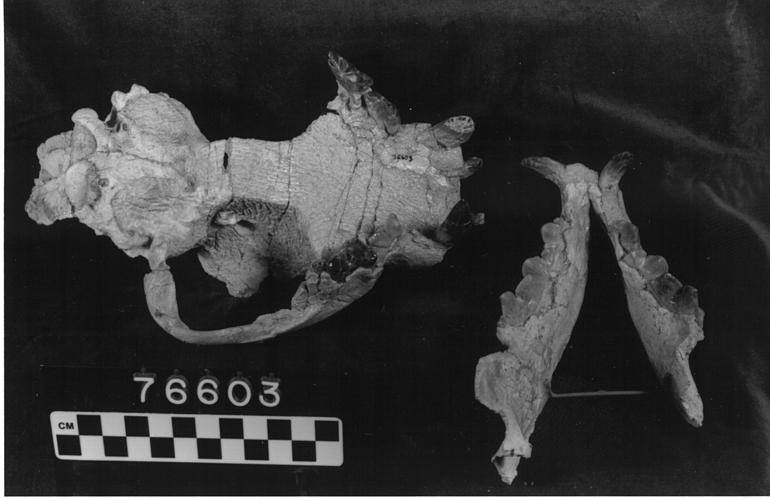
via iDigBio · via iDigBio. May be a photograph of a specimen, or an artist’s reconstruction — an interpretation of a skeleton, since colour and soft tissue are almost never preserved.
On record
Recorded, not inferred- Sits inside
- NimravusPBDB
- Diet
- carnivorePBDB, for Nimravidae
- Life habit
- ground dwellingPBDB, for Nimravidae
- Motility
- actively mobilePBDB, for Osteichthyes
- Environment
- terrestrialPBDB, for Eutheria
Time the record covers
At most 14 million years on record.
Every occurrence read is dated to somewhere between 31.8 Mya and 18.5 Mya, and nothing in the dating separates them, so that window is what the record shows rather than a span.
14 occurrences of Nimravus brachyops on record, most of them in the Oligocene. Bar height is expected occurrences, not a count: each fossil is spread across the span it is dated to, so a tall narrow bar means tight dating and a low wide one means loose.
When
14 occurrencesThese are dates about fossils, not the animal: the record can only begin after it arose and end before it died out, so either end may reach further. Shares are expected occurrences: a fossil dated to a span is counted partly in each period it straddles. More on what this infers.
Found in
5 formations
Loading coastlines…
The named rock units Nimravus brachyops has been recovered from, largest first. Drawn where the rock is now, not where it formed. 3 occurrences have no formation on record, which is common for older literature.
Nimravus brachyops and its relatives
OligoceneWhere Nimravus brachyops and its relatives were recorded in the Oligocene.
Found in the same rock
152 taxa- Miohippus6 sites
- Eporeodon occidentalis5 sites
- Agriochoerus guyotianus4 sites
- Archaeotherium4 sites
- Capacikala gradatus4 sites
- Daphoenus4 sites
- Hypertragulus hesperius4 sites
- Cormocyon copei3 sites
- Diceratherium3 sites
- Diceratherium annectens3 sites
- Diceratherium armatum3 sites
- Enhydrocyon stenocephalus3 sites
- Leptauchenia major3 sites
- Mesocyon brachyops3 sites
- Phlaocyon latidens3 sites
- Rhizocyon oregonensis3 sites
- Temnocyon altigenis3 sites
- Allocyon loganensis2 sites
- Allomys2 sites
- Alwoodia magna2 sites
- Archaeocyon pavidus2 sites
- Archaeotherium caninus2 sites
- Cynarctoides lemur2 sites
- Entelodontidae2 sites
The Paleobiology Database records 14 sites for Nimravus brachyops, and this reads all of them. The number is how many of those sites it was catalogued from too. The 24 sharing the most are listed.
This is not a list of everything alive at the time. It is only what has come out of the same ground as this animal and been written down.
Entered from
7 references- Revised chronostratigraphy and biostratigraphy of the John Day Formation (Turtle Cove and Kimberly Members), Oregon, with implications for updated calibration of the Arikareean North American land mammal age4
- Review of the Miocene Wounded Knee faunas of southwestern South Dakota4
- The species of Nimravus (Carnivora, Felidae)2
- Magnetostratigraphy and paleontology of Wagner Quarry, (late Oligocene, early Arikareean) basal Arikaree Group of the Pine Ridge region, Dawes County, Nebraska1
- A new species of Nimravus from the upper Oligocene of South Dakota1
- An upper Oligocene mammalian fauna from southern California1
- Observations on the faunae of the Miocene Tertiaries of Oregon1
Each of the 14 occurrences read was entered from one of these publications, ordered by how many each accounts for. This is not a search for papers mentioning the name. Entries link to doi.org where the Paleobiology Database holds an identifier, and to its own record where it does not. Relayed as the Paleobiology Database holds them, not checked against what they resolve to.
Media and terms
Media content2
Picture of Nimravus brachyops
- Source
- iDigBio
- Credit
- via iDigBio
- Licence
- not stated by the source
- Commercial use
- cannot be read from the licence given — check the record
Laser scan
- Source
- MorphoSource
- Licence
- not stated by the source
- Commercial use
- cannot be read from the licence given — check the record
- Specimen
- Nimravus brachyops · LACM:9384
This is what the site found, which is not the same as what exists.
Keep going
What may have been alongside itNimravus through timeFormations of the OligoceneThe world it lived on
Occurrence data from the Paleobiology Database, CC BY 4.0. (Cope 1878)