Mesochelydia
Mesochelydia is a clade within Pantestudines, more inclusive than Perichelydia, but less than Testudinata. The clade is known from the Early Jurassic to the Present, and contains all Jurassic representatives of Testudinata aside from Australochelys. The ancestral condition for Mesochelydia is thought to be aquatic, as opposed to terrestrial for Testudinata. They are distinguished from more basal testudinatans by the presence of the following characters: strap like pectoral girdle, supramarginals absent, reduced posterior entoplastral process, eleven pairs of peripherals, elongate processus interfenestralis, paired basioccipital tubercles, fully formed cavum tympani and antrum postoticum, single vomer, confluent external nares, lacrimals and supratemporals absent.

Uncredited · via Wikipedia/Commons. May be a photograph of a specimen, or an artist’s reconstruction — an interpretation of a skeleton, since colour and soft tissue are almost never preserved.
On record
Recorded, not inferred- Sits inside
- TestudinataPBDB
- Motility
- actively mobilePBDB, for Osteichthyes
- Environment
- terrestrialPBDB, for Diapsida
Time the record covers
At least 49 million years on record.
The record covers at least 192.9 Mya to 143.1 Mya. No occurrence read is dated outside 201.4 Mya to 121.4 Mya.
20 occurrences of Mesochelydia on record, most of them in the Early Jurassic. Bar height is expected occurrences, not a count: each fossil is spread across the span it is dated to, so a tall narrow bar means tight dating and a low wide one means loose.
When
20 occurrencesThese are dates about fossils, not the animal: the record can only begin after it arose and end before it died out, so either end may reach further. Shares are expected occurrences: a fossil dated to a span is counted partly in each period it straddles. More on what this infers.
Found in
6 formations
- Kayenta Formation · Glen Canyon Group12
- Cañadón Asfalto Formation · Sierra de Olte Group3
- Kota Formation · Gondwana Group2
- Moskovoretskaya Formation1
- Kilmaluag Formation · Great Estuarine Group1
- Batylykh Formation · Sangar Group1
Loading coastlines…
The named rock units Mesochelydia has been recovered from, largest first. Drawn where the rock is now, not where it formed.
Mesochelydia and its relatives
Early JurassicWhere Mesochelydia and its relatives were recorded in the Early Jurassic.
Found in the same rock
127 taxa- Kayentachelys10 sites
- Scutellosaurus lawleri10 sites
- Ornithischia6 sites
- Theropoda6 sites
- Archosauria5 sites
- Kayentatherium4 sites
- Scutellosaurus4 sites
- Tritylodontidae4 sites
- Caudata3 sites
- Condorchelys antiqua3 sites
- Dinnebitodon3 sites
- Oligokyphus3 sites
- Syntarsus kayentakatae3 sites
- Testudines3 sites
- Anura2 sites
- Crocodylomorpha2 sites
- Cteniogenys2 sites
- Dilophosaurus wetherilli2 sites
- Dinosauria2 sites
- Heterodontosauridae2 sites
- Hybodus2 sites
- Indochelys spatulata2 sites
- Lepidotes2 sites
- Picea2 sites
The Paleobiology Database records 18 sites for Mesochelydia, and this reads all of them. The number is how many of those sites it was catalogued from too. The 24 sharing the most are listed.
This is not a list of everything alive at the time. It is only what has come out of the same ground as this animal and been written down.
Entered from
10 references- Fossil Vertebrate Collections10
- Contribution to the diversity of the fossil record of turtles (Testudinidata) from Chubut province (Argentina) and its significance in understanding the evolution of turtles in southern South America2
- A reevaluation of the basal turtle Indochelys spatulata from the Early–Middle Jurassic (Toarcian–Aalenian) of India, with descriptions of new material1
- Basal turtle material from the Lower Cretaceous of Yakutia (Russia) filling the gap in the Asian record1
- A new stem turtle from the Middle Jurassic of Scotland: new insights into the evolution and palaeoecology of basal turtles1
- A new, nearly complete stem turtle from the Jurassic of South America with implications for turtle evolution1
- An archaic turtle, Heckerochelys romani gen. et sp. nov. from the Middle Jurassic of Moscow region, Russia1
- The first Jurassic turtle from India1
- Modern turtle origins: The oldest known cryptodire1
- Vertebrate biostratigraphy of the Glen Canyon Group in northern Arizona1
Each of the 20 occurrences read was entered from one of these publications, ordered by how many each accounts for. This is not a search for papers mentioning the name. Entries link to doi.org where the Paleobiology Database holds an identifier, and to its own record where it does not. Relayed as the Paleobiology Database holds them, not checked against what they resolve to.
Media and terms
Media content1
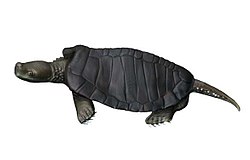
Picture of Mesochelydia
- Source
- Wikipedia/Commons
- Credit
- nobody named on the record
- Licence
- not stated by the source
- Commercial use
- cannot be read from the licence given — check the record
No 3D scan of Mesochelydia was found in Sketchfab.
Smithsonian Open Access and MorphoSource were not reached for this taxon, so this list is what the others held rather than everything there is.
The description on this site
- Licence
- CC BY-SA 4.0
This is what the site found, which is not the same as what exists.
Keep going
What may have been alongside itTestudinata through timeFormations of the Early JurassicThe world it lived on
Occurrence data from the Paleobiology Database, CC BY 4.0. Joyce 2017