Megaraptora
Megaraptora is a clade of carnivorous theropod dinosaurs. Its derived members, the Megaraptoridae are noted for their large hand claws and powerfully-built forelimbs, which are usually reduced in size in other large theropods.

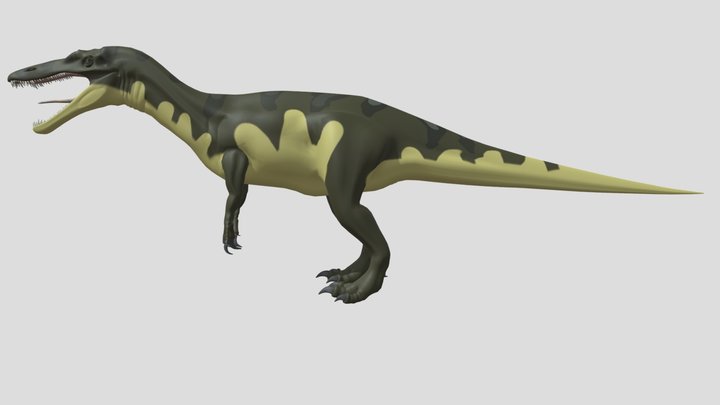
Rodolfo A. Coria, Philip J. Currie · CC BY 4.0 · via Wikipedia/Commons. May be a photograph of a specimen, or an artist’s reconstruction — an interpretation of a skeleton, since colour and soft tissue are almost never preserved.
On record
Recorded, not inferred- Sits inside
- CoelurosauriaPBDB
- Diet
- carnivorePBDB, for Coelurosauria
- Life habit
- ground dwelling, solitaryPBDB, for Theropoda
- Motility
- actively mobilePBDB, for Theropoda
- Environment
- terrestrialPBDB, for Theropoda
Time the record covers
At least 49 million years on record.
The record covers at least 121.4 Mya to 72.2 Mya. No occurrence read is dated outside 125.77 Mya to 66 Mya.
50 occurrences of Megaraptora on record, most of them in the Late Cretaceous. Bar height is expected occurrences, not a count: each fossil is spread across the span it is dated to, so a tall narrow bar means tight dating and a low wide one means loose.
When
50 occurrencesThese are dates about fossils, not the animal: the record can only begin after it arose and end before it died out, so either end may reach further. Shares are expected occurrences: a fossil dated to a span is counted partly in each period it straddles. More on what this infers.
Found in
21 formations
- "Wonthaggi" Formation · Strzelecki Group6
- Chorrillo Formation6
- Eumeralla Formation · Otway Group4
- Bajo de la Carpa Formation · Neuquén Group4
- Portezuelo Formation · Neuquén Group3
- Winton Formation · Rolling Downs Group3
Loading coastlines…
The named rock units Megaraptora has been recovered from, largest first. Drawn where the rock is now, not where it formed.
Megaraptora and its relatives
Late CretaceousWhere Megaraptora and its relatives were recorded in the Late Cretaceous.
Found in the same rock
238 taxa- Megaraptoridae17 sites
- Theropoda12 sites
- Abelisauridae7 sites
- Ornithopoda7 sites
- Iguanodontia5 sites
- Plesiosauria5 sites
- Pterosauria5 sites
- Actinopterygii4 sites
- Australovenator wintonensis4 sites
- Chelidae4 sites
- Dipnoi4 sites
- Titanosauria4 sites
- Atlascopcosaurus loadsi3 sites
- Dinosauria3 sites
- Maniraptora3 sites
- Megaraptor namunhuaiquii3 sites
- Testudines3 sites
- Ankylosauria2 sites
- Azhdarchoidea2 sites
- Bivalvia2 sites
- Brachyrostra2 sites
- Crocodylia2 sites
- Enantiornithes2 sites
- Galleonosaurus dorisae2 sites
The Paleobiology Database records 44 sites for Megaraptora, and this reads all of them. The number is how many of those sites it was catalogued from too. The 24 sharing the most are listed.
This is not a list of everything alive at the time. It is only what has come out of the same ground as this animal and been written down.
Entered from
41 references- The end of the dinosaur era in Patagonia (NatGeo Project)3
- Two new basal coelurosaurian theropod dinosaurs from the Lower Cretaceous Sao Khua Formation of Thailand3
- Evolutionary and paleobiogeographic implications of new carcharodontosaurian, megaraptorid, and unenlagiine theropod remains from the upper Lower Cretaceous of Victoria, southeast Australia2
- Megaraptorid (Theropoda: Tetanurae) partial skeletons from the Upper Cretaceous Bajo Barreal Formation of central Patagonia, Argentina: implications for the evolution of large body size in Gondwanan megaraptorans2
- New megaraptorid (Dinosauria: Theropoda) remains from the Lower Cretaceous Eumeralla Formation of Cape Otway, Victoria, Australia2
- Evolution of the carnivorous dinosaurs during the Cretaceous: The evidence from Patagonia2
- First record of Megaraptora (Theropoda, Neovenatoridae) from Brazil2
- Osteology of the wide-hipped titanosaurian sauropod dinosaur Savannasaurus elliottorum from the Upper Cretaceous Winton Formation of Queensland, Australia1
- New theropod (Tetanurae: Avetheropoda) material from the ‘mid’-Cretaceous Griman Greek Formation at Lightning Ridge, New South Wales, Australia1
- Paleontological discoveries in the Chorrillo Formation (upper Campanian-lower Maastrichtian, Upper Cretaceous), Santa Cruz Province, Patagonia, Argentina1
- A new megaraptoran theropod dinosaur from the Upper Cretaceous Bajo de la Carpa Formation of northwestern Patagonia1
- Ordenamiento y caracterización faunisitica del Cretacico superior del Grupo Chubut, Cuenca del Golfo San Jorge, Argentina1
Each of the 50 occurrences read was entered from one of these publications, ordered by how many each accounts for. This is not a search for papers mentioning the name. 29 further references are not listed. Entries link to doi.org where the Paleobiology Database holds an identifier, and to its own record where it does not. Relayed as the Paleobiology Database holds them, not checked against what they resolve to.
Media and terms
Media content3

Picture of Megaraptora
- Source
- Wikipedia/Commons
- Credit
- Rodolfo A. Coria, Philip J. Currie
- Licence
- CC BY 4.0
- Commercial use
- the licence allows it
Structured light scan
- Source
- MorphoSource
- Licence
- not stated by the source
- Commercial use
- cannot be read from the licence given — check the record
- Specimen
- Megaraptora indet. · nmv:p:208096
Smithsonian Open Access was not reached for this taxon, so this list is what the others held rather than everything there is.
The description on this site
- Source
- Wikipedia, “Megaraptora”
- Licence
- CC BY-SA 4.0
This is what the site found, which is not the same as what exists.
Keep going
What may have been alongside itCoelurosauria through timeFormations of the Late CretaceousThe world it lived on
Occurrence data from the Paleobiology Database, CC BY 4.0. Benson et al. 2010