Marmosa
The 29 species in the genus Marmosa are relatively small Neotropical members of the family Didelphidae. This genus is one of three that are known as mouse opossums. The others are Thylamys and Tlacuatzin, the grayish mouse opossum. Members of the genus Marmosops used to be called "slender mouse opossums", but are now just called "slender opossums". The thirteen members of the Marmosa subgenus Micoureus, known as woolly mouse opossums, were formerly considered to be a separate genus, but were moved into Marmosa in 2009. Based on a comparison of sequences of one mitochondrial and three nuclear genes, three new subgenera, Eomarmosa, Exulomarmosa and Stegomarmosa, were recognized by Voss et al. in 2014. Eomarmosa and Exulomarmosa, as well as Marmosa and Micoureus, are thought to be sister taxa, while Stegomarmosa is viewed as sister to Marmosa plus Micoureus. Exulomarmosa is a mostly trans-Andean clade.

Esteban Alzate · CC BY-SA 2.5 · via Wikipedia/Commons. May be a photograph of a specimen, or an artist’s reconstruction — an interpretation of a skeleton, since colour and soft tissue are almost never preserved.
On record
Recorded, not inferred- Also called
- mouse opossumPBDB
- Sits inside
- MarmosiniPBDB
- Diet
- carnivorePBDB
- Life habit
- scansorialPBDB, for Didelphidae
- Motility
- actively mobilePBDB, for Osteichthyes
- Environment
- terrestrialPBDB, for Marmosinae
Time the record covers
At least 10 million years on record.
The record covers at least 11 Mya to 11.7 ka. No occurrence read is dated outside 13.8 Mya to 0 Mya.
22 occurrences of Marmosa on record. The Paleobiology Database records this as a living group. Bar height is expected occurrences, not a count: each fossil is spread across the span it is dated to, so a tall narrow bar means tight dating and a low wide one means loose.
When
22 occurrences- Miocene9%
- Pliocene9%
- Pleistocene36%
- Holocene45%
These are dates about fossils, not the animal: the record can only begin after it arose and end before it died out, so either end may reach further. Shares are expected occurrences: a fossil dated to a span is counted partly in each period it straddles. More on what this infers.
Found in
4 formations
Loading coastlines…
The named rock units Marmosa has been recovered from, largest first. Drawn where the rock is now, not where it formed. 18 occurrences have no formation on record, which is common for older literature.
Found in the same rock
337 taxa- Cuniculus paca5 sites
- Oryzomys5 sites
- Pecari tajacu5 sites
- Didelphis marsupialis4 sites
- Puma yagouaroundi4 sites
- Sylvilagus brasiliensis4 sites
- Tayassu pecari4 sites
- Artibeus jamaicensis3 sites
- Conepatus3 sites
- Dasypus (Dasypus) novemcinctus3 sites
- Eira barbara3 sites
- Lagidium peruanum3 sites
- Leopardus pardalis3 sites
- Myotis3 sites
- Pseudoryzomys simplex3 sites
- Puma concolor3 sites
- Sciurus3 sites
- Tapirus3 sites
- Akodon cursor2 sites
- Alouatta seniculus2 sites
- Calomys callosus2 sites
- Catonyx cuvieri2 sites
- Cavia2 sites
- Coendou prehensilis2 sites
The Paleobiology Database records 16 sites for Marmosa, and this reads all of them. The number is how many of those sites it was catalogued from too. The 24 sharing the most are listed.
This is not a list of everything alive at the time. It is only what has come out of the same ground as this animal and been written down.
Entered from
17 references- Central Amazonian Forests and the Minimum Crtical Size of Ecosystems Project3
- Faunal remains3
- La Faune Pleistocene du Piaui (Nordeste du Bresil): Implications Paleoecologiques et Biochronologiques2
- A new species of Marmosa (Mammalia, Didelphimorphia, Didelphidae) from Parque Nacional del Río Abiseo, Peru.1
- New records of marsupials from the Miocene of Western Amazonia, Acre, Brazil1
- Diversidade de pequenos mamíferos (Didelphimorphia e Rodentia) do Holoceno do nordeste do estado do Rio Grande do Sul, Brasil: implicações taxonômicas e paleo ambientais1
- Quaternary mammals from Serra do Bodoquena, Mato Grosso do Sul, Brazil1
- A systematic reassessment and paleogeographic review of fossil Xenarthra from Peru1
- Barro Colorado Island and Tropical Biology1
- Pleistocene fauna of Early Ajuereado type from Cueva Blanca, Oaxaca1
- Geología y Paleontología de los sedimentos del Pleistoceno en el área de Punta Hermengo (Miramar, Prov. de Buenos Aires, Rep. Argentina): Aspectos paleoclimáticos1
- Sobre una colección de vertebrados fósiles de Monte Hermoso (Plioceno Superior), Argentina, con la descripción de una nueva especie de Marmosa (Marsupialia: Didelphidae)1
Each of the 22 occurrences read was entered from one of these publications, ordered by how many each accounts for. This is not a search for papers mentioning the name. 5 further references are not listed. Entries link to doi.org where the Paleobiology Database holds an identifier, and to its own record where it does not. Relayed as the Paleobiology Database holds them, not checked against what they resolve to.
Media and terms
Media content2
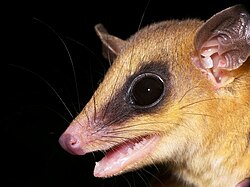
Picture of Marmosa
- Source
- Wikipedia/Commons
- Credit
- Esteban Alzate
- Licence
- CC BY-SA 2.5
- Commercial use
- the licence allows it
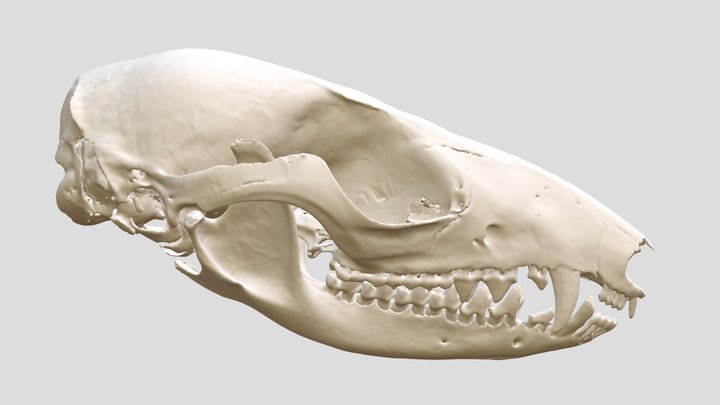
3D model
- Source
- Sketchfab
- Credit
- Biodiversity
- Licence
- CC Attribution
- Commercial use
- cannot be read from the licence given — check the record
Smithsonian Open Access and MorphoSource were not reached for this taxon, so this list is what the others held rather than everything there is.
The description on this site
- Source
- Wikipedia, “Marmosa”
- Licence
- CC BY-SA 4.0
This is what the site found, which is not the same as what exists.
Keep going
What may have been alongside itMarmosini through timeThe world it lived on
Occurrence data from the Paleobiology Database, CC BY 4.0. Gray 1821