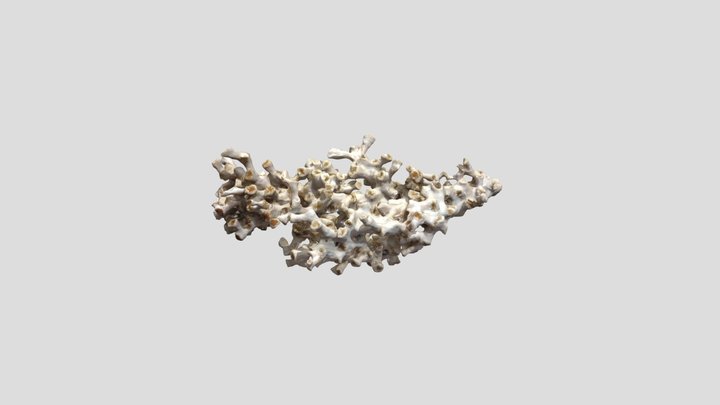
Lophelia pertusa

Uncredited · via Wikidata/Commons. May be a photograph of a specimen, or an artist’s reconstruction — an interpretation of a skeleton, since colour and soft tissue are almost never preserved.
On record
Recorded, not inferred- Sits inside
- LopheliaPBDB
- Diet
- suspension feederPBDB, for Lophelia
- Life habit
- colonial, clonal, depth=subthermoclinePBDB, for Lophelia
- Motility
- stationary, attachedPBDB, for Lophelia
- Vision
- blindPBDB, for Anthozoa
- Environment
- marinePBDB, for Lophelia
Time the record covers
At least 15 million years on record.
The record covers at least 15.98 Mya to 129 ka. No occurrence read is dated outside 20.45 Mya to 11.7 ka.
15 occurrences of Lophelia pertusa on record, most of them in the Pleistocene. The Paleobiology Database records this as a living group. Bar height is expected occurrences, not a count: each fossil is spread across the span it is dated to, so a tall narrow bar means tight dating and a low wide one means loose.
When
15 occurrences- Miocene13%
- Pleistocene87%
These are dates about fossils, not the animal: the record can only begin after it arose and end before it died out, so either end may reach further. Shares are expected occurrences: a fossil dated to a span is counted partly in each period it straddles. More on what this infers.
Found in
1 formation
Loading coastlines…
The named rock units Lophelia pertusa has been recovered from, largest first. Drawn where the rock is now, not where it formed. 14 occurrences have no formation on record, which is common for older literature.
Lophelia pertusa and its relatives
PleistoceneWhere Lophelia pertusa and its relatives were recorded in the Pleistocene.
Found in the same rock
75 taxa- Flabellum2 sites
- Madrepora oculata2 sites
- Ammonia1 site
- Argilloecia1 site
- Asperarca1 site
- Balanophyllia thalassae1 site
- Bathypsammia1 site
- Bigenerina1 site
- Bivalvia1 site
- Brizalina1 site
- Bulimina1 site
- Bulimina marginata1 site
- Bythocypris1 site
- Caryophyllia1 site
- Caryophyllia calveri1 site
- Caryophyllia smithii1 site
- Cassidulina1 site
- Ceratotrochus magnaghii1 site
- Cibicides1 site
- Cibicidoides1 site
- Conotrochus1 site
- Coralliophila1 site
- Cornuspira1 site
- Dendrophyllia1 site
The Paleobiology Database records 3 sites for Lophelia pertusa, and this reads all of them. The number is how many of those sites it was catalogued from too. The 24 sharing the most are listed.
This is not a list of everything alive at the time. It is only what has come out of the same ground as this animal and been written down.
Entered from
8 references- Pleistocene to recent scleractinian deep-water corals and coral facies in the eastern Mediterranean4
- Age constraints on the origin and growth history of a deep-water coral mound in the northeast Atlantic drilled during Integrated Ocean Drilling Program Expedition 3074
- Upper Pleistocene cold‑water corals from the Inner Sea of the Maldives: taphonomy and environment2
- Pleistocene (Calabrian) deep-water corals and associated biodiversity in the eastern Mediterranean (Karpathos Island, Greece)1
- Shallow-buried Pleistocene Madrepora-dominated coral mounds on a muddy continental slope, Tuscan Archipelago, NE Tyrrhenian Sea1
- Coral mounds on the West Florida slope; unanswered questions regarding the development of deep-water banks1
- Nuove osservazioni sulla corallofauna delle argille pleistoceniche di Archi (Reggio Calabria) [New observations of Pleistocene coral fauna from Archi (Calabria)]1
- Deep Sea Corals Collected by the Lamont Geological Observatory. 1 Atlantic Corals1
Each of the 15 occurrences read was entered from one of these publications, ordered by how many each accounts for. This is not a search for papers mentioning the name. Entries link to doi.org where the Paleobiology Database holds an identifier, and to its own record where it does not. Relayed as the Paleobiology Database holds them, not checked against what they resolve to.
Media and terms
Media content2
Picture of Lophelia pertusa
- Source
- Wikidata/Commons
- Credit
- nobody named on the record
- Licence
- not stated by the source
- Commercial use
- cannot be read from the licence given — check the record
Smithsonian Open Access was not reached for this taxon, so this list is what the others held rather than everything there is.
This is what the site found, which is not the same as what exists.
Keep going
What may have been alongside itLophelia through timeFormations of the PleistoceneThe world it lived on
Occurrence data from the Paleobiology Database, CC BY 4.0. (Linnaeus 1758)