Livyatan
Livyatan is an extinct genus of macroraptorial sperm whale, containing one known species: L. melvillei. The genus name was inspired by the biblical sea monster Leviathan, and the species name by Herman Melville, the author of the famous novel Moby-Dick about a white bull sperm whale. Herman Melville often referred to whales as "Leviathans" in his book. It is mainly known from the Pisco Formation of Peru during the Tortonian stage of the Miocene epoch, about 8.9–9.9 million years ago (mya); however, finds of isolated teeth from other locations such as Chile, Argentina, the United States (California), South Africa and Australia imply that either it or a close relative survived into the Pliocene, around 5 mya, and may have had a global presence.

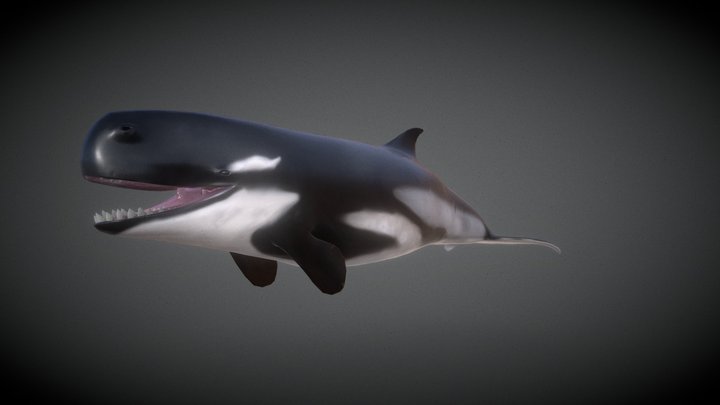
Ghedoghedo · CC BY-SA 4.0 · via Wikipedia/Commons. May be a photograph of a specimen, or an artist’s reconstruction — an interpretation of a skeleton, since colour and soft tissue are almost never preserved.
On record
Recorded, not inferred- Sits inside
- PhyseteroideaPBDB
- Diet
- carnivorePBDB, for Odontoceti
- Life habit
- aquatic, depth=surfacePBDB, for Cetacea
- Motility
- actively mobilePBDB, for Cetacea
- Environment
- marine,freshwaterPBDB, for Odontoceti
- Length
- 17.5 mWikidata
- Mass
- 57 tonneWikidata
Time the record covers
At least 6.2 million years on record.
The record covers at least 11.63 Mya to 5.333 Mya. No occurrence read is dated outside 23.04 Mya to 3.6 Mya.
6 occurrences of Livyatan on record, most of them in the Miocene. Bar height is expected occurrences, not a count: each fossil is spread across the span it is dated to, so a tall narrow bar means tight dating and a low wide one means loose.
When
6 occurrencesThese are dates about fossils, not the animal: the record can only begin after it arose and end before it died out, so either end may reach further. Shares are expected occurrences: a fossil dated to a span is counted partly in each period it straddles. More on what this infers.
Found in
6 formations
- Pisco Formation1
- Saladar Formation1
- Alexander Bay Formation1
- Bahía Inglesa Formation1
- Capistrano Formation1
- Varswater Formation1
Loading coastlines…
The named rock units Livyatan has been recovered from, largest first. Drawn where the rock is now, not where it formed.
Livyatan and its relatives
MioceneWhere Livyatan and its relatives were recorded in the Miocene.
Found in the same rock
95 taxa- Balaenopteridae3 sites
- Delphinidae3 sites
- Phalacrocorax3 sites
- Phocidae3 sites
- Physeteroidea3 sites
- Sula3 sites
- Carcharodon carcharias2 sites
- Carcharodon hastalis2 sites
- Cetotheriidae2 sites
- Myliobatidae2 sites
- Otodus megalodon2 sites
- Phocoenidae2 sites
- Pontoporiidae2 sites
- Alopias vulpinus1 site
- Antidorcas1 site
- Antilopini1 site
- Arctocephalus1 site
- Australithax1 site
- Balaenidae1 site
- Balaenoptera acutorostrata1 site
- Balistidae1 site
- Bathyergidae1 site
- Brachydelphis1 site
- Brachydelphis mazeasi1 site
The Paleobiology Database records 6 sites for Livyatan, and this reads all of them. The number is how many of those sites it was catalogued from too. The 24 sharing the most are listed.
This is not a list of everything alive at the time. It is only what has come out of the same ground as this animal and been written down.
Entered from
6 references- Gigantic Macroraptorial Sperm Whale Tooth From the Miocene of Orange County, California1
- Fossil cetaceans from Duinefontein (Koeberg) an early Pliocene site on the southwestern Cape, South Africa1
- Early Pliocene fossil cetaceans from Hondeklip Bay, Namaqualand, South Africa1
- First record of a macroraptorial sperm whale (Cetacea, Physeteroidea) from the Miocene of Argentina1
- New discoveries from the Bahia Inglesa Formation bonebed, a Late Miocene marine vertebrate assemblage from the Atacama Desert of Chile1
- The choristoderan reptile Monjurosuchus from the Early Cretaceous of Japan1
Each of the 6 occurrences read was entered from one of these publications, ordered by how many each accounts for. This is not a search for papers mentioning the name. Entries link to doi.org where the Paleobiology Database holds an identifier, and to its own record where it does not. Relayed as the Paleobiology Database holds them, not checked against what they resolve to.
Media and terms
Media content2

Picture of Livyatan
- Source
- Wikipedia/Commons
- Credit
- Ghedoghedo
- Licence
- CC BY-SA 4.0
- Commercial use
- the licence allows it
Smithsonian Open Access and MorphoSource were not reached for this taxon, so this list is what the others held rather than everything there is.
The description on this site
- Source
- Wikipedia, “Livyatan”
- Licence
- CC BY-SA 4.0
This is what the site found, which is not the same as what exists.
Keep going
What may have been alongside itPhyseteroidea through timeFormations of the MioceneThe world it lived on
Occurrence data from the Paleobiology Database, CC BY 4.0. Lambert et al. 2010