Linuparus
Linuparus, the spear lobsters, is a genus of medium-sized to large spiny lobsters in the family Palinuridae. It contains four extant species found at depths of 30–500 m (100–1,640 ft) in the Indo-Pacific, and 32 fossil species, ranging from the Early Cretaceous to the Oligocene. L. trigonus is the only extant species also known from the fossil record.

Andrey Butko · CC BY-SA 3.0 · via Wikipedia/Commons. May be a photograph of a specimen, or an artist’s reconstruction — an interpretation of a skeleton, since colour and soft tissue are almost never preserved.
On record
Recorded, not inferred- Sits inside
- PalinuridaePBDB
- Diet
- carnivorePBDB, for Decapoda
- Life habit
- epifaunalPBDB, for Palinuridae
- Motility
- actively mobilePBDB, for Malacostraca
- Vision
- well-developedPBDB, for Malacostraca
Time the record covers
At least 112 million years on record.
The record covers at least 119.57 Mya to 7.246 Mya. No occurrence read is dated outside 121.4 Mya to 5.333 Mya.
83 occurrences of Linuparus on record, most of them in the Late Cretaceous. The Paleobiology Database records this as a living group, and the chart stops with its fossils rather than at the present. Bar height is expected occurrences, not a count: each fossil is spread across the span it is dated to, so a tall narrow bar means tight dating and a low wide one means loose.
When
83 occurrences- Early Cretaceous9%
- Late Cretaceous75%
- Paleocene10%
- Eocene4%
- Oligoceneunder 1%
- Miocene1%
These are dates about fossils, not the animal: the record can only begin after it arose and end before it died out, so either end may reach further. Shares are expected occurrences: a fossil dated to a span is counted partly in each period it straddles. More on what this infers.
Found in
38 formations
- Bissekty Formation5
- Britton Formation · Eagle Ford Group4
- Krasnoyarka Formation4
- Ripley Formation3
- Eagle Ford Formation3
- Atherfield Clay Formation · Lower Greensand Group2
Loading coastlines…
The named rock units Linuparus has been recovered from, largest first. Drawn where the rock is now, not where it formed. 14 further formations hold fewer occurrences each and are not listed. 20 occurrences have no formation on record, which is common for older literature.
Linuparus and its relatives
Late CretaceousWhere Linuparus and its relatives were recorded in the Late Cretaceous.
Found in the same rock
760 taxa- Cenomanocarcinus vanstraeleni5 sites
- Inoceramus5 sites
- Ostrea5 sites
- Turritella5 sites
- Hoploparia4 sites
- Paraverrucoides alabamensis4 sites
- Protocallianassa mortoni4 sites
- Tetracarcinus subquadratus4 sites
- Enoploclytia3 sites
- Ferroranina dichrous3 sites
- Gyrodes3 sites
- Homarus brittonestris3 sites
- Homarus davisi3 sites
- Hoploparia gabbi3 sites
- Hoploparia stokesi3 sites
- Hoploparia tennesseensis3 sites
- Macroacaena tridens3 sites
- Meticonaxius rhacheochir3 sites
- Protocallianassa praecepta3 sites
- Pteria3 sites
- Raninella testacea3 sites
- Tellina3 sites
- Anatimya2 sites
- Baculites grandis2 sites
The Paleobiology Database records 58 sites for Linuparus, and this reads all of them. The number is how many of those sites it was catalogued from too. The 24 sharing the most are listed.
This is not a list of everything alive at the time. It is only what has come out of the same ground as this animal and been written down.
Entered from
45 references- Fossil Crustacea of the Atlantic and Gulf Coastal Plain14
- New Late Cretaceous lobsters from the Kyzylkum Desert of Uzbekistan7
- The Britton Notopocorystes Assemblage: An Eagle Ford Decapod Assemblage from the Cretaceous of North-Central Texas6
- Cretaceous and Eocene Decapod Crustaceans from Southern Vancouver Island, British Columbia Canada5
- Stratigraphy and fossil assemblages of the Upper Cretaceous system in the Makarov area, southern Sakhalin, Russian Far East4
- The fossil stalk-eyed Crustacea of the Pacific slope of North America4
- Late Cretaceous and Paleocene decapod crustaceans from James Ross Basin, Antarctic Peninsula3
- Decapod Crustaceans from the Cretaceous of Texas2
- Two new decapod species from the upper Cretaceous deposits of Hokkaido, Japan2
- Loerenthopluma danielae, A new crab (Decapoda, Brachyura, Retroplumidae) from the Lower Eocene of Northwest Belgium1
- Decapod crustaceans from the Paleocene of Central Texas, USA1
- New records of decapod macrurans from the Cretaceous of Catalonia and the Province of Castellon (Spain)1
Each of the 83 occurrences read was entered from one of these publications, ordered by how many each accounts for. This is not a search for papers mentioning the name. 33 further references are not listed. Entries link to doi.org where the Paleobiology Database holds an identifier, and to its own record where it does not. Relayed as the Paleobiology Database holds them, not checked against what they resolve to.
Media and terms
Media content2

Picture of Linuparus
- Source
- Wikipedia/Commons
- Credit
- Andrey Butko
- Licence
- CC BY-SA 3.0
- Commercial use
- the licence allows it
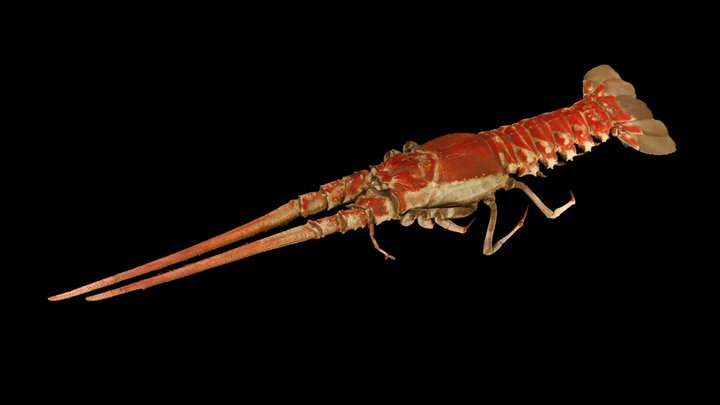
3D model
- Source
- Sketchfab
- Licence
- CC0 Public Domain
- Commercial use
- the licence allows it
Smithsonian Open Access was not reached for this taxon, so this list is what the others held rather than everything there is.
The description on this site
- Source
- Wikipedia, “Linuparus”
- Licence
- CC BY-SA 4.0
This is what the site found, which is not the same as what exists.
Keep going
What may have been alongside itPalinuridae through timeFormations of the Late CretaceousThe world it lived on
Occurrence data from the Paleobiology Database, CC BY 4.0. White 1847