Leptauchenia
Leptauchenia is an extinct goat-like genus of terrestrial herbivore belonging to the oreodont family Merycoidodontidae, and the type genus of the tribe Leptaucheniini. The genus was endemic to North America during the Late Oligocene to Early Miocene and lived for approximately 17.6 million years.

Ghedoghedo · CC BY-SA 3.0 · via Wikipedia/Commons. May be a photograph of a specimen, or an artist’s reconstruction — an interpretation of a skeleton, since colour and soft tissue are almost never preserved.
On record
Recorded, not inferred- Sits inside
- LeptaucheniinaePBDB
- Diet
- herbivorePBDB, for Merycoidodontidae
- Life habit
- ground dwellingPBDB, for Merycoidodontidae
- Motility
- actively mobilePBDB, for Osteichthyes
- Environment
- terrestrialPBDB, for Artiodactyla
Time the record covers
At least 7.1 million years on record.
The record covers at least 31.8 Mya to 24.7 Mya. No occurrence read is dated outside 33.9 Mya to 18.5 Mya.
188 occurrences of Leptauchenia on record, most of them in the Oligocene. Bar height is expected occurrences, not a count: each fossil is spread across the span it is dated to, so a tall narrow bar means tight dating and a low wide one means loose.
When
188 occurrencesThese are dates about fossils, not the animal: the record can only begin after it arose and end before it died out, so either end may reach further. Shares are expected occurrences: a fossil dated to a span is counted partly in each period it straddles. More on what this infers.
Found in
10 formations
- Brule Formation78
- Sharps Formation24
- Gering Formation23
- Harrison Formation · Arikaree Group4
- Deep River Formation2
- White River Formation1
Loading coastlines…
The named rock units Leptauchenia has been recovered from, largest first. Drawn where the rock is now, not where it formed. 52 occurrences have no formation on record, which is common for older literature.
Leptauchenia and its relatives
OligoceneWhere Leptauchenia and its relatives were recorded in the Oligocene.
Found in the same rock
266 taxa- Sespia nitida17 sites
- Mesoreodon minor14 sites
- Merycoidodon major13 sites
- Archaeocyon leptodus11 sites
- Nanotragulus loomisi10 sites
- Megoreodon grandis8 sites
- Capacikala gradatus7 sites
- Diceratherium annectens7 sites
- Hesperocyon gregarius7 sites
- Mesocyon temnodon7 sites
- Miniochoerus starkensis7 sites
- Palaeolagus hypsodus7 sites
- Palaeolagus philoi7 sites
- Desmatochoerus hatcheri6 sites
- Desmatochoerus megalodon6 sites
- Enhydrocyon pahinsintewakpa6 sites
- Miohippus6 sites
- Palaeocastor6 sites
- Castoridae5 sites
- Cynodesmus thooides5 sites
- Diceratherium armatum5 sites
- Hyaenodon5 sites
- Megalagus primitivus5 sites
- Merycoidodontidae5 sites
The Paleobiology Database records 138 sites for Leptauchenia, and this reads all of them. The number is how many of those sites it was catalogued from too. The 24 sharing the most are listed.
This is not a list of everything alive at the time. It is only what has come out of the same ground as this animal and been written down.
Entered from
25 references- The Phylogeny of the Oreodonts. Part 1: Merycoidodontinae, Eporeodontinae, and Leptaucheniinae, Three Subfamilies Of Oreodonts, With an Appendix to the Revision Of The Merycoidodontidae, and Part 2. Summary and Conclusions Concerning the Merycoidodontidae97
- Synonymies and reidentifications of North American fossil mammals50
- Stratigraphy and biostratigraphy of the eastern portion of the Wildcat Ridge, western Nebraska6
- Leptauchenia Leidy and Cyclopidius (Pithecistes) Cope, with descriptions of new and little known forms in the Marsh Collection6
- Review of the Miocene Wounded Knee faunas of southwestern South Dakota4
- Geology and paleontology of the Oligocene Harris Ranch Badlands, southwestern South Dakota3
- Contributions to the Stratigraphy and Palaeontology of the Goshen Hole Area, Wyoming. III. A New Basal Oligocene Formation3
- The mammalian fauna of the White River Oligocene; Part 4, Artiodactyla; Part 5, Perissodactyla2
- Magnetostratigraphy and paleontology of Wagner Quarry, (late Oligocene, early Arikareean) basal Arikaree Group of the Pine Ridge region, Dawes County, Nebraska1
- Biostratigraphy and biochronology of early Arikareean through late Hemingfordian small mammal faunas from the Nebraska Panhandle and adjacent areas1
- Chadron, Brule, and Arikaree Formations, North Dakota1
- The Whitneyan-Arikareean transition in the High Plains1
Each of the 188 occurrences read was entered from one of these publications, ordered by how many each accounts for. This is not a search for papers mentioning the name. 13 further references are not listed. Entries link to doi.org where the Paleobiology Database holds an identifier, and to its own record where it does not. Relayed as the Paleobiology Database holds them, not checked against what they resolve to.
Media and terms
Media content3
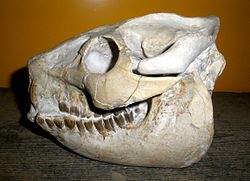
Picture of Leptauchenia
- Source
- Wikipedia/Commons
- Credit
- Ghedoghedo
- Licence
- CC BY-SA 3.0
- Commercial use
- the licence allows it
Laser scan
- Source
- MorphoSource
- Licence
- In Copyright
- Commercial use
- cannot be read from the licence given — check the record
- Specimen
- Leptauchenia decora · amnh:fm:627
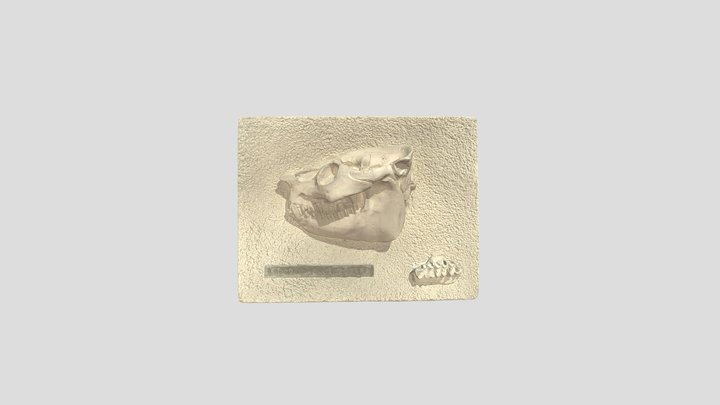
3D model
- Source
- Sketchfab
- Credit
- UIPaleoRepository
- Licence
- CC Attribution
- Commercial use
- cannot be read from the licence given — check the record
Smithsonian Open Access was not reached for this taxon, so this list is what the others held rather than everything there is.
The description on this site
- Licence
- CC BY-SA 4.0
This is what the site found, which is not the same as what exists.
Keep going
What may have been alongside itLeptaucheniinae through timeFormations of the OligoceneThe world it lived on
Occurrence data from the Paleobiology Database, CC BY 4.0. Leidy 1856