Lepidotrigla
Lepidotrigla is a genus of marine ray-finned fishes belonging to the family Triglidae, the gurnards and sea robins. These gurnards are found in the Eastern Atlantic, Indian and Western Pacific Oceans.

KayKayKnurrhahn · CC BY-SA 4.0 · via Wikipedia/Commons. May be a photograph of a specimen, or an artist’s reconstruction — an interpretation of a skeleton, since colour and soft tissue are almost never preserved.
On record
Recorded, not inferred- Sits inside
- TriglidaePBDB
- Diet
- carnivorePBDB, for Scorpaeniformes
- Life habit
- nektobenthicPBDB, for Scorpaeniformes
- Motility
- actively mobilePBDB, for Scorpaeniformes
Time the record covers
At least 40 million years on record.
The record covers at least 41.03 Mya to 129 ka. No occurrence read is dated outside 48.07 Mya to 11.7 ka.
19 occurrences of Lepidotrigla on record, most of them in the Oligocene. The Paleobiology Database records this as a living group. Bar height is expected occurrences, not a count: each fossil is spread across the span it is dated to, so a tall narrow bar means tight dating and a low wide one means loose.
When
19 occurrences- Eocene5%
- Oligocene43%
- Miocene36%
- Pleistocene16%
These are dates about fossils, not the animal: the record can only begin after it arose and end before it died out, so either end may reach further. Shares are expected occurrences: a fossil dated to a span is counted partly in each period it straddles. More on what this infers.
Found in
3 formations
Loading coastlines…
The named rock units Lepidotrigla has been recovered from, largest first. Drawn where the rock is now, not where it formed. 10 occurrences have no formation on record, which is common for older literature.
Lepidotrigla and its relatives
OligoceneWhere Lepidotrigla and its relatives were recorded in the Oligocene.
Found in the same rock
427 taxa- Argentina7 sites
- Gadidarum parvus7 sites
- Squalus alsaticus7 sites
- Brosmophycis6 sites
- Atlantoraja cecilae5 sites
- Diplacanthopoma5 sites
- Pontinus foreyi5 sites
- Diaphus4 sites
- Gadiculus argenteus4 sites
- Hoplobrotula4 sites
- Lesueurigobius4 sites
- Maurolicus muelleri4 sites
- Merluccius merluccius4 sites
- Physiculus huloti4 sites
- Trachurus4 sites
- Argentina sphyraena3 sites
- Arnoglossus kokeni3 sites
- Bregmaceros3 sites
- Cepola3 sites
- Dentex3 sites
- Dentex (Polysteganus) gregarius3 sites
- Dentex nobilis3 sites
- Gnathophis3 sites
- Hoplobrotula joachimica3 sites
The Paleobiology Database records 19 sites for Lepidotrigla, and this reads all of them. The number is how many of those sites it was catalogued from too. The 24 sharing the most are listed.
This is not a list of everything alive at the time. It is only what has come out of the same ground as this animal and been written down.
Entered from
11 references- Biostratigraphie et poissons fossiles de la formation de l'Argile de Boom (Oligocène moyen du Bassin Belge)7
- Les otolithes des téléostéens de l'oligo-miocène Belge3
- Fish otolith record reveals possible tropical-subtropical fish community in temperate Japan during the exceptionally warm Last Interglacial period1
- Fossil fish otoliths from the Chibanian Miyata Formation, Kanagawa Prefecture, Japan, with comments on the paleoenvironment1
- Fish otoliths from the pre-evaporitic (Early Messinian) sediments of northern Italy: their stratigraphic and palaeobiogeographic significance1
- The otoliths from the middle Eocene of Osteroden near Bramsche, north-western Germany1
- Pleistocene fish otoliths from the Mediterranean Basin: a synthesis1
- Otolithes de poissons du paléocanyon de saubrigues (chattien à langhien), aquitaine méridionale, France1
- Revision des otolithes de teleosteens du Tortonien stratotypique et de Montegibbio (Miocene Superieur d'Italie Septentrionale)1
- Les otholites de téléostéens des Marnes de Saubrigues (Miocène d'Aquitaine Méridionale, France)1
- Otoliti fossili terziari dell'Emilia1
Each of the 19 occurrences read was entered from one of these publications, ordered by how many each accounts for. This is not a search for papers mentioning the name. Entries link to doi.org where the Paleobiology Database holds an identifier, and to its own record where it does not. Relayed as the Paleobiology Database holds them, not checked against what they resolve to.
Media and terms
Media content3

Picture of Lepidotrigla
- Source
- Wikipedia/Commons
- Credit
- KayKayKnurrhahn
- Licence
- CC BY-SA 4.0
- Commercial use
- the licence allows it
CT scan
- Source
- MorphoSource
- Licence
- In Copyright
- Commercial use
- cannot be read from the licence given — check the record
- Specimen
- Lepidotrigla cavillone · UWFC:ADULT COLLECTION:UW 011510
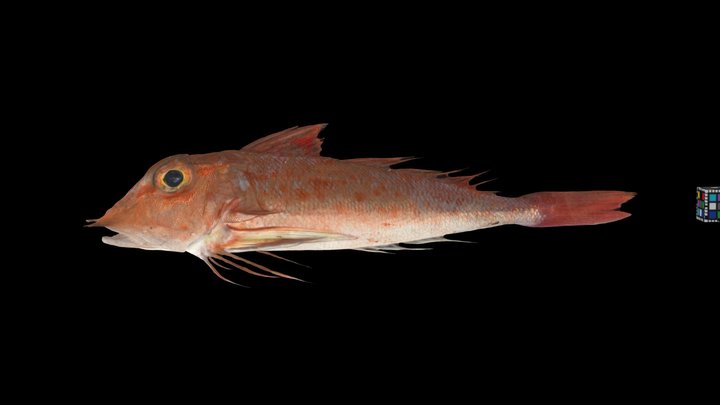
3D model
- Source
- Sketchfab
- Licence
- CC0 Public Domain
- Commercial use
- the licence allows it
Smithsonian Open Access was not reached for this taxon, so this list is what the others held rather than everything there is.
The description on this site
- Licence
- CC BY-SA 4.0
This is what the site found, which is not the same as what exists.
Keep going
What may have been alongside itTriglidae through timeFormations of the OligoceneThe world it lived on
Occurrence data from the Paleobiology Database, CC BY 4.0. Guenther 1860