Lepidotidae
Lepidotidae is an extinct family of fish, known from the Jurassic and Cretaceous periods. Most species were originally assigned to the genus Lepidotes which was long considered a wastebasket taxon. Cladistic analysis has indicated that they are close relatives of gars, with both being members of the order Lepisosteiformes. Members of the family are known from both marine and freshwater environments. Their bulky body morphology and small median fins suggests that they were slow-moving fish that were capable of performing fine movements in order to grasp prey. Lepidotes sensu stricto had peg-like grasping marginal teeth and crushing palatal teeth, and is known to have consumed small crustaceans, while Scheenstia had low rounded crushing marginal teeth, indicating a durophagous diet.

Anagoria · CC BY 3.0 · via Wikipedia/Commons. May be a photograph of a specimen, or an artist’s reconstruction — an interpretation of a skeleton, since colour and soft tissue are almost never preserved.
On record
Recorded, not inferred- Sits inside
- LepisosteiformesPBDB
- Diet
- carnivorePBDB, for Lepisosteiformes
- Life habit
- nektonicPBDB, for Lepisosteiformes
- Motility
- actively mobilePBDB, for Lepisosteiformes
- Environment
- freshwaterPBDB, for Lepisosteiformes
Time the record covers
At least 89 million years on record.
The record covers at least 182.9 Mya to 93.9 Mya. No occurrence read is dated outside 184.2 Mya to 89.8 Mya.
4 occurrences of Lepidotidae on record, most of them in the Middle Jurassic. Bar height is expected occurrences, not a count: each fossil is spread across the span it is dated to, so a tall narrow bar means tight dating and a low wide one means loose.
When
4 occurrencesThese are dates about fossils, not the animal: the record can only begin after it arose and end before it died out, so either end may reach further. Shares are expected occurrences: a fossil dated to a span is counted partly in each period it straddles. More on what this infers.
Found in
2 formations
Loading coastlines…
The named rock units Lepidotidae has been recovered from, largest first. Drawn where the rock is now, not where it formed. 1 occurrence has no formation on record, which is common for older literature.
Lepidotidae and its relatives
Middle JurassicWhere Lepidotidae and its relatives were recorded in the Middle Jurassic.
Found in the same rock
53 taxa- Ferganobatrachus riabinini2 sites
- Ferganoceratodus jurassicus2 sites
- Plantae2 sites
- Aidachar1 site
- Alectrosaurus1 site
- Amphilestidae1 site
- Amphitheriidae1 site
- Ankylosauridae1 site
- Aralobatrachus robustus1 site
- Aspidorhynchidae1 site
- Chengyuchelys latimarginalis1 site
- Chondrichthyes1 site
- Coelodiscus minutus1 site
- Daulestes inobservabilis1 site
- Docodonta1 site
- Eleganticeras elegantulum1 site
- Emausaurus ernsti1 site
- Eoscapherpeton asiaticum1 site
- Ferganocephale adenticulatum1 site
- Ferganodon1 site
- Ferganodon naryensis1 site
- Gobiates sosedkoi1 site
- Hybodontidae1 site
- Hybodus1 site
The Paleobiology Database records 4 sites for Lepidotidae, and this reads all of them. The number is how many of those sites it was catalogued from too. The 24 sharing the most are listed.
This is not a list of everything alive at the time. It is only what has come out of the same ground as this animal and been written down.
Entered from
3 references- Palaeoecology of Middle to Late Jurassic vertebrate assemblages from the Fergana and Junggar Basins (Central Asia)2
- A new lepisosteiform neopterygian (Actinopterygii) from the lower Toarcian Grimmen Formation (Lower Jurassic) of Mecklenburg and Western Pomerania, Germany1
- Drevneishie mlekopitaiushchie SSSR [Ancient mammals of the USSR]1
Each of the 4 occurrences read was entered from one of these publications, ordered by how many each accounts for. This is not a search for papers mentioning the name. Entries link to doi.org where the Paleobiology Database holds an identifier, and to its own record where it does not. Relayed as the Paleobiology Database holds them, not checked against what they resolve to.
Media and terms
Media content1
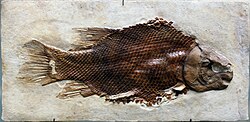
Picture of Lepidotidae
- Source
- Wikipedia/Commons
- Credit
- Anagoria
- Licence
- CC BY 3.0
- Commercial use
- the licence allows it
No 3D scan of Lepidotidae was found in MorphoSource and Sketchfab.
Smithsonian Open Access was not reached for this taxon, so this list is what the others held rather than everything there is.
The description on this site
- Source
- Wikipedia, “Lepidotidae”
- Licence
- CC BY-SA 4.0
This is what the site found, which is not the same as what exists.
Keep going
What may have been alongside itLepisosteiformes through timeFormations of the Middle JurassicThe world it lived on
Occurrence data from the Paleobiology Database, CC BY 4.0. Owen 1860