Ixodidae
The Ixodidae are the family of hard ticks or scale ticks, one of the three families of ticks, consisting of 750 species, as of 2025. They are known as 'hard ticks' because they have a scutum or hard shield, which the other major family of ticks, the 'soft ticks' (Argasidae), lack. They are ectoparasites of a wide range of host species, and some are vectors of pathogens that can cause human disease.

Richard Bartz · CC BY-SA 2.5 · via Wikipedia/Commons. May be a photograph of a specimen, or an artist’s reconstruction — an interpretation of a skeleton, since colour and soft tissue are almost never preserved.
On record
Recorded, not inferred- Also called
- hard tickPBDB
- Sits inside
- IxodoideaPBDB
- Life habit
- solitaryPBDB, for Arachnida
- Motility
- actively mobilePBDB, for Arachnida
- Environment
- terrestrialPBDB, for Arachnida
Time the record covers
At least 93 million years on record.
The record covers at least 93.9 Mya to 11.7 ka. No occurrence read is dated outside 100.5 Mya to 0 Mya.
4 occurrences of Ixodidae on record, most of them in the Late Cretaceous. The Paleobiology Database records this as a living group. Bar height is expected occurrences, not a count: each fossil is spread across the span it is dated to, so a tall narrow bar means tight dating and a low wide one means loose.
When
4 occurrences- Late Cretaceous75%
- Holocene25%
These are dates about fossils, not the animal: the record can only begin after it arose and end before it died out, so either end may reach further. Shares are expected occurrences: a fossil dated to a span is counted partly in each period it straddles. More on what this infers.
Ixodidae and its relatives
Late CretaceousWhere Ixodidae and its relatives were recorded in the Late Cretaceous.
Found in the same rock
212 taxa- Cornupalpatum burmanicum2 sites
- Cretacimermis protus2 sites
- Ornatomalthinus elvirae2 sites
- Acanthocorona sattleri1 site
- Acanthopsychops triaina1 site
- Achlyoconis heptatrichia1 site
- Adelohelea burmitica1 site
- Adelpholeon lithophorus1 site
- Adocimycolus aarondavisii1 site
- Aepyceratus hyperochus1 site
- Aethiocarenus burmanicus1 site
- Agamidae1 site
- Alavesia1 site
- Alavesia (Pennonalavesia) longicornuta1 site
- Alavesia hadroceria1 site
- Alavesia zigrasi1 site
- Aleksiana lapra1 site
- Amberophytum maculatum1 site
- Anchineus dolichobothris1 site
- Anebomorpha cercorhampha1 site
- Anisolabididae1 site
- Aphthartopsychops scutatus1 site
- Aptenoperissus burmanicus1 site
- Araneae1 site
The Paleobiology Database records 4 sites for Ixodidae, and this reads all of them. The number is how many of those sites it was catalogued from too. The 24 sharing the most are listed.
This is not a list of everything alive at the time. It is only what has come out of the same ground as this animal and been written down.
Entered from
4 references- Taphonomy of two Holocene penguin taphocoenoses in Potter Peninsula, South Shetland Islands, Antarctica1
- Ticks parasitised feathered dinosaurs as revealed by Cretaceous amber assemblages1
- Compluriscutula vetulum (Acari: Ixodida: Ixodidae), a new genus and species of hard tick from Lower Cretaceous Burmese amber1
- A new genus of hard ticks in Cretaceous Burmese amber (Acari: Ixodida: Ixodidae)1
Each of the 4 occurrences read was entered from one of these publications, ordered by how many each accounts for. This is not a search for papers mentioning the name. Each entry links to doi.org. Relayed as the Paleobiology Database holds them, not checked against what they resolve to.
Media and terms
Media content1
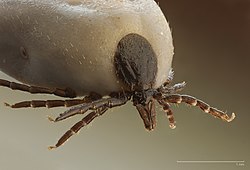
Picture of Ixodidae
- Source
- Wikipedia/Commons
- Credit
- Richard Bartz
- Licence
- CC BY-SA 2.5
- Commercial use
- the licence allows it
No 3D scan of Ixodidae was found in Sketchfab.
Smithsonian Open Access and MorphoSource were not reached for this taxon, so this list is what the others held rather than everything there is.
The description on this site
- Source
- Wikipedia, “Ixodidae”
- Licence
- CC BY-SA 4.0
This is what the site found, which is not the same as what exists.
Keep going
What may have been alongside itIxodoidea through timeFormations of the Late CretaceousThe world it lived on
Occurrence data from the Paleobiology Database, CC BY 4.0. Banks 1907