Isisaurus colberti
Isisaurus is a genus of titanosaurian dinosaur from the Late Cretaceous Lameta Formation of India and Pab Formation of Pakistan. The genus contains a single species, Isisaurus colberti.

Ansh Saxena · CC BY-SA 4.0 · via Wikipedia/Commons. May be a photograph of a specimen, or an artist’s reconstruction — an interpretation of a skeleton, since colour and soft tissue are almost never preserved.
On record
Recorded, not inferred- Sits inside
- IsisaurusPBDB
- Diet
- herbivorePBDB, for Sauropoda
- Life habit
- ground dwelling, gregariousPBDB, for Sauropoda
- Motility
- actively mobilePBDB, for Sauropoda
- Environment
- terrestrialPBDB, for Sauropoda
Time the record covers
At most 6.2 million years on record.
Every occurrence read is dated to somewhere between 72.2 Mya and 66 Mya, and nothing in the dating separates them, so that window is what the record shows rather than a span.
4 occurrences of Isisaurus colberti on record, most of them in the Late Cretaceous. Bar height is expected occurrences, not a count: each fossil is spread across the span it is dated to, so a tall narrow bar means tight dating and a low wide one means loose.
When
4 occurrences- Late Cretaceous100%
These are dates about fossils, not the animal: the record can only begin after it arose and end before it died out, so either end may reach further. Shares are expected occurrences: a fossil dated to a span is counted partly in each period it straddles. More on what this infers.
Found in
2 formations
- Lameta Formation2
- Vitakri Formation · Fort Munro Group2
Loading coastlines…
The named rock units Isisaurus colberti has been recovered from, largest first. Drawn where the rock is now, not where it formed.
Isisaurus colberti and its relatives
Late CretaceousWhere Isisaurus colberti and its relatives were recorded in the Late Cretaceous.
Found in the same rock
20 taxa- Pakisaurus balochistani2 sites
- Balochisaurus malkani1 site
- Clupea1 site
- Enchodus1 site
- Eoserranus1 site
- Gmelinoxylon1 site
- Igdabatis indicus1 site
- Imrankhanhero zilefatmi1 site
- Kurmademydini1 site
- Lepidotes1 site
- Lepisosteus indicus1 site
- Palmostroboxylon indicum1 site
- Palmoxylon pantii1 site
- Palmoxylon sagari1 site
- Pycnodus1 site
- Qaikshaheen masoomniazi1 site
- Saraikimasoom vitakri1 site
- Sulaimanisaurus gingerichi1 site
- Viracarpon1 site
- Vitakridrinda sulaimani1 site
The Paleobiology Database records 4 sites for Isisaurus colberti, and this reads all of them. The number is how many of those sites it was catalogued from too.
This is not a list of everything alive at the time. It is only what has come out of the same ground as this animal and been written down.
Entered from
3 references- Pakisaurus balochistani (Poripuchia, slender Titanosauria, Sauropoda) associated skeletons found from the latest Maastrichtian Vitakri Formation of Pakistan and referred fossils from India; filling of important missing links of Isisaurus colberti titanosaur found from Pakistan2
- A dinosaurian ulna from a new locality of Lameta succession, Salbardi area, districts Amravati, Maharashtra and Betul, Madhya Pradesh1
- New titanosaurid (Dinosauria: Sauropoda) from the Late Cretaceous of central India1
Each of the 4 occurrences read was entered from one of these publications, ordered by how many each accounts for. This is not a search for papers mentioning the name. Entries link to doi.org where the Paleobiology Database holds an identifier, and to its own record where it does not. Relayed as the Paleobiology Database holds them, not checked against what they resolve to.
Media and terms
Media content1
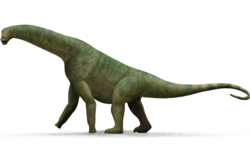
Picture of Isisaurus colberti
- Source
- Wikipedia/Commons
- Credit
- Ansh Saxena
- Licence
- CC BY-SA 4.0
- Commercial use
- the licence allows it
No 3D scan was found. Smithsonian Open Access, MorphoSource and Sketchfab were all searched.
The description on this site
- Source
- Wikipedia, “Isisaurus”
- Licence
- CC BY-SA 4.0
This is what the site found, which is not the same as what exists.
Keep going
What may have been alongside itIsisaurus through timeFormations of the Late CretaceousThe world it lived on
Occurrence data from the Paleobiology Database, CC BY 4.0. (Jain and Bandyopadhyay 1997)