Iguanidae
The Iguanidae is a family of lizards composed of the iguanas, chuckwallas, and their prehistoric relatives, including the widespread green iguana.

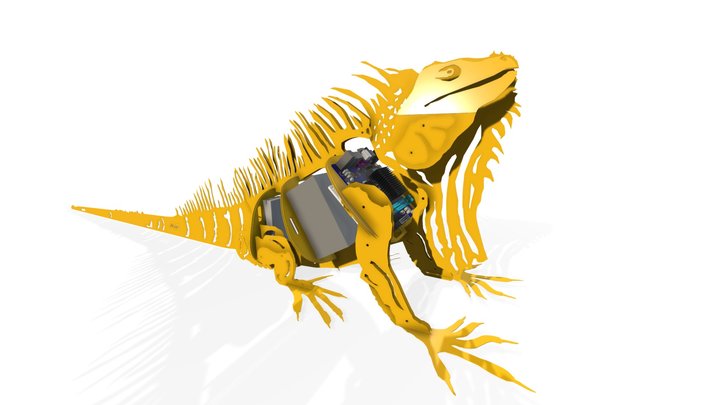
Manuel de Corselas ARS SUMMUM, Centro para el Estudio y Difusión Libres de la Historia del Arte · Public Domain · via Wikipedia/Commons. May be a photograph of a specimen, or an artist’s reconstruction — an interpretation of a skeleton, since colour and soft tissue are almost never preserved.
On record
Recorded, not inferred- Sits inside
- PleurodontaPBDB
- Diet
- omnivorePBDB
- Life habit
- ground dwellingPBDB
- Motility
- actively mobilePBDB, for Osteichthyes
- Environment
- terrestrialPBDB, for Amniota
Time the record covers
At least 110 million years on record.
The record covers at least 110.1 Mya to 11.7 ka. No occurrence read is dated outside 113.2 Mya to 0 Mya.
316 occurrences of Iguanidae on record, most of them in the Pleistocene. The Paleobiology Database records this as a living group. Bar height is expected occurrences, not a count: each fossil is spread across the span it is dated to, so a tall narrow bar means tight dating and a low wide one means loose.
When
316 occurrences- Early Cretaceousunder 1%
- Late Cretaceous3%
- Paleocene1%
- Eocene33%
- Oligocene5%
- Miocene11%
- Pliocene4%
- Pleistocene35%
- Holocene8%
These are dates about fossils, not the animal: the record can only begin after it arose and end before it died out, so either end may reach further. Shares are expected occurrences: a fossil dated to a span is counted partly in each period it straddles. More on what this infers.
Found in
64 formations
- Friars Formation · La Jolla Group13
- Wasatch Formation8
- Valentine Formation · Ogallala Group8
- Alamosa Formation8
- Chadron Formation8
- "unnamed sandstone" Formation6
Loading coastlines…
The named rock units Iguanidae has been recovered from, largest first. Drawn where the rock is now, not where it formed. 40 further formations hold fewer occurrences each and are not listed. 159 occurrences have no formation on record, which is common for older literature.
Iguanidae and its relatives
PleistoceneWhere Iguanidae and its relatives were recorded in the Pleistocene.
Found in the same rock
3,203 taxa- Sceloporus27 sites
- Bufo25 sites
- Phrynosoma25 sites
- Thamnophis25 sites
- Rana24 sites
- Glyptosaurinae22 sites
- Sceloporus undulatus22 sites
- Anura21 sites
- Equus21 sites
- Anguidae19 sites
- Crotalus19 sites
- Leiocephalus19 sites
- Serpentes19 sites
- Ambystoma tigrinum18 sites
- Boidae18 sites
- Anolis17 sites
- Geocapromys17 sites
- Rana pipiens17 sites
- Amphisbaenidae15 sites
- Bufo woodhousei15 sites
- Colubridae15 sites
- Peromyscus15 sites
- Anguini14 sites
- Gekkonidae14 sites
The Paleobiology Database records 201 sites for Iguanidae, and this reads all of them. The number is how many of those sites it was catalogued from too. The 24 sharing the most are listed.
This is not a list of everything alive at the time. It is only what has come out of the same ground as this animal and been written down.
Entered from
133 references- Evolution des lézards du Paléogène en Europe18
- Summary of known occurrences of terrestrial vertebrates from Eocene strata of southern California17
- The Late Wisconsinan vertebrate fauna from Deadman Cave, southern Arizona11
- A Pleistocene herpetofauna from Eddy County, New Mexico10
- Les Cordylidae (Reptilia, Lacertilia) de l'Eocène français9
- Reconstruction of mid Wisconsinan environments in southern New Mexico9
- Late Quaternary fossil vertebrates from the Cayman Islands8
- Middle Pleistocene (late Irvingtonian: Nebraskan) climatic changes in south-central Colorado8
- Holocene vertebrates from a dry cave on Eleuthera Island, Commonwealth of The Bahamas7
- Early Eocene lizards of the Wasatch Formation near Bitter Creek, Wyoming: diversity and paleoenvironment during an interval of global warming6
- The Evolution of Mid-latitude Faunas during the Eocene: Late Eocene Lizards of the Medicine Pole Hills Reconsidered6
- Late Cenozoic Lizards of the Anza Borrego Desert, California6
Each of the 316 occurrences read was entered from one of these publications, ordered by how many each accounts for. This is not a search for papers mentioning the name. 121 further references are not listed. Entries link to doi.org where the Paleobiology Database holds an identifier, and to its own record where it does not. Relayed as the Paleobiology Database holds them, not checked against what they resolve to.
Media and terms
Media content2

Picture of Iguanidae
- Source
- Wikipedia/Commons
- Credit
- Manuel de Corselas ARS SUMMUM, Centro para el Estudio y Difusión Libres de la Historia del Arte
- Licence
- Public Domain
- Commercial use
- the licence allows it
Smithsonian Open Access and MorphoSource were not reached for this taxon, so this list is what the others held rather than everything there is.
The description on this site
- Source
- Wikipedia, “Iguanidae”
- Licence
- CC BY-SA 4.0
This is what the site found, which is not the same as what exists.
Keep going
What may have been alongside itPleurodonta through timeFormations of the PleistoceneThe world it lived on
Occurrence data from the Paleobiology Database, CC BY 4.0. Oppel 1811