Hypnomys
Hypnomys, otherwise known as Balearic giant dormice, is an extinct genus of dormouse (Gliridae) in the subfamily Leithiinae. Its species are considered examples of insular gigantism. They were endemic to the Balearic Islands in the western Mediterranean from the Early Pliocene until their extinction around the 3rd millennium BC. They first appeared in the fossil record on Mallorca during the Early Pliocene, presumably as a result to the evaporation of the Mediterranean sea during the Messinian salinity crisis connecting the Balearic Islands with mainland Europe. They later spread to Menorca, and a possible molar is also known from Ibiza. Hypnomys became extinct during the late Holocene likely shortly after human arrival on the Balearics. They were one of only three native land mammals to the islands at the time of human arrival, alongside the shrew Nesiotites and goat-antelope Myotragus. Their closest living relatives are of the genus Eliomys, including the European garden dormouse.

Pere Bover1,2*, Josep A. Alcover1,2, Jacques J. Michaux3, Lionel Hautier4, Rainer Hutterer2,5 · CC BY 2.5 · via Wikipedia/Commons. May be a photograph of a specimen, or an artist’s reconstruction — an interpretation of a skeleton, since colour and soft tissue are almost never preserved.
On record
Recorded, not inferred- Also called
- Balearic DormicePBDB
- Sits inside
- DryomyinaePBDB
- Diet
- herbivorePBDB, for Rodentia
- Life habit
- ground dwellingPBDB, for Rodentia
- Motility
- actively mobilePBDB, for Osteichthyes
- Environment
- terrestrialPBDB, for Eutheria
Time the record covers
At least 3.4 million years on record.
The record covers at least 3.6 Mya to 129 ka. No occurrence read is dated outside 5.333 Mya to 11.7 ka.
7 occurrences of Hypnomys on record, most of them in the Pliocene. Bar height is expected occurrences, not a count: each fossil is spread across the span it is dated to, so a tall narrow bar means tight dating and a low wide one means loose.
When
7 occurrences- Pliocene53%
- Pleistocene47%
These are dates about fossils, not the animal: the record can only begin after it arose and end before it died out, so either end may reach further. Shares are expected occurrences: a fossil dated to a span is counted partly in each period it straddles. More on what this infers.
Hypnomys and its relatives
PlioceneWhere Hypnomys and its relatives were recorded in the Pliocene.
Found in the same rock
75 taxa- Nesiotites4 sites
- Tyto balearica3 sites
- Discoglossus2 sites
- Myotragus2 sites
- Myotragus kopperi2 sites
- Pica mourerae2 sites
- Podarcis2 sites
- Vipera2 sites
- Accipiter nisus1 site
- Aegypius1 site
- Alytes1 site
- Anatidae1 site
- Anguidae1 site
- Anthracomys1 site
- Apodemus1 site
- Athene1 site
- Aves1 site
- Blancomys1 site
- Bufo1 site
- Castillomys crusafonti1 site
- Chasmaporthetes lunensis1 site
- Colubroidea1 site
- Columba palumbus1 site
- Corvidae1 site
The Paleobiology Database records 7 sites for Hypnomys, and this reads all of them. The number is how many of those sites it was catalogued from too. The 24 sharing the most are listed.
This is not a list of everything alive at the time. It is only what has come out of the same ground as this animal and been written down.
Entered from
7 references- First evidence of faunal succession in terrestrial vertebrates of the Plio-Pleistocene of the Balearic Islands, western Mediterranean1
- Why are there no giants at the dwarves feet? Insular micromammals in the eastern Mediterranean1
- The Cova des Pas de Vallgornera (Llucmajor, Mallorca): a singular deposit bearing an exceptional well preserved Early Pleistocene vertebrate fauna1
- Nesiotites rafelinensis sp. nov., the earliest shrew (Mammalia, Soricidae) from the Balearic Islands, Spain1
- A new species of Pica (Aves: Corvidae) from the Plio-Pleistocene of Mallorca, Balearic Islands (Western Mediterranean).1
- Accumulated bones in a Pliocene cave in Cerro Pelado, Spain1
- Une nouvelle forme insulaire d'effraie geante, Tyto balearica n. sp. (Aves, Strigiformes), du Plio-Pleistocene des Baleares1
Each of the 7 occurrences read was entered from one of these publications, ordered by how many each accounts for. This is not a search for papers mentioning the name. Entries link to doi.org where the Paleobiology Database holds an identifier, and to its own record where it does not. Relayed as the Paleobiology Database holds them, not checked against what they resolve to.
Media and terms
Media content2
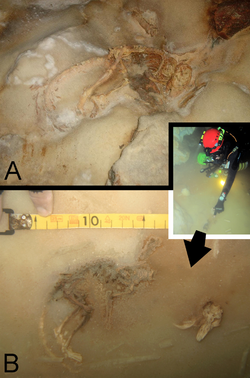
Picture of Hypnomys
- Source
- Wikipedia/Commons
- Credit
- Pere Bover1,2*, Josep A. Alcover1,2, Jacques J. Michaux3, Lionel Hautier4, Rainer Hutterer2,5
- Licence
- CC BY 2.5
- Commercial use
- the licence allows it
CT scan
- Source
- MorphoSource
- Licence
- not stated by the source
- Commercial use
- cannot be read from the licence given — check the record
- Specimen
- Hypnomys morpheus · na:uncatalogued
Smithsonian Open Access was not reached for this taxon, so this list is what the others held rather than everything there is.
The description on this site
- Source
- Wikipedia, “Hypnomys”
- Licence
- CC BY-SA 4.0
This is what the site found, which is not the same as what exists.
Keep going
What may have been alongside itDryomyinae through timeFormations of the PlioceneThe world it lived on
Occurrence data from the Paleobiology Database, CC BY 4.0. Bate 1918