Hydrochoeridae
Hydrochoerinae is a subfamily of Caviidae, consisting of two living genera, Hydrochoerus, the capybaras, and Kerodon, the rock cavies. In addition, a number of extinct genera related to capybaras should also be placed in this subfamily. The taxonomy of Hydrochoerinae is confused because, until 2005, living capybaras and their extinct relatives were placed in their own family, Hydrochoeridae. Recent molecular phylogenetic studies recognize a close relationship between Hydrochoerus and Kerodon, supporting placement of both genera in a subfamily of Caviidae. The taxonomy of fossil hydrochoerines is in a state of flux. In recent years, the diversity of fossil hydrochoerines has been substantially reduced. This is largely due to the recognition that capybara molar teeth show strong variation in shape over the life of an individual. In one instance, material once referred to four genera and seven species on the basis of differences in molar shape is now thought to represent differently aged individuals of a single species, Cardiatherium paranense.

Adrian Pingstone · Public Domain · via Wikipedia/Commons. May be a photograph of a specimen, or an artist’s reconstruction — an interpretation of a skeleton, since colour and soft tissue are almost never preserved.
On record
Recorded, not inferred- Sits inside
- CavioideaPBDB
- Diet
- grazerPBDB
- Life habit
- amphibiousPBDB
- Motility
- actively mobilePBDB, for Osteichthyes
- Environment
- terrestrialPBDB, for Eutheria
Time the record covers
At least 11 million years on record.
The record covers at least 11.63 Mya to 129 ka. No occurrence read is dated outside 13.82 Mya to 0 Mya.
53 occurrences of Hydrochoeridae on record, most of them in the Miocene. The Paleobiology Database records this as a living group. Bar height is expected occurrences, not a count: each fossil is spread across the span it is dated to, so a tall narrow bar means tight dating and a low wide one means loose.
When
53 occurrences- Miocene73%
- Pliocene16%
- Pleistocene11%
- Holoceneunder 1%
These are dates about fossils, not the animal: the record can only begin after it arose and end before it died out, so either end may reach further. Shares are expected occurrences: a fossil dated to a span is counted partly in each period it straddles. More on what this infers.
Found in
20 formations
- Ituzaingo Formation11
- Arroyo Chasicó Formation5
- Solimoes Formation5
- Puerto Madryn Formation3
- Río Negro Formation3
- Urumaco Formation2
Loading coastlines…
The named rock units Hydrochoeridae has been recovered from, largest first. Drawn where the rock is now, not where it formed. 8 occurrences have no formation on record, which is common for older literature.
Hydrochoeridae and its relatives
MioceneWhere Hydrochoeridae and its relatives were recorded in the Miocene.
Found in the same rock
740 taxa- Cardiatherium11 sites
- Chasicotatus ameghinoi5 sites
- Macraucheniidae5 sites
- Cardiatherium paranense4 sites
- Cardiomys4 sites
- Equus4 sites
- Lagostomus (Lagostomopsis)4 sites
- Macrochorobates scalabrinii4 sites
- Paedotherium minor4 sites
- Proeuphractus4 sites
- Protabrocoma antiqua4 sites
- Tetrastylus4 sites
- Tremacyllus impressus4 sites
- Anas crecca3 sites
- Anura3 sites
- Aspidocalyptus castroi3 sites
- Camelidae3 sites
- Carcharodon hastalis3 sites
- Cardiatherium chasicoense3 sites
- Cardiatherium patagonicum3 sites
- Caviodon3 sites
- Chorobates villosissimus3 sites
- Cullinia3 sites
- Dasypodidae3 sites
The Paleobiology Database records 33 sites for Hydrochoeridae, and this reads all of them. The number is how many of those sites it was catalogued from too. The 24 sharing the most are listed.
This is not a list of everything alive at the time. It is only what has come out of the same ground as this animal and been written down.
Entered from
34 references- Miocene vertebrates from Entre Rios province, eastern Argentina7
- Late Miocene Capybaras from Argentina: Skull Anatomy, Taxonomy, Evolution, and Biochronology4
- Imigrantes em um continente perdido: O registro fossilífero de roedores Caviomorpha (Mammalia: Rodentia: Ctenohystrica) do Cenozoico do Brasil3
- Advances in the understanding of Neogene mammalian fauna in the Pampean region (central Argentina) through revising “biozone” hypotheses based on new dates and biochronological analyses2
- Capybaras (Rodentia, Hydrochoeridae, Hydrochoerinae) and their bearing in the calibration of the late Miocene-Pliocene sequences of South America2
- Late Miocene continental biota in Northeastern Patagonia (Peninsula Valdes Chubut Argentina)2
- Bioestratigrafia de la fauna de mamíferos de las Formaciones Socorro, Urumaco y Codore (Mioceno medio - Plioceno temprno)de la región de Urumaco, Falcon, Venezuela2
- Small mammals (Insectivora, Lagomorpha, and Rodentia) from the early Pleistocene (early Irvingtonian) Leisey Shell Pit Local Fauna, Hillsborough County, Florida2
- mamiferos terrestres del Mioceno medio-tardio de las cuencas de los rios Colorado y Negro (Argentina): Evolucion ambiental2
- Estado actual del conocimiento de los vertebrados de la Formación Arroyo Chasicó (Plioceno temprano) de la provincia de Buenos Aires2
- El puelchense de Buenos Aires y su fauna (Plioceno Medio) segunda parte2
- A new capybara from the late Miocene of San Juan Province, Argentina, and its phylogenetic implications1
Each of the 53 occurrences read was entered from one of these publications, ordered by how many each accounts for. This is not a search for papers mentioning the name. 22 further references are not listed. Entries link to doi.org where the Paleobiology Database holds an identifier, and to its own record where it does not. Relayed as the Paleobiology Database holds them, not checked against what they resolve to.
Media and terms
Media content1
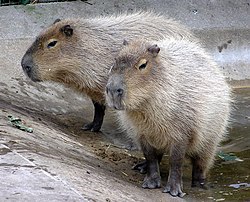
Picture of Hydrochoeridae
- Source
- Wikipedia/Commons
- Credit
- Adrian Pingstone
- Licence
- Public Domain
- Commercial use
- the licence allows it
No 3D scan of Hydrochoeridae was found in MorphoSource and Sketchfab.
Smithsonian Open Access was not reached for this taxon, so this list is what the others held rather than everything there is.
The description on this site
- Licence
- CC BY-SA 4.0
This is what the site found, which is not the same as what exists.
Keep going
What may have been alongside itCavioidea through timeFormations of the MioceneThe world it lived on
Occurrence data from the Paleobiology Database, CC BY 4.0. Gill 1872