Hollardops
Hollardops is a genus of trilobite in the order Phacopida that lived during the Devonian. Their fossils are found in the upper Emsian of western Europe and in the lower Emsian to lowermost Eifelian of North Africa. The type species, Asteropyge mesocristata, was described from Algeria by Le Maître in 1952. The genus Hollardops was erected by Morzadec in 1997. In the same year, Lieberman & Kloc erected Modellops and Philipsmithiana but those genera are regarded as subjective synonyms of Hollardops. The 10-segmented thoracic condition of Hollardops is a rare feature among acastid trilobites that almost always have 11 thorax segments. Van Viersen & Kloc (2022) revisited Hollardops and described a number of new species from the Devonian of Morocco. They also regarded Pennarbedops Bignon & Crônier, 2013 as a synonym of Hollardops. Van Viersen & Kloc construed Hollardops as a scavenger or predator with well-developed eyes, that used its shovel-like cephalon to plough the top layers of the sediment in search of food. Hollardops had small pits horizontally along the fringe of the exoskeleton; these are believed to have housed setae that allowed the trilobite to closely monitor its surroundings.

Daderot · CC0 · via Wikipedia/Commons. May be a photograph of a specimen, or an artist’s reconstruction — an interpretation of a skeleton, since colour and soft tissue are almost never preserved.
On record
Recorded, not inferred- Sits inside
- AcastidaePBDB
- Diet
- carnivorePBDB, for Phacopina
- Life habit
- low-level epifaunalPBDB, for Trilobita
- Motility
- fast-movingPBDB, for Trilobita
- Vision
- well-developedPBDB, for Acastidae
- Environment
- marinePBDB, for Trilobita
Time the record covers
At most 23 million years on record.
Every occurrence read is dated to somewhere between 410.62 Mya and 387.95 Mya, and nothing in the dating separates them, so that window is what the record shows rather than a span.
8 occurrences of Hollardops on record, most of them in the Devonian. Bar height is expected occurrences, not a count: each fossil is spread across the span it is dated to, so a tall narrow bar means tight dating and a low wide one means loose.
When
8 occurrences- Devonian100%
These are dates about fossils, not the animal: the record can only begin after it arose and end before it died out, so either end may reach further. Shares are expected occurrences: a fossil dated to a span is counted partly in each period it straddles. More on what this infers.
Found in
4 formations
Loading coastlines…
The named rock units Hollardops has been recovered from, largest first. Drawn where the rock is now, not where it formed.
Hollardops and its relatives
DevonianWhere Hollardops and its relatives were recorded in the Devonian.
Found in the same rock
44 taxa- Austerops menchikoffi5 sites
- Gerastos tuberculatus marocensis3 sites
- Morocops3 sites
- Morocops granulops3 sites
- Austerops speculator2 sites
- Cornuproetus2 sites
- Cyphaspis2 sites
- Cyphaspis agayuara2 sites
- Cyphaspis hamidi2 sites
- Geesops fabrei2 sites
- Gerastos2 sites
- Walliserops2 sites
- Acanthopyge1 site
- Acanthopyge (Lobopyge) bassei1 site
- Acastoides haddadi1 site
- Acastoides zguilmensis1 site
- Asteropyge (Comura)1 site
- Austerops legrandi1 site
- Barrandeops lebesus1 site
- Boeckops1 site
- Ceratocephala1 site
- Cyphaspides ammari1 site
- Destombesina1 site
- Diademaproetus praecursor1 site
The Paleobiology Database records 6 sites for Hollardops, and this reads all of them. The number is how many of those sites it was catalogued from too. The 24 sharing the most are listed.
This is not a list of everything alive at the time. It is only what has come out of the same ground as this animal and been written down.
Entered from
4 references- Trilobites from the upper Lower to Middle Devonian Timrhanrhart Formation, Jbel Gara el Zguilma, southern Morocco4
- A trilobite faunule from the Lower Devonian of the Saoura Valley, Algeria: biodiversity, morphological variability and palaeobiogeographical affinities2
- Trilobites from the Red Fauna (latest Emsian, Devonian) of Hamar Laghdad, Morocco and their biodiversity1
- Latest Early to Early Middle Devonian trilobites from he Erbenochile bed, Jbel Issoumour, southeastern Morocco1
Each of the 8 occurrences read was entered from one of these publications, ordered by how many each accounts for. This is not a search for papers mentioning the name. Entries link to doi.org where the Paleobiology Database holds an identifier, and to its own record where it does not. Relayed as the Paleobiology Database holds them, not checked against what they resolve to.
Media and terms
Media content2

Picture of Hollardops
- Source
- Wikipedia/Commons
- Credit
- Daderot
- Licence
- CC0
- Commercial use
- the licence allows it
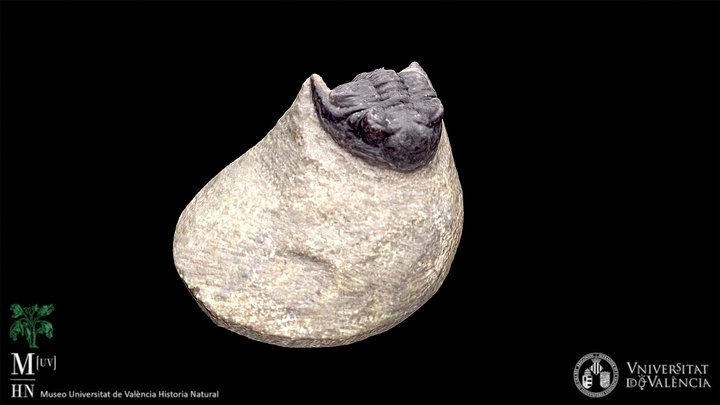
3D model
- Source
- Sketchfab
- Licence
- CC Attribution
- Commercial use
- cannot be read from the licence given — check the record
Smithsonian Open Access was not reached for this taxon, so this list is what the others held rather than everything there is.
The description on this site
- Source
- Wikipedia, “Hollardops”
- Licence
- CC BY-SA 4.0
This is what the site found, which is not the same as what exists.
Keep going
What may have been alongside itAcastidae through timeFormations of the DevonianThe world it lived on
Occurrence data from the Paleobiology Database, CC BY 4.0. Morzadec 1997