Hemiscylliidae
The Hemiscylliidae are a family of sharks in the order Orectolobiformes, commonly known as longtail carpet sharks and sometimes bamboo sharks. They are found in shallow waters of the tropical Indo-Pacific.

This illustration was made by Citron You must credit this : Citron / CC-BY-SA-3.0 · CC BY-SA 3.0 · via Wikipedia/Commons. May be a photograph of a specimen, or an artist’s reconstruction — an interpretation of a skeleton, since colour and soft tissue are almost never preserved.
On record
Recorded, not inferred- Sits inside
- OrectoloboideiPBDB
- Diet
- carnivorePBDB, for Orectolobiformes
- Life habit
- nektobenthicPBDB, for Orectolobiformes
- Motility
- actively mobilePBDB, for Orectolobiformes
Time the record covers
At least 171 million years on record.
The record covers at least 182.9 Mya to 11.63 Mya. No occurrence read is dated outside 184.2 Mya to 7.246 Mya.
279 occurrences of Hemiscylliidae on record, most of them in the Late Cretaceous. The Paleobiology Database records this as a living group, and the chart stops with its fossils rather than at the present. Bar height is expected occurrences, not a count: each fossil is spread across the span it is dated to, so a tall narrow bar means tight dating and a low wide one means loose.
When
279 occurrences- Early Jurassic11%
- Middle Jurassic7%
- Late Jurassicunder 1%
- Early Cretaceous8%
- Late Cretaceous50%
- Paleocene4%
- Eocene18%
- Oligoceneunder 1%
- Miocene1%
These are dates about fossils, not the animal: the record can only begin after it arose and end before it died out, so either end may reach further. Shares are expected occurrences: a fossil dated to a span is counted partly in each period it straddles. More on what this infers.
Found in
84 formations
- Hunstanton Formation14
- Newhaven Chalk Formation9
- Marnes de Donzacq Formation7
- Matam Formation7
- Carlile Shale Formation · Colorado Group4
- Hythe Formation · Lower Greensand Group4
Loading coastlines…
The named rock units Hemiscylliidae has been recovered from, largest first. Drawn where the rock is now, not where it formed. 60 further formations hold fewer occurrences each and are not listed. 123 occurrences have no formation on record, which is common for older literature.
Hemiscylliidae and its relatives
Late CretaceousWhere Hemiscylliidae and its relatives were recorded in the Late Cretaceous.
Found in the same rock
1,792 taxa- Chiloscyllium53 sites
- Rhinobatos49 sites
- Squalicorax kaupi37 sites
- Cretalamna appendiculata34 sites
- Dasyatis34 sites
- Chiloscyllium greeni28 sites
- Hemiscyllium26 sites
- Heterodontus26 sites
- Scyliorhinus25 sites
- Squatina25 sites
- Coupatezia24 sites
- Archaeolamna kopingensis21 sites
- Crassescyliorhinus germanicus20 sites
- Hybodus20 sites
- Scapanorhynchus raphiodon20 sites
- Scyliorhinidae20 sites
- Galeorhinus19 sites
- Squatina (Cretascyllium) hassei19 sites
- Cretodus semiplicatus18 sites
- Teleostei18 sites
- Anomotodon hermani17 sites
- Squalicorax falcatus17 sites
- Carcharias16 sites
- Pseudocorax laevis16 sites
The Paleobiology Database records 207 sites for Hemiscylliidae, and this reads all of them. The number is how many of those sites it was catalogued from too. The 24 sharing the most are listed.
This is not a list of everything alive at the time. It is only what has come out of the same ground as this animal and been written down.
Entered from
96 references- Sharks (Elasmobranchii: Euselachii) from the Late Cretaceous of France and the UK32
- Late Cretaceous and Danian neoselachians from southern Sweden27
- Toarcian shark and ray faunas (Chondrichthyans) from Luxembourg and Belgium in the aftermath of the T-OAE24
- Albian and Cenomanian selachian assemblages from north-east England15
- La Couche à Crassum (Toarcien moyen) au Luxembourg: stratigraphie et faunes de la coupe de Dudelange-Zoufftgen9
- Nouvelle faunes de sélaciens (Elasmobranchii, Neoselachii) de l'Eocène moyen des Landes (Sud-Ouest, France). Implication dans la connaissance des communautés de sélaciens d'eau profondes9
- The selachian fauna (sharks and rays) of the phosphate series of Ndendouri-Ouali Diala (Matam, Western Senegal): Dating and paleoenvironmental interests7
- Les Orectolobiformes, Carcharhiniformes et Myliobatiformes (Elasmobranchii, Neoselachii) des bassins à phosphate du Maroc (Maastrichtien-Lutétien basal). Systématique, biostratigraphie, évolution et dynamique des faunes7
- Shark and ray faunas in the Middle and Late Eocene of the Fayum Area, Egypt6
- Vertebrate microsite assemblages (exclusive of mammals) from the Foremost and Oldman Formations of the Judith River Group (Campanian) of southeastern Alberta: an illustrated guide5
- Les sélaciens des terrains néocrétacés and paléocènes de Belgique and des contrées limitrophes. Eléments d'une biostratigraphie intercontinentale5
- Revision of Eocene Antarctic carpet sharks (Elasmobranchii, Orectolobiformes) from Seymour Island, Antarctic Peninsula4
Each of the 279 occurrences read was entered from one of these publications, ordered by how many each accounts for. This is not a search for papers mentioning the name. 84 further references are not listed. Entries link to doi.org where the Paleobiology Database holds an identifier, and to its own record where it does not. Relayed as the Paleobiology Database holds them, not checked against what they resolve to.
Media and terms
Media content1
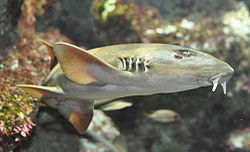
Picture of Hemiscylliidae
- Source
- Wikipedia/Commons
- Credit
- This illustration was made by Citron You must credit this : Citron / CC-BY-SA-3.0
- Licence
- CC BY-SA 3.0
- Commercial use
- the licence allows it
No 3D scan of Hemiscylliidae was found in MorphoSource and Sketchfab.
Smithsonian Open Access was not reached for this taxon, so this list is what the others held rather than everything there is.
The description on this site
- Licence
- CC BY-SA 4.0
This is what the site found, which is not the same as what exists.
Keep going
What may have been alongside itOrectoloboidei through timeFormations of the Late CretaceousThe world it lived on
Occurrence data from the Paleobiology Database, CC BY 4.0. Gill 1862