Haliaeetus leucogaster
The white-bellied sea eagle, also known as the white-breasted sea eagle, is a large diurnal bird of prey in the family Accipitridae. Originally described by Johann Friedrich Gmelin in 1788, it is closely related to Sanford's sea eagle of the Solomon Islands, and the two are considered a superspecies. A distinctive bird, the adult white-bellied sea eagle has a white head, breast, under-wing coverts and tail. The upper parts are grey and the black under-wing flight feathers contrast with the white coverts. The tail is short and wedge-shaped as in all Haliaeetinae species. Like many raptors, the female is larger than the male, and can measure up to 90 cm (35 in) long with a wingspan of up to 2.2 m (7.2 ft), and weigh 4.5 kg (9.9 lb). Immature birds have brown plumage, which is gradually replaced by white until the age of five or six years. The call is a loud goose-like honking.

JJ Harrison · CC BY-SA 3.0 · via Wikipedia/Commons. May be a photograph of a specimen, or an artist’s reconstruction — an interpretation of a skeleton, since colour and soft tissue are almost never preserved.
On record
Recorded, not inferred- Also called
- white-bellied sea-eaglePBDB
- Sits inside
- HaliaeetusPBDB
- Diet
- carnivorePBDB, for Accipitridae
- Life habit
- volantPBDB, for Accipitridae
- Motility
- actively mobilePBDB, for Theropoda
- Environment
- terrestrialPBDB, for Accipitridae
- Mass
- 117 gWikidata
Time the record covers
At most 118 thousand years on record.
Every occurrence read is dated to somewhere between 129 ka and 11.7 ka, and nothing in the dating separates them, so that window is what the record shows rather than a span.
2 occurrences of Haliaeetus leucogaster on record, most of them in the Pleistocene. The Paleobiology Database records this as a living group. Bar height is expected occurrences, not a count: each fossil is spread across the span it is dated to, so a tall narrow bar means tight dating and a low wide one means loose.
When
2 occurrences- Pleistocene100%
These are dates about fossils, not the animal: the record can only begin after it arose and end before it died out, so either end may reach further. Shares are expected occurrences: a fossil dated to a span is counted partly in each period it straddles. More on what this infers.
Haliaeetus leucogaster and its relatives
PleistoceneWhere Haliaeetus leucogaster and its relatives were recorded in the Pleistocene.
Found in the same rock
28 taxa- Charadriiformes2 sites
- Columba vitiensis2 sites
- Columbidae2 sites
- Synoicus ypsilophorus2 sites
- Turnix maculosus2 sites
- Tyto2 sites
- Aythya australis1 site
- Calidris1 site
- Cuculidae1 site
- Dendrocygna arcuata1 site
- Ducula1 site
- Falco1 site
- Fulica1 site
- Geopelia1 site
- Grus1 site
- Laridae1 site
- Macropygia1 site
- Motacillidae1 site
- Ninox1 site
- Passeriformes1 site
- Passerinae indet.1 site
- Ptilinopus1 site
- Rallidae1 site
- Synoicus chinensis1 site
The Paleobiology Database records 2 sites for Haliaeetus leucogaster, and this reads all of them. The number is how many of those sites it was catalogued from too. The 24 sharing the most are listed.
This is not a list of everything alive at the time. It is only what has come out of the same ground as this animal and been written down.
Entered from
2 references- First record of avian extinctions from the Late Pleistocene and Holocene of Timor Leste1
- First record of avian extinctions from the Late Pleistocene and Holocene of Timor Leste1
Each of the 2 occurrences read was entered from one of these publications, ordered by how many each accounts for. This is not a search for papers mentioning the name. Each entry links to doi.org. Relayed as the Paleobiology Database holds them, not checked against what they resolve to.
Media and terms
Media content1
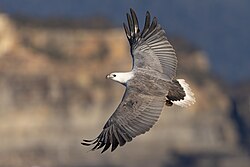
Picture of Haliaeetus leucogaster
- Source
- Wikipedia/Commons
- Credit
- JJ Harrison
- Licence
- CC BY-SA 3.0
- Commercial use
- the licence allows it
No 3D scan of Haliaeetus leucogaster was found in Sketchfab.
Smithsonian Open Access and MorphoSource were not reached for this taxon, so this list is what the others held rather than everything there is.
The description on this site
- Licence
- CC BY-SA 4.0
This is what the site found, which is not the same as what exists.
Keep going
What may have been alongside itHaliaeetus through timeFormations of the PleistoceneThe world it lived on
Occurrence data from the Paleobiology Database, CC BY 4.0. (Gmelin 1788)