Gyrolithes
Gyrolithes is a trace fossil consisting of a vertically spiraling burrow, known from Cambrian strata onward.

Nchazarra · CC BY 3.0 · via Wikipedia/Commons. May be a photograph of a specimen, or an artist’s reconstruction — an interpretation of a skeleton, since colour and soft tissue are almost never preserved.
On record
Recorded, not inferred- Sits inside
- IchnofossilsPBDB
Time the record covers
At least 525 million years on record.
The record covers at least 529 Mya to 3.6 Mya. No occurrence read is dated outside 538.8 Mya to 2.58 Mya.
6 occurrences of Gyrolithes on record, most of them in the Cambrian. Bar height is expected occurrences, not a count: each fossil is spread across the span it is dated to, so a tall narrow bar means tight dating and a low wide one means loose.
When
6 occurrences- Cambrian33%
- Ordovician17%
- Middle Jurassic17%
- Eocene17%
- Pliocene17%
These are dates about fossils, not the animal: the record can only begin after it arose and end before it died out, so either end may reach further. Shares are expected occurrences: a fossil dated to a span is counted partly in each period it straddles. More on what this infers.
Found in
6 formations
- Breivik Formation1
- Opalinuston Formation1
- Voosi Formation1
- Beach Formation · Bell Island Group1
- Caracoles Formation1
- Cozla Formation1
Loading coastlines…
The named rock units Gyrolithes has been recovered from, largest first. Drawn where the rock is now, not where it formed.
Gyrolithes and its relatives
CambrianWhere Gyrolithes and its relatives were recorded in the Cambrian.
Found in the same rock
53 taxa- Planolites3 sites
- Amiantis1 site
- Aulichnites1 site
- Balanidae1 site
- Bergaueria perata1 site
- Bergaueria prantli1 site
- Bositra buchi1 site
- Calycraterion samsonowiczi1 site
- Chondrites1 site
- Cochlichnus1 site
- Creipatella sp.1 site
- Crepipatella1 site
- Cruziana breadstoni1 site
- Cruziana problematica1 site
- Cruziana semiplicata1 site
- Cyclinella subquadrata1 site
- Diplichnites1 site
- Diplocraterion parallelum1 site
- Ensis macha1 site
- Eurhomalea1 site
- Gastropoda1 site
- Helminthopsis hieroglyphica1 site
- Helminthopsis tenuis1 site
- Jurapseudes friedericianus1 site
The Paleobiology Database records 5 sites for Gyrolithes, and this reads all of them. The number is how many of those sites it was catalogued from too. The 24 sharing the most are listed.
This is not a list of everything alive at the time. It is only what has come out of the same ground as this animal and been written down.
Entered from
6 references- Lithostratigraphy and Biostratigraphy of Pliocene and Pleistocene Marine Deposits and Age of the highest Marine Terrace from the Sacaco Basin and its Environs (southern Peru)1
- Coral reefs near the Eocene–Oligocene boundary in the northern Transylvanian Basin, Romania: Composition and paleoenvironmental interpretation1
- Trace fossils Didymaulichnus cf. tirasensis and Monomorphichnus isp. from the Estonian Lower Cambrian with a discussion on the early Cambrian ichnocoenoses of Baltica1
- Edicaran fossils from the Innerelv Member (late Proterozoic) of the Tanafjorden area, northeastern Finmark1
- Paläontologische Untersuchungen im unteren Opalinuston der Nordschweiz1
- Ichnology of the Upper Cambrian? to Lower Ordovician Bell Island and Wabana groups of eastern Newfoundland, Canada1
Each of the 6 occurrences read was entered from one of these publications, ordered by how many each accounts for. This is not a search for papers mentioning the name. Entries link to doi.org where the Paleobiology Database holds an identifier, and to its own record where it does not. Relayed as the Paleobiology Database holds them, not checked against what they resolve to.
Media and terms
Media content2

Picture of Gyrolithes
- Source
- Wikipedia/Commons
- Credit
- Nchazarra
- Licence
- CC BY 3.0
- Commercial use
- the licence allows it
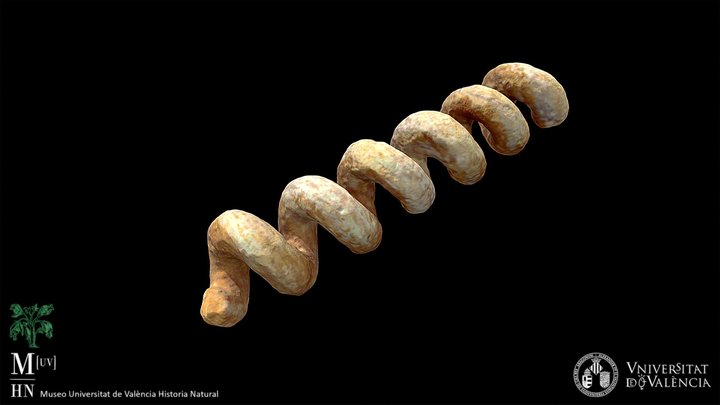
3D model
- Source
- Sketchfab
- Licence
- CC Attribution
- Commercial use
- cannot be read from the licence given — check the record
Smithsonian Open Access and MorphoSource were not reached for this taxon, so this list is what the others held rather than everything there is.
The description on this site
- Source
- Wikipedia, “Gyrolithes”
- Licence
- CC BY-SA 4.0
This is what the site found, which is not the same as what exists.
Keep going
What may have been alongside itIchnofossils through timeFormations of the CambrianThe world it lived on
Occurrence data from the Paleobiology Database, CC BY 4.0. de Saporta 1884