Gyroidina
Gyroidina is a genus of foraminifera belonging to the family Gavelinellidae of the superfamily Chilostomelloidea and the order Rotaliida. Its temporal range is the Holocene.

Anna Tikhonova, Sofia Merenkova, Sergei Korsun and Alexander Matul · CC BY 4.0 · via Wikipedia/Commons. May be a photograph of a specimen, or an artist’s reconstruction — an interpretation of a skeleton, since colour and soft tissue are almost never preserved.
On record
Recorded, not inferred- Sits inside
- GavellinellinaePBDB
- Diet
- omnivorePBDB, for Foraminifera
- Life habit
- semi-infaunalPBDB, for Foraminifera
- Motility
- stationaryPBDB, for Foraminifera
Time the record covers
At least 100 million years on record.
The record covers at least 100.5 Mya to 11.7 ka. No occurrence read is dated outside 113.2 Mya to 0 Mya.
393 occurrences of Gyroidina on record, most of them in the Late Cretaceous. The Paleobiology Database records this as a living group. Bar height is expected occurrences, not a count: each fossil is spread across the span it is dated to, so a tall narrow bar means tight dating and a low wide one means loose.
When
393 occurrences- Early Cretaceousunder 1%
- Late Cretaceous28%
- Paleocene4%
- Eocene13%
- Oligocene14%
- Miocene9%
- Pliocene7%
- Pleistocene21%
- Holocene4%
These are dates about fossils, not the animal: the record can only begin after it arose and end before it died out, so either end may reach further. Shares are expected occurrences: a fossil dated to a span is counted partly in each period it straddles. More on what this infers.
Found in
30 formations
- El Haria Formation99
- Esmeraldas Formation5
- San Lorenzo Formation4
- Escudo de Veraguas Formation · Bocas del Toro Group3
- Cluj Limestone Formation3
- Roca Formation · Malargüe Group3
Loading coastlines…
The named rock units Gyroidina has been recovered from, largest first. Drawn where the rock is now, not where it formed. 6 further formations hold fewer occurrences each and are not listed. 240 occurrences have no formation on record, which is common for older literature.
Gyroidina and its relatives
Late CretaceousWhere Gyroidina and its relatives were recorded in the Late Cretaceous.
Found in the same rock
1,321 taxa- Pullenia119 sites
- Cibicidoides115 sites
- Gyroidinoides104 sites
- Dentalina98 sites
- Oridorsalis98 sites
- Anomalinoides87 sites
- Lenticulina87 sites
- Cassidulina68 sites
- Stilostomella67 sites
- Nuttallides61 sites
- Gaudryina58 sites
- Nodosaria58 sites
- Saracenaria58 sites
- Lagena54 sites
- Spiroplectammina53 sites
- Dorothia51 sites
- Bulimina50 sites
- Karreriella49 sites
- Anomalinoides acuta48 sites
- Coryphostoma48 sites
- Praebulimina48 sites
- Gyroidinoides subangulata47 sites
- Osangularia47 sites
- Pullenia quinqueloba47 sites
The Paleobiology Database records 312 sites for Gyroidina, and this reads 240 of them. Of that, one read hit the database's own return limit, so every count below is a floor rather than a total. The number is how many of those sites it was catalogued from too. The 24 sharing the most are listed.
This is not a list of everything alive at the time. It is only what has come out of the same ground as this animal and been written down.
Entered from
63 references- The Late Campian and Maastrichtian in northwestern Tunisia: palaeoenvironmental inferences from lithology, macrofauna and benthic formainifera99
- Site U141737
- Site U151727
- Site U140627
- Site U140520
- Site U141816
- Neogene benthic foraminifera of the Hatton-Rockall Basin12
- Site U141010
- Site U14079
- Site U14099
- Site U14197
- Mid-slope Site U13807
Each of the 393 occurrences read was entered from one of these publications, ordered by how many each accounts for. This is not a search for papers mentioning the name. 51 further references are not listed. Each entry links to doi.org. Relayed as the Paleobiology Database holds them, not checked against what they resolve to.
Media and terms
Media content2
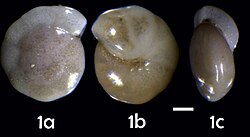
Picture of Gyroidina
- Source
- Wikipedia/Commons
- Credit
- Anna Tikhonova, Sofia Merenkova, Sergei Korsun and Alexander Matul
- Licence
- CC BY 4.0
- Commercial use
- the licence allows it
CT scan
- Source
- MorphoSource
- Licence
- not stated by the source
- Commercial use
- cannot be read from the licence given — check the record
- Specimen
- Gyroidina sp. · l-cb
The description on this site
- Source
- Wikipedia, “Gyroidina”
- Licence
- CC BY-SA 4.0
This is what the site found, which is not the same as what exists.
Keep going
What may have been alongside itGavellinellinae through timeFormations of the Late CretaceousThe world it lived on
Occurrence data from the Paleobiology Database, CC BY 4.0. d'Orbigny 1826