Gyrinus minutus
Gyrinus minutus is a species of whirligig beetle in the family Gyrinidae. It is found in North America and Europe.The body is entirely black with a dull appearance due to its microsculpture. G. minutus typically inhabit open edges of larger water bodies like lakes and reservoirs but also reside in sparsely vegetated ponds and slow-flowing river parts. Their swimming abilities are weaker than other gyrinids, and they often disperse in groups when disturbed. Reproduction begins in early spring with mating on water surfaces, followed by egg-laying on aquatic plants. Larvae hatch after a week, growing quickly and reaching maturity within three to four weeks. They are capable of flight, and adults can be found in new locations throughout the summer. G. minutus lacks volatile production for predator defense or has minimal amounts, likely due to its behavior and habitat preferences. Interestingly, while G. minutus rarely aggregates, it can still respond to alarm signals from other species.

Edmund Reitter · Public Domain · via Wikipedia/Commons. May be a photograph of a specimen, or an artist’s reconstruction — an interpretation of a skeleton, since colour and soft tissue are almost never preserved.
On record
Recorded, not inferred- Sits inside
- GyrinusPBDB
- Motility
- actively mobilePBDB, for Arthropoda
- Environment
- terrestrialPBDB, for Insecta
Time the record covers
At most 118 thousand years on record.
Every occurrence read is dated to somewhere between 129 ka and 11.7 ka, and nothing in the dating separates them, so that window is what the record shows rather than a span.
2 occurrences of Gyrinus minutus on record, most of them in the Pleistocene. The Paleobiology Database records this as a living group. Bar height is expected occurrences, not a count: each fossil is spread across the span it is dated to, so a tall narrow bar means tight dating and a low wide one means loose.
When
2 occurrences- Pleistocene100%
These are dates about fossils, not the animal: the record can only begin after it arose and end before it died out, so either end may reach further. Shares are expected occurrences: a fossil dated to a span is counted partly in each period it straddles. More on what this infers.
Gyrinus minutus and its relatives
PleistoceneWhere Gyrinus minutus and its relatives were recorded in the Pleistocene.
Found in the same rock
326 taxa- Amara2 sites
- Aphodius2 sites
- Bembidion2 sites
- Blethisa multipunctata2 sites
- Cercyon tristis2 sites
- Chaetocnema2 sites
- Chrysolina2 sites
- Dyschirius2 sites
- Elaphrus riparius2 sites
- Tournotaris bimaculatus2 sites
- Acidota crenata1 site
- Aclypea calva1 site
- Aclypea opaca1 site
- Aegialia (Psammoporus) sabuleti1 site
- Agabus1 site
- Agabus (Acatodes) arcticus1 site
- Agabus (Acatodes) congener1 site
- Agabus (Acatodes) sturmii1 site
- Agabus (Gaurodytes) bipustulatus1 site
- Agabus (Gaurodytes) nebulosus1 site
- Agonum sahlbergi1 site
- Agonum sexpunctatum1 site
- Agonum versutum1 site
- Amara (Cyrtonotus) torrida1 site
The Paleobiology Database records 2 sites for Gyrinus minutus, and this reads all of them. The number is how many of those sites it was catalogued from too. The 24 sharing the most are listed.
This is not a list of everything alive at the time. It is only what has come out of the same ground as this animal and been written down.
Entered from
2 references- Paleogeography of the lower Volga at the end of Atelian time based on entomological and botanical data1
- A Late Pleistocene fauna and flora from Upton Warren, Worcestershire1
Each of the 2 occurrences read was entered from one of these publications, ordered by how many each accounts for. This is not a search for papers mentioning the name. Each entry links to the Paleobiology Database's own record for the work.
Media and terms
Media content1
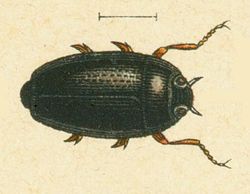
Picture of Gyrinus minutus
- Source
- Wikipedia/Commons
- Credit
- Edmund Reitter
- Licence
- Public Domain
- Commercial use
- the licence allows it
No 3D scan was found. Smithsonian Open Access, MorphoSource and Sketchfab were all searched.
The description on this site
- Licence
- CC BY-SA 4.0
This is what the site found, which is not the same as what exists.
Keep going
What may have been alongside itGyrinus through timeFormations of the PleistoceneThe world it lived on
Occurrence data from the Paleobiology Database, CC BY 4.0. Fabricius 1798