Gonorynchiformes
The Gonorynchiformes are an order of ray-finned fish that includes the important food source, the milkfish, and a number of lesser-known types, both marine and freshwater.

Bryan Harry (U.S. National Park Service) · Public Domain · via Wikipedia/Commons. May be a photograph of a specimen, or an artist’s reconstruction — an interpretation of a skeleton, since colour and soft tissue are almost never preserved.
On record
Recorded, not inferred- Sits inside
- AnotophysaPBDB
- Diet
- carnivorePBDB
- Life habit
- nektonicPBDB
- Motility
- actively mobilePBDB
- Environment
- freshwaterPBDB
Time the record covers
At least 98 million years on record.
The record covers at least 121.4 Mya to 23.04 Mya. No occurrence read is dated outside 125.77 Mya to 5.333 Mya.
48 occurrences of Gonorynchiformes on record, most of them in the Late Cretaceous. The Paleobiology Database records this as a living group, and the chart stops with its fossils rather than at the present. Bar height is expected occurrences, not a count: each fossil is spread across the span it is dated to, so a tall narrow bar means tight dating and a low wide one means loose.
When
48 occurrencesThese are dates about fossils, not the animal: the record can only begin after it arose and end before it died out, so either end may reach further. Shares are expected occurrences: a fossil dated to a span is counted partly in each period it straddles. More on what this infers.
Found in
19 formations
- Romualdo Formation · Santana Group7
- Fort Union Formation6
- Hell Creek Formation · Montana Group5
- Two Medicine Formation · Montana Group2
- Bet Meir or Amminadav Formation2
- Crato Formation · Santana Group2
Loading coastlines…
The named rock units Gonorynchiformes has been recovered from, largest first. Drawn where the rock is now, not where it formed. 9 occurrences have no formation on record, which is common for older literature.
Gonorynchiformes and its relatives
Late CretaceousWhere Gonorynchiformes and its relatives were recorded in the Late Cretaceous.
Found in the same rock
718 taxa- Notogoneus16 sites
- Acanthomorphata12 sites
- Osteoglossomorpha11 sites
- Teleostei11 sites
- Otophysa8 sites
- Esox7 sites
- Rhacolepis buccalis7 sites
- Tharrhias araripis7 sites
- Vinctifer7 sites
- Estesesox6 sites
- Cladocyclus gardneri5 sites
- Coriops5 sites
- Habrosaurus dilatus5 sites
- Opisthotriton kayi5 sites
- Pterosauria5 sites
- Brannerion4 sites
- Calamopleurus cylindricus4 sites
- Dastilbe crandalli4 sites
- Euteleostei4 sites
- Hiodontidae4 sites
- Lisserpeton bairdi4 sites
- Mesodma thompsoni4 sites
- Platacodon nanus4 sites
- Scapherpeton tectum4 sites
The Paleobiology Database records 44 sites for Gonorynchiformes, and this reads all of them. The number is how many of those sites it was catalogued from too. The 24 sharing the most are listed.
This is not a list of everything alive at the time. It is only what has come out of the same ground as this animal and been written down.
Entered from
28 references- Moderate extinctions and slow recovery of non-marine teleost fishes across the Cretaceous–Paleogene boundary, with a systematic appraisal of early Paleocene teleost fishes from Saskatchewan, Canada and Montana, USA7
- A systematic reappraisal and quantitative study of the nonmarine teleost fishes from the late Maastrichtian of the Western Interior of North America: evidence from vertebrate microfossil localities6
- New Fossiliferous Sites of the Romualdo Formation, Lower Cretaceous, Araripe Basin, Exu, Pernambuco, Northeast of Brazil6
- The uppermost Oligocene of Aix-en-Provence (Bouches-du-Rhône, Southern France): A Cenozoic brackish subtropical Konservat Lagerstätte, with fishes, insects and plants2
- The first record of a notosuchian crocodyliform from Italy2
- On a collection of upper Cretaceous fishes from Mount Lebanon, Syria, with descriptions of four new genera and nineteen new species2
- Ricerche sui Pesci Fossili di Chiavòn (Strati di Sotzka -- Miocene Inferiore)2
- Osteology and relationships of Caeus (“Chanos”) leopoldi (Teleostei, Gonorynchiformes, Chanidae) from the marine Albian (Early Cretaceous) of Pietraroja (Campania, southern Italy)1
- An early Eocene fish fauna from the Bitter Creek area of the Wasatch Formation of southwestern Wyoming, U.S.A.1
- Sapperichthys gen. nov., a new gonorynchidfrom the Cenomanian of Chiapas, Mexico1
- Triplomystus applegatei, sp. nov. (Teleostei: Ellimmichthyiformes), a rare "triple armored herring" from El Espinal Quarry (Early Cretaceous), Chiapas, southeastern Mexico1
- Fossil Vertebrate Collections1
Each of the 48 occurrences read was entered from one of these publications, ordered by how many each accounts for. This is not a search for papers mentioning the name. 16 further references are not listed. Entries link to doi.org where the Paleobiology Database holds an identifier, and to its own record where it does not. Relayed as the Paleobiology Database holds them, not checked against what they resolve to.
Media and terms
Media content1
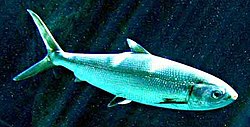
Picture of Gonorynchiformes
- Source
- Wikipedia/Commons
- Credit
- Bryan Harry (U.S. National Park Service)
- Licence
- Public Domain
- Commercial use
- the licence allows it
No 3D scan of Gonorynchiformes was found in MorphoSource and Sketchfab.
Smithsonian Open Access was not reached for this taxon, so this list is what the others held rather than everything there is.
The description on this site
- Licence
- CC BY-SA 4.0
This is what the site found, which is not the same as what exists.
Keep going
What may have been alongside itAnotophysa through timeFormations of the Late CretaceousThe world it lived on
Occurrence data from the Paleobiology Database, CC BY 4.0.