Fulgoridae
The family Fulgoridae is a large group of hemipteran insects, especially abundant and diverse in the tropics, containing over 125 genera worldwide. They are mostly of moderate to large size, many with a superficial resemblance to Lepidoptera due to their brilliant and varied coloration. Various genera and species are sometimes referred to as lanternflies or lanthorn flies.

Richard Ling <wikipedia@rling.com> · CC BY-SA 3.0 · via Wikipedia/Commons. May be a photograph of a specimen, or an artist’s reconstruction — an interpretation of a skeleton, since colour and soft tissue are almost never preserved.
On record
Recorded, not inferred- Also called
- fulgorid planthopperPBDB
- Sits inside
- FulgoroideaPBDB
- Motility
- actively mobilePBDB, for Arthropoda
- Environment
- terrestrialPBDB, for Insecta
Time the record covers
At least 39 million years on record.
The record covers at least 48.07 Mya to 8.725 Mya. No occurrence read is dated outside 56 Mya to 5.09 Mya.
31 occurrences of Fulgoridae on record, most of them in the Eocene. The Paleobiology Database records this as a living group, and the chart stops with its fossils rather than at the present. Bar height is expected occurrences, not a count: each fossil is spread across the span it is dated to, so a tall narrow bar means tight dating and a low wide one means loose.
When
31 occurrencesThese are dates about fossils, not the animal: the record can only begin after it arose and end before it died out, so either end may reach further. Shares are expected occurrences: a fossil dated to a span is counted partly in each period it straddles. More on what this infers.
Found in
6 formations
- Shanwang Formation11
- Green River Formation10
- Florissant Formation3
- Eifel Formation2
- Allenby Formation · Princeton Group1
- Niubao Formation1
Loading coastlines…
The named rock units Fulgoridae has been recovered from, largest first. Drawn where the rock is now, not where it formed. 3 occurrences have no formation on record, which is common for older literature.
Fulgoridae and its relatives
EoceneWhere Fulgoridae and its relatives were recorded in the Eocene.
Found in the same rock
1,136 taxa- Limois shanwangensis6 sites
- Cerambycidae5 sites
- Calosoma maderae4 sites
- Camponotites shanwangensis4 sites
- Dascillus shandongianus4 sites
- Eocaenonemonychini4 sites
- Hylobius plenus4 sites
- Lystra richardsoni4 sites
- Sciomyza disjecta4 sites
- Sciomyza manca4 sites
- Anomala furva3 sites
- Araneae3 sites
- Bibio shanwangensis3 sites
- Chlaenius furvus3 sites
- Cleridae3 sites
- Epicaerus saxatilis3 sites
- Formica3 sites
- Gerstaeckerus alviolatus3 sites
- Heptagenia3 sites
- Lathrobium abscessum3 sites
- Lithopsis fimbriata3 sites
- Pronemobius tertiarius3 sites
- Allodahlia shanwangensis2 sites
- Anobium ovale2 sites
The Paleobiology Database records 19 sites for Fulgoridae, and this reads all of them. The number is how many of those sites it was catalogued from too. The 24 sharing the most are listed.
This is not a list of everything alive at the time. It is only what has come out of the same ground as this animal and been written down.
Entered from
14 references- The Tertiary Insects of North America9
- Zhang, 19896
- The Fossil Insects of the Green River Shales3
- Systematik, Phylogenie, Taphonomie und Paläoökologie der Insekten aus dem Mittel-Eozän des Eckfelder Maares, Vulkaneifel2
- Fossil insects in the diatoms of Shanwang2
- A Lagerstätte from Australia provides insight into the nature of Miocene mesic ecosystems1
- The first Fulgoridae (Hemiptera: Fulgoromorpha) from the Eocene of the central Qinghai-Tibetan Plateau1
- Zhang et al., 19941
- Insecta1
- Oxycephala gen. nov., a Miocene Homoptera (Insecta) from Linqu of Shandong1
- Arthropodes fossiles de la Montagne d'Andance, Massif du Coiron - Ardèche1
- Canadian fossil insects, myriapods and arachnids, 1. The Tertiary Hemiptera of British Columbia1
Each of the 31 occurrences read was entered from one of these publications, ordered by how many each accounts for. This is not a search for papers mentioning the name. 2 further references are not listed. Entries link to doi.org where the Paleobiology Database holds an identifier, and to its own record where it does not. Relayed as the Paleobiology Database holds them, not checked against what they resolve to.
Media and terms
Media content1
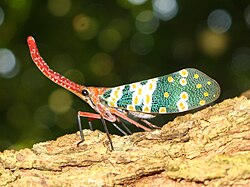
Picture of Fulgoridae
- Source
- Wikipedia/Commons
- Credit
- Richard Ling <wikipedia@rling.com>
- Licence
- CC BY-SA 3.0
- Commercial use
- the licence allows it
No 3D scan of Fulgoridae was found in Sketchfab.
Smithsonian Open Access and MorphoSource were not reached for this taxon, so this list is what the others held rather than everything there is.
The description on this site
- Source
- Wikipedia, “Fulgoridae”
- Licence
- CC BY-SA 4.0
This is what the site found, which is not the same as what exists.
Keep going
What may have been alongside itFulgoroidea through timeFormations of the EoceneThe world it lived on
Occurrence data from the Paleobiology Database, CC BY 4.0. Latreille 1807