Fragilaria
Fragilaria is a genus of freshwater and saltwater diatoms. It is usually a colonial diatom, forming filaments of cells mechanically joined by protrusions on the face and in the center of their valves. The individual diatoms appear swollen in their centers where they are joined to the colonial ribbon. The genus grows as both plankton and benthic species, free living in colonies or as epiphytes. Some species are bloom forming diatoms in eutrophic lakes. The type species is Fragilaria pectinalis Lyngbye from designating a lectotype from Conferva pectinalis O.F.Müller. The taxonomy of the genus is still uncertain.

Kristian Peters http://www.korseby.net/outer/flora/algae/index.html · CC BY-SA 3.0 · via Wikipedia/Commons. May be a photograph of a specimen, or an artist’s reconstruction — an interpretation of a skeleton, since colour and soft tissue are almost never preserved.
On record
Recorded, not inferred- Sits inside
- FragilariaceaePBDB
- Diet
- "photoautotroph"PBDB, for Bacillariophyceae
- Environment
- marine,brackish,freshwaterPBDB, for Bacillariophyceae
Time the record covers
At least 27 million years on record.
The record covers at least 27.3 Mya to 11.7 ka. No occurrence read is dated outside 33.9 Mya to 0 Mya.
61 occurrences of Fragilaria on record, most of them in the Pleistocene. The Paleobiology Database records this as a living group. Bar height is expected occurrences, not a count: each fossil is spread across the span it is dated to, so a tall narrow bar means tight dating and a low wide one means loose.
When
61 occurrences- Oligocene2%
- Miocene5%
- Pliocene8%
- Pleistocene84%
- Holocene2%
These are dates about fossils, not the animal: the record can only begin after it arose and end before it died out, so either end may reach further. Shares are expected occurrences: a fossil dated to a span is counted partly in each period it straddles. More on what this infers.
Found in
4 formations
- Kelseyville Formation13
- Gadeb Formation · Gadeb Plain Group3
- Embetsu Formation1
- Latah Formation1
Loading coastlines…
The named rock units Fragilaria has been recovered from, largest first. Drawn where the rock is now, not where it formed. 43 occurrences have no formation on record, which is common for older literature.
Fragilaria and its relatives
PleistoceneWhere Fragilaria and its relatives were recorded in the Pleistocene.
Found in the same rock
241 taxa- Thalassiosira27 sites
- Actinocyclus26 sites
- Neodenticula24 sites
- Rhizosolenia23 sites
- Thalassionema23 sites
- Bacterosira19 sites
- Cocconeis19 sites
- Chaetoceros17 sites
- Thalassiothrix longissima17 sites
- Navicula15 sites
- Nitzschia15 sites
- Coscinodiscus14 sites
- Paralia sulcata14 sites
- Fragilariopsis12 sites
- Odontella12 sites
- Delphineis11 sites
- Pinnularia10 sites
- Melosira9 sites
- Porosira9 sites
- Proboscia9 sites
- Pyxidicula9 sites
- Paralia8 sites
- Stephanodiscus8 sites
- Amphora7 sites
The Paleobiology Database records 44 sites for Fragilaria, and this reads all of them. The number is how many of those sites it was catalogued from too. The 24 sharing the most are listed.
This is not a list of everything alive at the time. It is only what has come out of the same ground as this animal and been written down.
Entered from
16 references- Site U133919
- Diatom biostratigraphy and the paleolimnology of Clear Lake, Lake County, California13
- Site U13446
- Site U13453
- The Shelton Mastodon Site: Multidisciplinary study of a late Pleistocene (Twocreekan) locality in Southeastern Michigan3
- Hominid occupation of the east central Highlands of Ethiopia in the Plio-Pleistocene3
- A Catalogue of Indian Fossil Plants3
- Site U14452
- Site U13432
- The Afro–Asian labeonine genus Garra Hamilton, 1822 (Teleostei, Cyprinidae) in the Pliocene of Central Armenia: Palaeoecological and palaeobiogeographical implications1
- Site U13561
- Site U13601
Each of the 61 occurrences read was entered from one of these publications, ordered by how many each accounts for. This is not a search for papers mentioning the name. 4 further references are not listed. Entries link to doi.org where the Paleobiology Database holds an identifier, and to its own record where it does not. Relayed as the Paleobiology Database holds them, not checked against what they resolve to.
Media and terms
Media content1
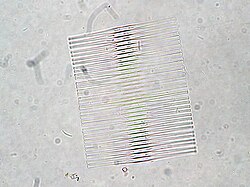
Picture of Fragilaria
- Source
- Wikipedia/Commons
- Credit
- Kristian Peters http://www.korseby.net/outer/flora/algae/index.html
- Licence
- CC BY-SA 3.0
- Commercial use
- the licence allows it
No 3D scan of Fragilaria was found in MorphoSource and Sketchfab.
Smithsonian Open Access was not reached for this taxon, so this list is what the others held rather than everything there is.
The description on this site
- Source
- Wikipedia, “Fragilaria”
- Licence
- CC BY-SA 4.0
This is what the site found, which is not the same as what exists.
Keep going
What may have been alongside itFragilariaceae through timeFormations of the PleistoceneThe world it lived on
Occurrence data from the Paleobiology Database, CC BY 4.0. Lyngbye 1819