Flacourtiaceae
The Flacourtiaceae is a defunct family of flowering plants whose former members have been scattered to various families, mostly to the Achariaceae and Salicaceae. It was so vaguely defined that hardly anything seemed out of place there and it became a dumping ground for odd and anomalous genera, gradually making the family even more heterogeneous. In 1975, Hermann Sleumer noted that "Flacourtiaceae as a family is a fiction; only the tribes are homogeneous."

J.M.Garg · CC BY 3.0 · via Wikipedia/Commons. May be a photograph of a specimen, or an artist’s reconstruction — an interpretation of a skeleton, since colour and soft tissue are almost never preserved.
On record
Recorded, not inferred- Sits inside
- ViolalesPBDB
- Diet
- "photoautotroph"PBDB, for Angiospermae
Time the record covers
At least 64 million years on record.
The record covers at least 66 Mya to 1.8 Mya. No occurrence read is dated outside 72.2 Mya to 774 ka.
56 occurrences of Flacourtiaceae on record, most of them in the Eocene. The Paleobiology Database records this as a living group, and the chart stops with its fossils rather than at the present. Bar height is expected occurrences, not a count: each fossil is spread across the span it is dated to, so a tall narrow bar means tight dating and a low wide one means loose.
When
56 occurrences- Late Cretaceous5%
- Paleocene24%
- Eocene34%
- Oligocene3%
- Miocene30%
- Pliocene2%
- Pleistocene2%
These are dates about fossils, not the animal: the record can only begin after it arose and end before it died out, so either end may reach further. Shares are expected occurrences: a fossil dated to a span is counted partly in each period it straddles. More on what this infers.
Found in
14 formations
- Fort Union Formation7
- Deccan Intertrappean Formation6
- Willwood Formation5
- Lower Churia Formation · Siwalik Group4
- London Clay Formation3
- Okinoyama Formation · Ube Group2
Loading coastlines…
The named rock units Flacourtiaceae has been recovered from, largest first. Drawn where the rock is now, not where it formed. 20 occurrences have no formation on record, which is common for older literature.
Flacourtiaceae and its relatives
EoceneWhere Flacourtiaceae and its relatives were recorded in the Eocene.
Found in the same rock
1,110 taxa- Dicotyledoneae9 sites
- Cercidiphyllum genetrix6 sites
- Populus nebrascensis6 sites
- Azolla5 sites
- Cornophyllum5 sites
- Fabaceae5 sites
- Sabal5 sites
- Cinnamomum4 sites
- Cocculus flabella4 sites
- Dipterocarpus siwalicus4 sites
- Hamamelidaceae4 sites
- Oncoba variabilis4 sites
- Platanus raynoldsii4 sites
- Sapindaceae4 sites
- Albizia siwalica3 sites
- Ampelopsis acerifolia3 sites
- Banaraphyllum ovatum3 sites
- Calophyllum suraikholaensis3 sites
- Carpolithus3 sites
- Cupressistrobus gardneri3 sites
- Cycadeospermum3 sites
- Cynometra palaeoiripa3 sites
- Dalbergia3 sites
- Dicotylophyllum anomalum3 sites
The Paleobiology Database records 39 sites for Flacourtiaceae, and this reads all of them. The number is how many of those sites it was catalogued from too. The 24 sharing the most are listed.
This is not a list of everything alive at the time. It is only what has come out of the same ground as this animal and been written down.
Entered from
21 references- Angiospermous fossil leaves from the Siwalik foreland basins and their palaeoclimatic implications12
- Megaflora of the Hell Creek and lower Fort Union Formations in the western Dakotas: Vegetational response to climate change, the Cretaceous-Tertiary boundary event, and rapid marine transgression6
- A Catalogue of Fossil Plants from India Part 4: Cenozoic (Tertiary) Megafossils6
- Plant and mammal diversity in the Paleocene to Early Eocene of the Bighorn Basin5
- Chandler, 19613
- Some Paleocene megaspores and other small fossils3
- A Paleocene lowland macroflora from Patagonia reveals signifcantly greater richness than North American analogs2
- Decoupled plant and insect diversity after the end-Cretaceous extinction2
- Fossil flora from the Himalayan foot-hills of Darjeeling District, West Bengal and its palaeoecological and phytogeographical significance2
- Geologie, Paläontologie und Palökologie der südostbayerischen unter-priabonen (Ober-Eozän) Riffkalkvorkommen bei Hallthurm (Nördliche Kalkalpen) und der Kirchbergs bei Neubeuern (Helvetikum)2
- The Eocene flora of the Ube coal-field, southwest Honshu, Japan2
- Chandler, 19632
Each of the 56 occurrences read was entered from one of these publications, ordered by how many each accounts for. This is not a search for papers mentioning the name. 9 further references are not listed. Entries link to doi.org where the Paleobiology Database holds an identifier, and to its own record where it does not. Relayed as the Paleobiology Database holds them, not checked against what they resolve to.
Media and terms
Media content1
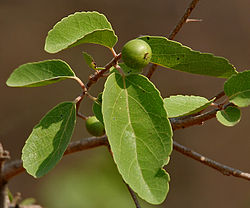
Picture of Flacourtiaceae
- Source
- Wikipedia/Commons
- Credit
- J.M.Garg
- Licence
- CC BY 3.0
- Commercial use
- the licence allows it
No 3D scan of Flacourtiaceae was found in MorphoSource and Sketchfab.
Smithsonian Open Access was not reached for this taxon, so this list is what the others held rather than everything there is.
The description on this site
- Licence
- CC BY-SA 4.0
This is what the site found, which is not the same as what exists.
Keep going
What may have been alongside itViolales through timeFormations of the EoceneThe world it lived on
Occurrence data from the Paleobiology Database, CC BY 4.0. Richard and Candolle 1824