Erinaceidae
Erinaceidae is a family in the order Eulipotyphla, consisting of the hedgehogs and moonrats. Until recently, it was assigned to the order Erinaceomorpha, which has been subsumed with the paraphyletic Soricomorpha into Eulipotyphla. Eulipotyphla has been shown to be monophyletic; Soricomorpha is paraphyletic because both Soricidae and Talpidae share a more recent common ancestor with Erinaceidae than with solenodons.

Gibe · CC BY-SA 3.0 · via Wikipedia/Commons. May be a photograph of a specimen, or an artist’s reconstruction — an interpretation of a skeleton, since colour and soft tissue are almost never preserved.
On record
Recorded, not inferred- Also called
- hedgehogPBDB
- Sits inside
- EulipotyphlaPBDB
- Diet
- insectivore, carnivorePBDB
- Life habit
- semifossorialPBDB
- Motility
- actively mobilePBDB, for Osteichthyes
- Environment
- terrestrialPBDB, for Eutheria
Time the record covers
At least 57 million years on record.
The record covers at least 57.5 Mya to 11.7 ka. No occurrence read is dated outside 60.9 Mya to 0 Mya.
917 occurrences of Erinaceidae on record, most of them in the Miocene. The Paleobiology Database records this as a living group. Bar height is expected occurrences, not a count: each fossil is spread across the span it is dated to, so a tall narrow bar means tight dating and a low wide one means loose.
When
917 occurrencesThese are dates about fossils, not the animal: the record can only begin after it arose and end before it died out, so either end may reach further. Shares are expected occurrences: a fossil dated to a span is counted partly in each period it straddles. More on what this infers.
Found in
141 formations
- Hsanda Gol Formation73
- Valentine Formation · Ogallala Group29
- Loh Formation29
- Aral Formation14
- Lower Manchar Formation13
- Paskapoo Formation12
Loading coastlines…
The named rock units Erinaceidae has been recovered from, largest first. Drawn where the rock is now, not where it formed. 117 further formations hold fewer occurrences each and are not listed. 453 occurrences have no formation on record, which is common for older literature.
Erinaceidae and its relatives
MioceneWhere Erinaceidae and its relatives were recorded in the Miocene.
Found in the same rock
2,745 taxa- Deinogalerix intermedius34 sites
- Apodemus30 sites
- Parvericius montanus30 sites
- Archaeolaginae28 sites
- Geomyoidea24 sites
- Soricidae23 sites
- Erinaceus22 sites
- Lagomorpha22 sites
- Metechinus amplior21 sites
- Copemys longidens19 sites
- Mikrotia19 sites
- Mylagaulidae19 sites
- Solitudo19 sites
- Untermannerix copiosus19 sites
- Camelidae18 sites
- Chiroptera18 sites
- Mustelidae18 sites
- Cupidinimus nebraskensis17 sites
- Marmotini17 sites
- Rhinocerotidae16 sites
- Brachyerix macrotis15 sites
- Canidae15 sites
- Castoridae15 sites
- Eucastor tortus15 sites
The Paleobiology Database records 654 sites for Erinaceidae, and this reads 240 of them. The number is how many of those sites it was catalogued from too. The 24 sharing the most are listed.
This is not a list of everything alive at the time. It is only what has come out of the same ground as this animal and been written down.
Entered from
318 references- Oligocene stratigraphy across the Eocene and Miocene boundaries in the Valley of Lakes (Mongolia)103
- The giant erinaceid insectivore, Deinogalerix Freudenthal, from the Upper Miocene of Gargano, Italy51
- Vertebrate biostratigraphy of the Ogallala Group in Nebraska34
- Origin and History of the Erinaceinae and Brachyericinae (Mammalia, Insectivora) in North America26
- Kleinsäugerstratigraphie in der miozänen Hörnlischüttung (Ostschweiz); (Biostratigraphy of small mammals in the Hörnlischüttung of Miocene age (East Switzerland))20
- Erinaceidae and Dimylidae (Lipotyphla) from the Upper Middle Miocene of South Germany18
- Insectivora und Chiroptera (Mammalia) aus dem Neogen der Türkei14
- Hedgehogs (Erinaceidae, Lipotyphla) from the Miocene of Pakistan, with description of a new species of Galerix13
- Neue Ergebnisse zur Stratigraphie der mittleren Serie der Oberen Süßwassermolasse Bayerns (New results on the stratigraphy of the middle series of upper Freshwater Molasse, Bavaria)12
- Miocene mammals of the Split Rock area, Granite Mountains basin, central Wyoming12
- Pleistocene vertebrate faunas of Hungary12
- Biostratigraphy and biochronology of early Arikareean through late Hemingfordian small mammal faunas from the Nebraska Panhandle and adjacent areas10
Each of the 917 occurrences read was entered from one of these publications, ordered by how many each accounts for. This is not a search for papers mentioning the name. 306 further references are not listed. Entries link to doi.org where the Paleobiology Database holds an identifier, and to its own record where it does not. Relayed as the Paleobiology Database holds them, not checked against what they resolve to.
Media and terms
Media content1
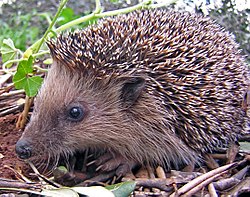
Picture of Erinaceidae
- Source
- Wikipedia/Commons
- Credit
- Gibe
- Licence
- CC BY-SA 3.0
- Commercial use
- the licence allows it
No 3D scan of Erinaceidae was found in Sketchfab.
Smithsonian Open Access and MorphoSource were not reached for this taxon, so this list is what the others held rather than everything there is.
The description on this site
- Source
- Wikipedia, “Erinaceidae”
- Licence
- CC BY-SA 4.0
This is what the site found, which is not the same as what exists.
Keep going
What may have been alongside itEulipotyphla through timeFormations of the MioceneThe world it lived on
Occurrence data from the Paleobiology Database, CC BY 4.0. Fischer von Waldheim 1817